
2
Current Uses of Dietary Reference Standards
This chapter begins with a brief discussion of the history of dietary recommendations for nutrients in the United States and Canada. This discussion includes a conceptual framework that both describes two main general uses of the dietary reference standards and is the basis for organizing the remainder of this report. The next section catalogues the current uses of dietary reference standards on the basis of information provided by the U.S. and Canadian federal agencies involved in health and nutrition policy.
CHANGES OVER TIME
Since the publication of the first Recommended Dietary Allowances (RDAs) for the United States in 1941 and Daily Recommended Nutrient Intakes (DRNIs) for Canada in 1938 (now shortened to RNIs), applications of quantitative recommended intakes have expanded both in scope and diversity. Uses range from their original objective to serve as a goal for good nutrition to such diverse uses as food planning and procurement, design and evaluation of food assistance programs, development of nutrition education materials, food labeling, food fortification, and dietary research.
Primary Applications
In 1941, the Food and Nutrition Board first proposed the RDAs “to serve as a goal for good nutrition and as a ‘yardstick’ by which to measure progress toward that goal...” (NRC, 1941, p. 1). Even today,
many of the specific uses and applications of dietary reference standards fall into the two general categories defined implicitly in 1941—diet planning and diet assessment. Diet planning applications involve using dietary reference standards to develop recommendations for what intakes should be (i.e., as a goal for good nutrition). Diet assessment applications involve determining the probable adequacy or inadequacy of observed intakes (i.e., a yardstick by which to measure progress). These two general applications of dietary reference standards are interrelated.
The first Canadian dietary standards—DRNIs—were issued by the Canadian Council on Nutrition (1938) and stated that the standards were to be used as the basis for evaluation of observed diets. It was not clear whether group diets (group mean intakes) or individual diets were intended.
The 1990 version of the RNIs and 1989 RDAs did not differ in the described derivations of the recommended intakes but differences remain about how intended uses are described, resulting in some confusion for the users of both reports. The joint U.S. and Canadian development of the new Dietary Reference Intakes (DRIs) should resolve this confusion.
Conceptual Framework
Figure 2-1 illustrates a conceptual framework adapted from one first developed by Beaton (1994) which can be applied to the uses of dietary reference standards. As shown in this figure, knowledge about distributions of requirements and intakes feeds into the two general applications of diet planning and assessment. Within each of these general categories, the applications differ according to whether they are for an individual or for population groups.
The simplicity of this conceptual framework belies the complexity in using and interpreting DRIs to plan and assess diets. In the past, both planning and assessment applications relied primarily on the former RDAs or RNIs because these were the only quantitative nutrient reference standards widely available. The concepts underlying the former RDAs often were not well understood and thus some applications of the former RDAs for both assessment and planning were not appropriate (IOM, 1994). For the three newly introduced dietary reference intakes —the Estimated Average Requirement (EAR), Adequate Intake (AI), and Tolerable Upper Intake Level (UL)—guidance is needed to differentiate which should be used in various applications in diet assessment and planning. As discussed in the next section, the wide range of uses for dietary
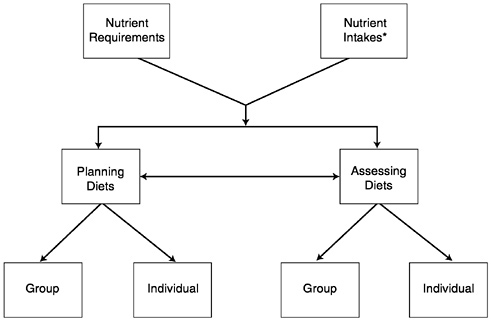
FIGURE 2-1 Conceptual framework—uses of dietary standards. *Food plus supplements.
SOURCE: Adapted from Beaton (1994).
reference standards represents both the importance of developing scientifically based standards and the need to assist the user in understanding fully how each DRI should be used and interpreted.
USES OF THE FORMER RDAs AND RNIs
Users of dietary reference standards include those who plan meals for individuals and groups; individual consumers who decide what foods to eat and how much; the food industry which produces, voluntarily fortifies, and markets foods; federal, state, and local government agencies that design, operate, and evaluate food and nutrition assistance programs; scientific and regulatory bodies that formulate standards and regulations to ensure marketed foods are safe and appropriately advertised; and nutrition and health professionals who educate, counsel, evaluate, and monitor public health.
Table 2-1 and the following text includes the major applications for which the Recommended Dietary Allowances (RDAs) and Recommended
TABLE 2-1 Reported Uses of Dietary Reference Standardsa
|
General Use of Dietary Reference Standards |
Assessment (A) or Planning (P) |
|
Evaluation of Dietary Data |
|
|
Assess nutrient intake of individuals |
A |
|
Assess nutrient intakes of groups |
A |
|
Nutrition Education and Guides for Food Selection |
|
|
Evaluate an individual's diet as a basis for recommending specific changes in food patterns and nutrient needs |
A |
|
Evaluate nutrient intakes of groups as a basis for nutrition education sessions |
A |
|
Provide guidance to individuals and groups on how to obtain a nutritious diet |
P |
|
Develop food guides and dietary guidelines |
P |
|
Specific Identified Uses of Dietary Reference Standards |
|
Compare an individual's nutrient intake with Recommended Dietary Allowances (RDA) or Recommended Nutrient Intakes (RNI) |
|
Compare nutrient intakes with RDA or RNI to estimate the percentage of the population at risk of inadequate intake based on percent of RDA or RNI Compare nutrient intakes—mean, median, and distributions of intake—with RDA or RNI for population subgroups to determine the size and type of populations considered to be at risk of inadequate intake Compare nutrient intakes with RDA or RNI to assess variations over time in the percentage of the population at risk of inadequate intake based on prevalence below RDA or RNI Monitor the potential of the food supply to meet the nutritional needs of the population, examine trends, and evaluate changes over time in diets |
|
Compare an individual's nutrient intake with dietary reference standards and identify changes in food consumption patterns that might reduce the risk of inadequate intake |
|
Compare nutrient intakes of population subgroups with dietary reference standards and identify changes in food consumption patterns that might reduce the risk of inadequate intake; identify foods that are important contributors of nutrients |
|
Counsel individuals and educate groups on selecting foods to meet required nutritional standards |
|
Use in developing and revising the U.S. Department of Agriculture 's Dietary Guidelines for Americans and the Food Guide Pyramid, and Canada's Food Guide to Healthy Eating, which provide information on types and amounts of foods that meet nutritional requirements |
continued
TABLE 2-1 Continued
|
General Use of Dietary Reference Standards |
Assessment (A) or Planning (P) |
|
Food and Nutrition Assistance Programs |
|
|
Develop plans for feeding groups to meet nutritional standards and for food budgeting and purchasing |
P |
|
Develop food packages for program benefits |
A, P |
|
Evaluate meals and foods offered by programs |
A |
|
Design food and nutrition assistance programs |
A |
|
Evaluate the dietary effects of food and nutrition assistance programs |
A |
|
Determine eligibility for the Special Supplemental Nutrition Program for Women, Infants, and Children (WIC) |
A |
|
Military Food and Nutrition Planning and Policy |
|
|
Nutrition research |
A |
|
Food procurement and meal planning |
P |
|
Specific Identified Uses of Dietary Reference Standards |
|
Use dietary reference standards and typical food-purchasing patterns to define four official U.S. Department of Agriculture food plans: (1) the Thrifty Food Plan, used as the basis for the Food Stamp Program; (2) and (3) the moderate and liberal food plans, used as the basis for military food allowances; and (4) the low-cost food plan, used for financial planning in bankruptcy and other similar court cases Design meal patterns that provide a specified percentage of the dietary reference standards for the National School Lunch Program, the School Breakfast Program, the Child and Adult Care Feeding Program, and the Summer Food Service Program |
|
Use as a basis for evaluating and modifying nutrient content of food packages for the Special Supplemental Nutrition Program for Women, Infants, and Children (WIC), the Food Distribution Program on Indian Reservations, and the Commodity Supplemental Food Program |
|
Compare nutrients offered at meals—means, medians, and distributions—with program regulations |
|
Compare nutrient intakes—mean, median, and distributions of intake—with dietary reference standards to identify population subgroups for possible intervention with food assistance, fortification, and education |
|
Compare nutrient intakes—mean, median, and distributions of intake—with dietary reference standards, by program participation; estimate program effects and estimate the percentage, by program participation status, at risk of inadequate intake |
|
Compare individual nutrient intake with dietary reference standards to assess whether an individual is at nutritional risk on the basis of an inadequate diet |
|
Determine whether dietary reference standards need to be adjusted for field conditions (peacetime, peacetime overseas, conflict, war) Compare nutrient intakes with dietary reference standards to evaluate the ability of the military meal planning to meet nutritional standards |
|
Use dietary reference standards as a basis for planning meals for the military and use of fortified foods, supplements, special food products |
continued
TABLE 2-1 Continued
|
Specific Identified Uses of Dietary Reference Standards |
|
Use dietary reference standards to set military rations Determine military rations based on adjusted dietary reference standards for field conditions—Nutritional Standards for Operational Rations |
|
Develop nutrition education material for military personnel to counsel them how to meet required nutritional standards and how to avoid overconsumption |
|
Use dietary reference standards to assess the adequacy of, and as a basis for, planning meals in institutional settings such as hospitals, dormitories, prisons, and nursing homes |
|
Use epidemiological analyses relating nutrient intakes to health and nutritional status |
|
Use dietary reference standards as reference points for deriving nutrient reference standards for food labels Use dietary reference standards to communicate information on the nutrient content of foods |
|
Use dietary reference standards as a basis for modifying menu plans for patient groups requiring therapeutic diets |
|
Use dietary reference standards as benchmark for modifying the diets of individual patients requiring therapeutic diets |
|
Use dietary reference standards as a basis for assessing the individual 's observed intake |
|
Compare nutrient intakes of population subgroups with dietary reference standards to determine which nutrients are inadequately consumed; fortification may be mandated by government or voluntary by the food industry Use by industry as a guide for developing new or modified food products |
|
Compare nutrient intakes with dietary reference standards to identify the size and type of populations at risk from use of particular foods and food products; identify extreme and unusual patterns of intakes of foods, food ingredients, or food additives; and determine the need to enact or modify regulations |
Nutrient Intakes (RNIs) have been used in the past, although there may be other uses that are not identified here.
Evaluation of Dietary Data
Dietary reference standards have been used to evaluate dietary intake data for individuals, frequently in conjunction with biochemical, clinical, or anthropometric data. They can also be used to evaluate intake data for groups of individuals. Possible uses in evaluating groups include: estimating the percentage of the population at risk of inadequate or excessive intake; identifying subgroups at risk of inadequate or excessive intake; examining changes over time in the percentage of the population and of population subgroups at risk of inadequate or excessive intake; monitoring the potential of the food supply to meet the nutritional needs of the population; and examining trends and changes in food consumption over time.
Nutrition Education and Guides for Food Selection
Nutrient standards (specifically, the former RDAs and RNIs) have long been the foundation for discussing nutrient needs, for comparing the nutritional value of foods, and for counseling individuals and groups on how to meet nutritional requirements as part of nutrition education (Sims, 1996). Dietary assessment also provides information for nutrition education efforts and guides food selection. By linking findings from dietary assessment with foods consumed, it is possible to identify foods that are important contributors of nutrients, specify food consumption patterns that might reduce the probability of dietary inadequacy, and educate individuals and groups about appropriate foods and food consumption patterns. The difficulty encountered in applying dietary reference standards for this purpose is in translating quantitative nutrient recommendations into food-based information for dietary planning. Food guides, such as the U.S. Department of Agriculture's (USDA) Food Guide Pyramid and Health Canada's Food Guide to Healthy Eating, attempt to do just this. These guides group foods according to their nutrient contributions and provide recommendations for selecting the types and amounts of foods that provide the recommended intakes for most nutrients (Welsh et al., 1992). It may be difficult, however, to develop food guides which meet the RDAs and AIs for all nutrients, and consideration of the Tolerable Upper Intake Level (UL) in developing or modifying food guides will provide an additional challenge.
Food and Nutrition Assistance Programs
Quantitative nutrient recommendations have been the cornerstone of food and nutrition assistance programs. In the United States, the RDAs have been used: (1) as the basis for specified meal patterns in child nutrition programs and other institutional feeding programs; (2) as the nutritional goals of the Thrifty Food Plan, a low-cost food plan that determines benefit levels for the Food Stamp Program; (3) in development of food packages and benefits for various targeted nutrition programs such as the Special Supplemental Nutrition Program for Women, Infants, and Children (WIC); and (4) in assessment of compliance with USDA nutrition program regulations. There are few government-operated nutrition assistance programs in Canada and thus, no equivalent reported uses of the RNIs.
Similarly, dietary reference standards—typically the former RDAs and RNIs—have been used as guidelines for planning meals by incorporation into regulations for feeding groups (e.g., school children or elderly adults) and for making food purchasing and budgeting decisions.
In general, when the former RDAs were used to plan diets, the goals were set such that a certain percentage of the RDA was achieved over a period of a week or longer. The challenge for those who have used the former RDAs and RNIs for planning meals and designing food and nutrition program benefits will be how to incorporate the new reference standards of Estimated Average Requirements (EARs), RDAs, Adequate Intakes (AIs), and ULs to enhance and improve the nutritional dimension of diet planning.
Military Food and Nutrition Planning and Policy
The U.S. Department of Defense uses dietary reference standards for dietary assessment, food procurement and meal planning, setting nutrient levels of military rations for deployment, and developing nutrition education materials for military personnel. Nutrient standards are used by the military to plan menus and meals for garrison feeding and to assess whether provision of fortified foods, nutrient supplements, or special food products are needed in operational conditions. For example, in the past the military adapted the former RDAs to reflect variations in physical activity or stress or to emphasize performance enhancement (rather than to prevent deficiencies) (AR 40-25, 1985).
Institutional Dietary Assessment and Planning
People who are fed in institutional settings vary in demographic and life stage characteristics (e.g., day care centers vs. long-term care facilities), health status, expected duration of residence (e.g., a school vs. a correctional facility), and proportion of total dietary intake obtained from institutional food services (e.g., a single congregate meal program vs. a nursing home). Institutions also vary in their characteristics, such as whether clients consume food in the facility or at another location (e.g., congregate vs. home-delivered meals), availability and degree of food choice offered to clients or residents, food budgets, ownership (public or private), legal requirements pertaining to food or nutrient composition of the diet served, and the means used to assess and monitor whether nutrient needs of clients are met.
In general, institutions that cater to individuals at high nutritional risk and those that provide clients with most or all of their food on a long-term basis have a particular need to plan diets or menus that allow individuals to consume nutrients at levels comparable to nutrient recommendations.
The former RDAs and RNIs have been widely used as the basis for menu planning for groups and as goals to achieve in interventions aimed at improving the nutritional quality of individual meals or overall diets. They have also been used as benchmarks against which intakes are assessed (e.g., the proportion of residents achieving the RDA or RNI). Specific categories of DRIs may be more appropriate for some of these purposes.
Assessment of Disease Risk
Much of the knowledge of the relationships between nutrients and specific diseases comes from clinical and epidemiological studies of diet and disease in diverse human populations. Thus, epidemiological research is used to identify possible relationships between specific dietary components and observed disease patterns. In turn, the dietary reference standards can be used to assess intakes and exposure to nutrients in the study of a nutrient's relationship to risk of dietary deficiency diseases, chronic diseases, or adverse effects resulting from excessive intake or exposure.
Food Labels and Nutritional Marketing
Food labeling is a highly visible application of the use of quantitative nutrient standards. As of 2000, food labels in both the U.S. and Canada still use values based on older standards (1983 Recommended Daily Nutrient Intakes in Canada and 1968 RDAs in the United States). In addition to providing consumers with information on the nutrient content of food products, the nutrient standards serve as a basis for nutrient content claims and health claims. For example, in the United States, if a food label contains a claim that the food is a good source of a vitamin, that food must contain at least 10 percent of the Daily Value (DV) for that vitamin in the serving portion usually consumed. The DV is based on the Reference Daily Intake, which was usually based on the highest RDA for adolescents or adults as established in the 1968 RDAs (NRC, 1968). To make a health claim with regard to lowering the risk of a chronic disease, a food must meet specific regulatory guidelines with respect to the required content of the nutrient for which the health claim is made. The food industry often uses messages on food labels to communicate and market the nutritional benefits of food products.
Clinical Dietetics
RDAs and RNIs have also been used as the basis for planning menus for groups of hospital patients, as a reference point for modifying diets of patients, and as a guide for the formulation of oral nutritional supplements or of complete enteral and parenteral feeding solutions. The use of quantitative nutrient standards for developing therapeutic diets and counseling patients requires caution since in the past, and now with the DRIs, these standards were established to meet the needs of almost all apparently healthy individuals. Those with therapeutic needs may not have their needs met, or they may have specific clinical conditions that would be worsened by consuming a nutrient at the recommended level. In developing therapeutic diets for patients with a specific disease, the usual procedure is first to use recommended intakes for nutrients that are not affected by the disease. For other nutrients, estimates are based on the best evidence of needs during illness. These assumptions are usually specified in the diet manuals of hospitals and professional associations.
Food Fortification and Development of New or Modified Food Products
Public health professionals and the food industry also use the results from dietary assessment to identify nutrients that appear to be inadequate in groups evaluated and then to consider either fortifying foods or developing new foods to assist in meeting nutrient needs. Fortification can be of significant benefit when a large segment of the population has usual intakes of a nutrient below the dietary standard and nutrition education efforts have been ineffective. Food fortification in the United States may be mandatory, such as in the folate, iron, and selected B vitamin fortification of cereal grains, or voluntary, as in the addition of a large array of vitamins in ready-to-eat cereals. The effects of fortification on intake distributions depend on the choice of food fortified.
Food Safety Considerations
Dietary assessment provides information for people concerned with the food safety considerations associated with the prevalence of very high intakes of nutrients. Information on how to apply the UL should be helpful here.
LOOKING AHEAD: APPLYING THE DRIs
The introduction of the Dietary Reference Intakes (DRIs), especially the Estimated Average Requirement (EAR) and Tolerable Upper Intake Level (UL), provides better tools for many of the uses described here and presented in Table 2-1. This report presents how specific DRIs should be used for dietary assessment. While some examples of application in the assessment of individuals and of groups are provided, not all of the uses described above are specifically addressed. A subsequent report will discuss using specific DRIs in planning.


