
8
Ozone
INTRODUCTION
Atmospheric ozone has several environmental implications, which can be classified roughly b/y altitude:
-
In the stratosphere, where 90 percent of atmospheric ozone resides, ozone plays a critical role in absorbing ultraviolet (UV) radiation and preventing it from reaching Earth's surface.
-
In the upper and middle troposphere, ozone is a major greenhouse gas, causing inhomogeneous radiative forcing.
-
In the lower and middle troposphere, ozone maintains the oxidizing power of the atmosphere by providing a source of the hydroxyl radical (OH−) in the presence of water vapor. Oxidation by OH− is the main sink for a number of environmentally important gases, including methane (CH4), carbon monoxide (CO), hydrofluoro-carbons, and methyl bromide.
-
In surface air, ozone is a pernicious pollutant, toxic to humans and vegetation. It is the principal contributor to smog over the United States.
Anthropogenic emissions affect ozone in a complicated way involving nonlinear chemical processes and transport over a wide range of scales. It is well established that human activity has caused a decrease of ozone in the stratosphere and an increase in the troposphere, but the mechanisms are still unclear and predictions for the future are uncertain. The importance of continuously monitoring ozone trends throughout the atmosphere has long been recognized, and regular reports are published by the World Meteorological Organization (WMO, 1999). The role of space-based measurements as a key component of trend assessments is well established. The National Polar-orbiting Operational Environmental Satellite System (NPOESS) includes as one of its environmental data record (EDR) requirements the measurement of columns and vertical profiles of ozone with the Ozone Mapping and Profiler Suite (OMPS). Important EDRs for OMPS are summarized in Table 8.1.
The committee's findings concerning the current status and future NPOESS plans for measurement of ozone in the stratosphere and troposphere for research purposes are given in Box 8.1.
TABLE 8.1 Selected Environmental Data Record Requirements for the NPOESS Ozone Mapping and Profiler Suite
|
System Capability |
Threshold |
Objective |
|
Horizontal resolution |
||
|
Total column |
50 km at nadir |
50 km worst case |
|
Vertical profile |
250 km |
250 km |
|
Vertical resolution |
||
|
0-10 km |
NA |
3 km |
|
10-25 km |
5 km |
1 km |
|
25-60 km |
5 km |
3 km |
|
Measurement precision |
||
|
Total column |
0.001 atm-cm |
0.001 atm-cm |
|
Profile |
||
|
0-10 km |
NA |
10% |
|
10-15 km |
10% |
3% |
|
15-50 km |
3% |
1% |
|
50-60 km |
10% |
3% |
|
Measurement accuracy |
||
|
Total column |
±0.015 atm-cm |
±0.005 atm-cm |
|
Profile |
||
|
0-10 km |
NA |
10% |
|
10-15 km |
20% |
10% |
|
15-60 km |
10% |
5% |
|
Long-term stability (%) |
||
|
Total column |
1% |
0.5% |
|
Profile |
2% |
1% |
|
SOURCE: IPO NPOESS (1996). The updated IORD and other documentationrelated to the NPOESS program are available online at <http: npoesslib.ipo.noxaa.govElectLib.htm>. |
||
BASIC SCIENCE ISSUES
Long-Term Trend in Ozone: The Measurement Record
The environmental implications of stratospheric ozone depletion were just emerging when the Nimbus-7 satellite was launched in 1978. This marked the beginning of space-based ozone monitoring with observations from the Solar Backscatter Ultraviolet (SBUV), Total Ozone Mapping Spectrometer (TOMS), and Satellite Aerosol and Gas Experiment (SAGE) instruments. Since that time a National Plan for Stratospheric Monitoring (NOAA, 1989) was put into place. Its keystone was the continuation of ozone observations on the NOAA polar orbiting satellite series with the SBUV2 instrument. Parallel to this plan, NASA has been flying improved TOMS and SAGE instruments on U.S. and Russian environmental satellites. The Upper Atmosphere Research Satellite (UARS) launched in 1991 carried instruments to measure several stratospheric parameters, including ozone. The Global Ozone Monitoring Experiment (GOME), a new multispectral nadir instrument launched on the European Earth Resources Satellite (ERS-2) in April 1995, is expected to provide data on tropospheric ozone columns and related constituents.
These space-based observations are supplemented by several other long-term data sets. The Dobson and Brewer networks of ground-based spectrophotometers provide total ozone column measurements at more than 150 sites. Ozonesondes launched from sites around the world, at frequencies that vary from twice a month to three times a week, provide detailed vertical profiles of ozone from the surface to the middle stratosphere (Logan, 1999; Logan et al., 1999). Aircraft campaigns sponsored by NASA and other agencies measure ozone concurrently with
a large number of related species to improve our understanding of the factors controlling ozone in the lower stratosphere and in the troposphere.
|
Box 8.1 Findings Current understanding of atmospheric ozone has been reviewed by WMO (1999). Three priorities for future space-based observations emerge from the WMO report: (1) improved observation of ozone concentrations at altitudes below 20 km, (2) measurement of ozone concurrently with related species, and (3) better understanding of the long-term trend in ozone. How do NASA and NPOESS plans meet the science requirements? The research plans of NASA target the first two of these priorities but not the third; there is no commitment by the agency to ensure continuity of observations, as is needed for long-term trend studies. Indeed, the ability to detect long-term trends from satellite observations over the past decade has been largely serendipitous, and yet it has proven crucial for assessing human effects on atmospheric ozone. The NPOESS environmental data record (EDR) objectives for the operational Ozone Mapping and Profiler Suite (OMPS) instrument (see Table 8.1) provide specifications comparable to those of the new generation of research instruments and would make NPOESS a powerful source of information for detecting long-term trends in atmospheric ozone. The EDR thresholds (Table 8.1) are sufficient for detecting long-term trends in ozone columns but inadequate for detecting trends in the vertical distribution of ozone because of the coarse vertical resolution (5 km) and the insufficient precision below 15 km. Resolving the vertical distribution of ozone trends is critical to interpreting trends in the total column and assessing ozone radiative forcing. The following observations for the OMPS sensor on NPOESS are intended to ensure its usefulness for monitoring long-term trends in ozone:
|
The recent WMO (1999) report gives a detailed discussion of the measurement capabilities of the space- and ground-based instruments used to assess long-term trends in ozone concentration. The principal instruments are summarized in Table 8.2. The accuracies, precisions, and instrument drifts in Table 8.2 were verified by intercomparisons with other ground- and space-based instruments (WMO, 1999). Additional space-based data for ozone are available from the TIROS-N operational vertical sounders (TOVS) on NOAA polar-orbiting satellites from 1979 to the present. Comparison with other sounders indicates that TOVS are sensitive only to trends in lower stratospheric ozone. TOVS ozone retrievals are complicated by cloud effects, water vapor absorption, and surface emissivity; intersatellite instrument differences further complicate the interpretation of the data. Because of these problems, TOVS data have been of little use for long-term trend analyses.
Trends in total ozone columns for the period 1978 through 1998 have been analyzed using data from the TOMS and SBUV instruments as well as from the Dobson and Brewer ground-based networks (WMO, 1999). The different records are in good agreement:
TABLE 8.2 Measurement Capabilities of Ozone Instruments Currently Used for Long-Term Trend Analyses
|
Instrumenta |
Measurement |
Accuracy (%) |
Precision (%) |
Time-dependent drift error (%) |
|
Dobson and Brewer Spectrophotometers |
Total column |
1-2 |
0.5 (annual mean) |
|
|
TOMS |
Total column |
3 |
2 |
1.5 (14 yr) |
|
SBUV, SBUV2 |
Vertical profile (25-45 km, 5-km resolution) |
3 |
2 |
3 |
|
SAGE, SAGE-II |
Vertical profile (20-50 km, 1-km resolution) |
3-5 |
2 |
<0.5 yr−1 |
|
Ozonesondes |
Vertical profile (0-30 km, high resolution) |
3-5 |
3 |
|
|
aAcronyms for instruments are defined in Appendix B. |
||||
-
No significant trends in tropical regions (20 degrees S to 20 degrees N);
-
Negative trends in the extratropical northern hemisphere of 3 to 6 percent per decade in winter and spring and 1 to 3 percent per decade in summer and fall;
-
Large negative trends of 6 to 22 percent per decade at high southern latitudes in winter and spring, due to the influence of the Antarctic ozone hole, with weaker negative trends of 2 to 5 percent per decade in summer; and
-
Recent declines in Arctic springtime, with ozone loss during individual months of 25 to 35 percent in 1996 and 1997.
The origin of the Antarctic ozone hole is now well understood, but there is still much uncertainty about the trends in the midlatitudes and in the Arctic. Examining the vertical profile in the trend affords some insight. Space-based observations of the vertical distribution of ozone are available from the SAGE and SBUV instruments but do not extend reliably below 20 km altitude. Ozonesondes offer the only source of information at lower altitudes, but with poor spatial coverage, mainly over extratropical continental regions of the northern hemisphere. Data compiled in the WMO (1999) assessment indicate that ozone trends are negative at all altitudes from 10 to 65 km, with two local maxima: 7.4±2.0 percent per decade at 40 km and 7.6±4.6 percent per decade at 15 km (Figure 8.1). Most of the decline in the total ozone column takes place below 20 km, where ozonesonde data are the only data available. There is a need to extend satellite observations to that altitude range and also to improve the long-term calibration of the ozonesonde measurements.
Long-term trends in tropospheric ozone can be determined at only a few northern midlatitude stations where there is sufficient ozonesonde coverage. Data for 1970 through 1996 show decreases or no significant trends at Canadian stations, no significant trends at U.S. stations, and increases of 5 to 15 percent per decade at European and Japanese stations (WMO, 1999). For 1980 through 1996, there are generally no significant trends except for decreases at the Canadian stations of 2 to 8 percent per decade. Increasing subsonic aircraft emissions have so far not produced a detectable trend of ozone in the upper troposphere (Logan, 1994). According to atmospheric chemistry models, the current subsonic aircraft fleet should have caused a 3 to 9 percent increase in ozone at 9 to 13 km at northern midlatitudes, but such a change could have gone undetected in trend analyses because of other factors influencing ozone. A further increase of 13 percent in ozone in the upper troposphere at northern midlatitudes is expected by 2050 owing to continued increases in aircraft emissions (IPCC, 1999).
Where Is the Science Heading?
The main science questions relating to ozone trends over the next 20 years are expected to be the following:
-
Polar regions: Will Antarctic ozone levels recover as chlorine levels decline? Will ozone levels in the Arctic continue to decline? How will changes in stratospheric climate affect polar ozone loss?
-
Northern midlatitudes: Will ozone columns continue to decline or will they recover?
-
Troposphere: How will ozone concentrations change in response to changes in subsonic aircraft emissions, industrial emissions at northern midlatitudes, and biomass burning and economic development in the tropics?
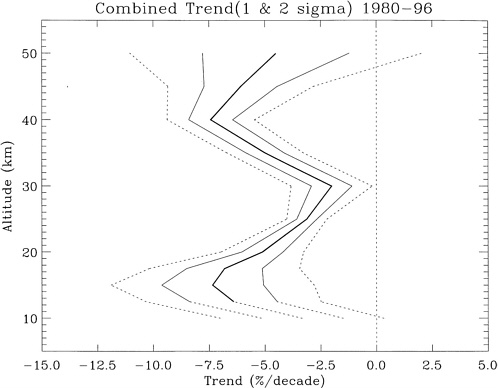
FIGURE 8.1 Estimate of mean ozone trend for 1980 to 1996 using data from Umkehr, ozonesondes, SAGE III, and SBUV measurement systems at the northern and midlatitudes (heavy solid line). Combined uncertainties are also shown as 1 sigma (light solid line) and 2 sigma (dashed line). Combined trends and uncertainties are extended down to 10 km as shown by the light dotted lines. The results below 15 km are a mixture of tropospheric and stratospheric trends, and the exact numbers should be viewed with caution. Combined trends have not been extended lower into the troposphere because the small sample of sonde stations introduces additional unqualified uncertainty about the representativeness of mean trends. (Reprinted from WMO, 1999.)
Measurement Requirements
Instrument Capabilities
The ability to discern future trends in ozone from space-based sensors will depend on the magnitude of the trend, the length of the observational record, and the degree of autocorrelation and noise in the data. A reasonable
requirement is that a trend of 2 percent per decade be detectable from a 15-year record. To meet such a requirement, the noise in the data must be less than 3 percent (Weatherhead et al., 1998), which places a lower limit on the instrument precision. In addition, a 1-km vertical resolution is needed to resolve the fine vertical structure of the trend (see Figure 8.1). Resolving this structure is important for interpreting the trend for chlorine, aerosols, and other changes.
Overlapping Observations
Since 1978, there have been near-continuous space-based observations of ozone columns and stratospheric ozone profiles from a combination of TOMS, SBUV, and SAGE, supplemented more recently by measurements from the UARS satellite (the Halogen Occulation Experiment (HALOE) and the Microwave Limb Sounder (MLS) instruments) and from GOME. Temporal overlaps between these instruments have allowed detailed intercomparisons to play a key role in assessing the precision, accuracy, and long-term drift of the instruments (WMO, 1999). However, these overlaps have been somewhat serendipitous; no deliberate effort has been made to ensure the continuity and long-term traceability of ozone measurements.
Gaps in the satellite record are unacceptable for detecting long-term trends in ozone, because satellites offer the only means for global monitoring of the ozone distribution. Ground-based observations from spectrophotometers, sondes, or lidars offer only sparse spatial coverage. They are inadequate for observing, for example, the evolution of polar ozone loss in the Arctic, an issue that is emerging as a major environmental concern for the decades ahead. Continuity of space-based observations of ozone, involving planned overlap between successive instruments, is essential for detecting and interpreting long-term trends.
Much of the emphasis in long-term ozone monitoring has been on the total ozone column, which is directly and simply related to trends in the ultraviolet flux at the surface. As discussed previously, high-precision measurement of the vertical distribution is critical for interpreting trends in the total ozone column. There is currently some uncertainty in the ozone trend below 20 km because of inadequate measurement capabilities. This situation should improve with the new generation of space-based instruments.
There is a pressing need to develop a capability for space-based detection of trends in tropospheric ozone. Ozonesondes are currently the only means for diagnosing ozone trends in the troposphere, but the sparsity of the ozonesonde network lends considerable uncertainty to trend assessments. The new generation of satellite instruments will improve the capability for space-based observations of ozone in the troposphere and in the tropopause region. However, these instruments are intended for research applications and have short planned lifetimes. There is no plan at this time to use space-based measurements to detect long-term trends in tropospheric ozone, and this gap is reflected by the absence of an NPOESS threshold EDR for ozone below 10 km altitude (see Table 8.1). In the committee's view, however, technology for reliable space-based measurement of tropospheric ozone, at least down to 5 km altitude, should nevertheless be available for operational use by the time NPOESS is launched.
Data Management
Calculation of ozone columns and vertical profiles from the radiances measured aboard a satellite is based on well-established radiative transfer theory, and the algorithms used by the current generation of sensors can be described as mature. It is essential for long-term traceability of the data that any changes in the algorithms over the lifetime of an instrument be accompanied by a complete reprocessing of the previously collected data. This reprocessing is done routinely for the existing suite of ozone sensors (e.g., TOMS, SAGE II) and should be adhered to in managing NPOESS data. Such routine reprocessing requires that the raw radiance data from the sensors must be archived.
OBSERVING STRATEGY
NASA and NPOESSIPO Plans
The next ozone sensor planned for launch by NASA will be the SAGE III instrument in a Sun-synchronous orbit, possibly aboard a Russian spacecraft. SAGE III will have better performance and dynamic range than SAGE II, especially below 20 km, and it will have additional capabilities for measuring water vapor, nitrogen dioxide (NO2), aerosols, and subvisible cirrus (SAGE III is described in Chapter 7 of this report). The Sun-synchronous orbit will provide SAGE III measurements in both polar regions. Global coverage of the vertical distribution of ozone will require an additional SAGE III instrument flying in an inclined orbit. There are plans to fly a SAGE III instrument on the International Space Station in an inclined orbit (51.6 degrees) beginning in 2002. An earlier launch in an inclined orbit is being considered by NASA as a flight of opportunity, but a spacecraft has not been identified. The delay in achieving global coverage with SAGE III is a serious concern, as the existing Earth Radiation Budget Satellite (ERBS) spacecraft carrying the SAGE II experiment in an inclined orbit has been in space since 1984 and could cease operation any day. As previously mentioned, if SAGE II were lost, continuity in the data record for the vertical distribution of ozone would be lost, as well as the opportunity to attribute ozone trends in coming years to aerosol changes, chlorine, and other factors.
The Earth Observing System (EOS)-Chemistry satellite mission, scheduled for launch in December 2002 on a polar orbit, will have a payload focused on improving our understanding of ozone in the stratosphere and the troposphere. The payload will include:
-
The Ozone Monitoring Instrument (OMI), an instrument of TOMS and GOME heritage, which will measure column concentrations of ozone and a number of other species.
-
The High Resolution Dynamics Limb Sounder (HIRDLS), an infrared limb-scanning radiometer designed to sound the upper troposphere, stratosphere, and mesosphere for ozone, a number of ancillary gases, and aerosols. HIRDLS will provide sounding observations with horizontal and vertical resolution superior to that previously obtained and will observe the lower stratosphere with improved sensitivity and accuracy.
-
The Microwave Limb Sounder, which will measure the concentrations of ozone and a number of ancillary gases in the stratosphere and will also measure ozone, water vapor, and cirrus ice content in the upper troposphere. An earlier version of MLS was flown on the UARS satellite.
-
The Tropospheric Emission Spectrometer (TES), a Fourier transform infrared spectrometer that will measure the emission of ozone and other species, including water vapor, CO, nitric oxide, and nitric acid (HNO3) at high spectral resolution in the infrared. TES will have both nadir and limb observation capabilities and will focus particularly on tropospheric observations, where it will provide vertical resolutions of 2.3 km (limb) and about 4 km (nadir).
NPOESS includes as one of its EDRs the measurement of columns and vertical profiles of ozone with the OMPS. One OMPS flight unit is to be provided on the Polar-orbiting Operational Environmental Satellite in 2004, to be followed by three flight units for NPOESS launches in 2007, 2010, and 2016. Comparison with future requirements for detecting long-term trends in ozone (discussed previously) indicates that an OMPS instrument meeting the EDR objective would provide an excellent record for assessing trends in ozone columns and profiles down to 10 km. An OMPS instrument that simply meets the threshold would be inadequate to assess trends below 25 km because of the coarse vertical resolution and low precision. As discussed above, vertical resolution of trends below 25 km is essential for interpreting trends in total ozone columns. There is, therefore, a considerable difference between the threshold and objective EDRs in terms of the usability of OMPS data for long-term trend monitoring. This usability will also be contingent on the overlap of OMPS records from successive NPOESS satellites to ensure long-term traceability. An overlap of at least 1 year is desirable to provide comparison data for a full annual cycle (R. McPeters, Goddard Space Flight Center, personal communication, 1998).
International Plans
Two instruments for ozone observations, the Scanning Imaging Absorption Spectrometer for Atmospheric Cartography (SCIAMACHY) and the Michelson Interferometer for Passive Atmospheric Sounding (MIPAS), will be launched by the European Space Agency (ESA) on the ENVISAT. The SCIAMACHY is an advanced version of GOME with both nadir and limb capability; it will provide vertical profiles of ozone, nitrogen dioxide, and some other species in the stratosphere and for one or two levels in the troposphere. The MIPAS is a Fourier transform spectrometer for measuring high-resolution gaseous emission spectra at Earth' s limb and should have good detection capabilities for ozone (O3), water (H2O), HNO3, nitrous oxide, and CH4. It was initially developed for the stratosphere but may be able to measure down to 5 km.
CALIBRATION AND VALIDATION
Approaches
Calibration and validation of satellite sensors set the stage on which the integrity of all data subsequently derived will be based. Calibration is the set of prelaunch and on-orbit operations or processes used to determine the relationship between satellite instrument output values and traceable standards. Validation involves evaluating the algorithms required to extract geophysical quantities from calibrated and well-characterized instruments.
As part of an international effort, the Ozone Processing Team (OPT) at the GSFC has committed more than 15 years to refining and validating ozone data from SBUV and TOMS instruments. This effort is being conducted through algorithm improvements and comprehensive studies of pre-and postlaunch calibrations (Hilsenrath et al., 1997). TOMS and SBUV operate on similar principles and employ a common algorithm using the observed Earth's geometrical albedo in the 250 to 380 nm wavelength range. The albedo measurement allows canceling nearly all time-dependent instrument changes common to both the radiance and irradiance measurements. The accuracy of the ozone measurement depends on the accuracy of the prelaunch albedo calibration, the uncertainty in the solar diffuser time-dependent changes, and the application of the algorithm. Other non-canceling parameters, such as instrument linearity, must also be tracked carefully over time.
Consistent prelaunch calibration is essential for traceability when successive instruments of one type are flown. Equally important are accurate absolute calibrations to understand differences among instruments employing different techniques. Calibration involves the use of standards and measurements provided by the National Institute of Standards and Technology (NIST), such as irradiance lamps and integrating sphere radiance targets. Radiance calibrations of the SBUV, TOMS, and GOME instruments have been compared using these standards and thus have common and consistent prelaunch calibrations.
Accurate description of the time-dependent characteristics of an instrument is fundamental to detecting long-term trends. Several methods are now implemented for tracking postlaunch instrument calibration. These methods include on-board calibration systems, algorithmic techniques, and intercomparisons (Hilsenrath et al., 1997). One method of evaluating and calibrating the sensitivity of an aging satellite instrument is to compare observed albedos with those measured from a freshly launched instrument. In accordance with this concept, the U.S. National Plan for Stratospheric Monitoring (NOAA, 1989) called for regular flights of an SBUV instrument (called the SSBUV) on the space shuttle as additional assurance that the drift in the NOAA SBUV2 instruments would be accurately corrected. SSBUV calibration has been tracked with a precision of 1 percent and has flown eight times from 1989 to 1996.
Pre- and postlaunch calibration is the first step in producing high-quality, long-term environmental data sets from space-based instruments. The second step is data validation. To meet this requirement, a comprehensive program of correlative measurements for in-orbit validation is needed. Ozone column measurements can be validated using ground-based spectrophotometers, and agreement between TOMS and the Dobson network is found to be better than 1 percent (WMO, 1999). Validation of space-based vertical ozone profiles has been done mostly by comparisons with ozonesonde data, but the small number of coincidences is a limiting factor. SAGE-ozonesonde comparisons at 20 to 25 km show no significant difference within an uncertainty range of a few
percent but show significant differences above 25 km (potentially from ozonesonde error) and below 20 km (potentially from SAGE error). The SAGE-ozonesonde comparisons further demonstrated no significant instrument drift at 20 to 25 km altitude (less than 0.2 percent yr −1). SAGE II-lidar comparisons for the period 1990 to 1997 and over the altitude range 22.5 to 35 km show an instrument drift of less than 0.5±1 percent yr−1 on average.
Challenges
Evidence from past satellite instruments shows that calibration and validation must not be regarded as a one-time effort to be made at the beginning of an instrument flight period but rather an effort that must continue through the lifetime of the instrument. Given the multiplicity of launches involving several countries and agencies, it is important that validation be considered not on a satellite-by-satellite basis but rather as part of an integrated international plan. In this way, the full validation capabilities of all nations' research communities can be applied to the total suite of space-based ozone measurements (Kaye and Miller, 1997).
Validating vertical profiles of ozone is a major challenge, as there are no continuous observational data sets against which to compare the space-based measurements. The SAGE II instrument was initially validated with a dedicated program of ozonesonde measurements (Cunnold et al., 1989; Attmannspacher et al., 1989). Since then, continued validation has had to rely on the regular ozonesonde launch program, which affords few coincidences with the satellite data. Coincidence over a time interval of less than 3 hours appears to be necessary for meaningful comparison (WMO, 1999). Below 20 km altitude, aircraft are a platform of choice for validating space-based observations. The SAGE III Ozone Loss and Validation Experiment (SOLVE), conducted by NASA in the winter 1999-2000 using both the ER-2 and DC-8 aircraft, is the first aircraft mission dedicated to validating space-based ozone data. Additional aircraft missions need to be planned by NASA for validating the sensors of the Chemistry satellite, to be launched in 2002.
EVOLUTION STRATEGY
New Measurement Technologies
Ozone measurements above 25 km altitude are made currently with high reliability by a number of existing spaceborne instruments, including SAGE II, HALOE, SBUV, and MLS. The push for new technology is driven principally by the need to (1) miniaturize and simplify the existing satellite instruments, (2) extend the range of ozone observations to lower altitudes, and (3) measure ozone concurrently with related species to better understand the mechanisms for ozone formation and loss.
The new generation of research instruments, including SAGE III, TES, HIRDLS, and MLS, will provide improved measurement of ozone in the lower stratosphere and the troposphere, along with concurrent measurements of several ancillary species. The TES instrument, designed specifically for tropospheric measurements, has a spectral resolution of 0.025 cm−1 in the infrared, corresponding to the width of individual lines in the lower troposphere; this will allow detection of ozone, CO, and water vapor down to the surface. TES has both limb and nadir measurement capabilities to further improve tropospheric detection. The limb observation will provide 2.3 km vertical resolution down to cloud tops, while the nadir observation will provide ~4 km vertical resolution with less likelihood of cloud interference.
Space-based lidars could allow measurement of ozone vertical profiles down to the surface with a vertical resolution of about 2 km. NASA and the Canadian Space Agency (CSA) have jointly proposed the development of a spaceborne lidar system, Ozone Research with Advanced Cooperative Lidar Experiments (ORACLE), to measure ozone profiles in the lower stratosphere and in the troposphere with simultaneous measurements of aerosol and cloud profiles. The Differential Absorption Laser (DIAL) technique will be used to measure ozone profiles and columns in the UV (306 to 318 nm), while direct lidar backscatter returns in the visible or near-infrared will provide the simultaneous aerosol and cloud profile measurements. These techniques have had a long history of application in aircraft studies of tropospheric and stratospheric ozone and aerosols. The transition to space-based applications is made possible by recent advances in tunable solid-state laser technology that have
opened the way for compact, efficient, high-power laser systems and advances in composite material and other receiver technologies permitting the development of large-area, lightweight receiver systems.
New Sampling Strategies
Present and planned space-based ozone sensors provide global coverage, but with relatively sparse sampling, i.e., a return time of typically 3 to 7 days on a given tract. This is a significant limitation, considering the large variability of concentrations at extratropical latitudes and in the troposphere. Measurements on a geostationary orbit would provide continuous data over spatial scenes representing one-third of a hemisphere. Nadir observation of O3, CO, and H2O with ~2 km vertical resolution down to the surface could be achieved in a geostationary orbit with a Fourier transform spectrometer or a gas-correlation spectrometer.
REFERENCES
Attmannspacher, J. de la Noe, D. De Muer, J. Lenoble, G. Megie, J. Pelon, P. Pruvost, and R. Reiter. 1989. European validation of SAGE II ozone profiles. J. Geophys. Res. 94: 8461-8466.
Cunnold, D.M., W.P. Chu, R.A. Barnes, M.P. McCormick, and R.E. Veiga. 1989. Validation of SAGE II ozone measurements. J. Geophys. Res. 94: 8447-8460.
Hilsenrath, E., P.K. Bhartia, R.P. Cebula, and C.G. Wellemeyer. 1997. Calibration and intercalibration of BUV satellite ozone data. J. Adv. Space Res. 19: 1345-1353.
Integrated Program Office (IPO), National Polar-orbiting Operational Environmental Satellite System (NPOESS). 1996. Integrated Operational Requirements Document (IORD) I. Joint Agency Requirements Group Administrators. 61 pp. + figures.
Intergovernmental Panel on Climate Change (IPCC). 1999. Special Report on Aviation and the Global Atmosphere. Cambridge, U.K.: Cambridge University Press.
Kaye, J.A., and A.J. Miller. 1997. Tropospheric ozone measurements and their use in validation of TOMS and SAGE data products. Earth Observer 9: 31-34.
Logan, J.A. 1994. Trends in the vertical distribution of ozone: An analysis of ozonesonde data. J. Geophys. Res. 99: 25553-25585.
Logan, J.A. 1999. An analysis of ozonesonde data for the lower stratosphere: Recommendations for testing models. J. Geophys. Res. 104: 16151-16170.
Logan, J.A., I.A. Megretskaia, A.J. Miller, G.C. Tiao, D. Choi, L. Zhang, L. Bishop, R. Stolarski, G.J. Labow, S.M. Hollandsworth, G.E. Bodeker, H. Claude, D. DeMuer, J.B. Kerr, D.W. Tarasick, S.J. Oltmans, B. Johnson, F. Schmidlin, J. Staehelin, P. Viatte, and O. Uchino. 1999. Trends in the vertical distribution of ozone: A comparison of two analyses of ozonesonde data. J. Geophys. Res. 104: 26373-26399.
National Oceanic and Atmospheric Administration (NOAA). 1989. National Plan for Stratospheric Monitoring and Early Detection of Change, 1988-1997. FCM-P17-1989. U.S. Department of Commerce, July.
Weatherhead, E.C., G.C. Reinsel, G.C. Tiao, X.L. Meng, D.S. Choi, W.K. Cheang, T. Keller, J. DeLuisi, D.J. Wuebbles, J.B. Kerr, A.J. Miller, S.J. Oltmans, and J.E. Frederick. 1998. Factors affecting the detection of trends: Statistical considerations and applications to environmental data. J. Geophys. Res. 103: 17149-17161.
World Meteorological Organization (WMO). 1999. Scientific Assessment of Ozone Depletion: 1998. Geneva: WMO.


