
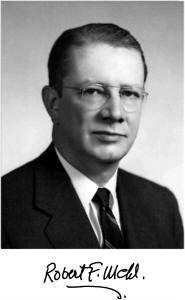
ROBERT FRANKLIN MEHL
March 30, 1898–January 29, 1976
BY C. S. SMITH AND W. W. MULLINS
ROBERT FRANKLIN MEHL played a vital role in the transition of nineteenth-century metallurgy into the much broader field of materials science and engineering, which combines structural and physical approaches to the nature and use of materials with the earlier chemical-analytical framework. His contributions were at several levels: partly in the research he himself did, partly in his effective advocacy of a more fundamental approach to materials, and partly in his establishment of a new concept for a curriculum for the education of metallurgists. According to one of his closest associates, F. N. Rhines, Mehl's strongest points were: “(1) ability to identify and exploit areas ripe for development, (2) ability to inspire deep interest in scientific pursuits, and (3) foresight in developing the curriculum in physical metallurgy. ”
Robert Franklin Mehl was born in Lancaster, Pennsylvania, on March 30, 1898. His grandfather had emigrated from the vicinity of Munich following the revolution of 1848. His father, whose formal education terminated before high school, became a manager in a Lancaster department store. His mother, May Ward, was born in Columbia, Pennsylvania, of English and German parentage. On December 27,
1923, Mehl married Helen Charles. They had three children: Robert F., Jr., Marjorie, and Gretchen. Mehl died on January 29, 1976.
Although of modest means, Mehl's parents encouraged his advanced education and permitted him to have a small laboratory in the basement of their home when he was about twelve, an experience that marks his first recollections of an interest in science. He attended Franklin and Marshall College in his hometown. Living in his parents' home, he worked weekends and vacations in department and drug stores to meet college expenses. He expected to begin a job as an analytical chemist after two years of college, but a teaching assistantship enabled him to graduate near the top of his class in 1919. He participated in athletics and was interested in art; the hobby of oil painting continued throughout his life. His main interests, however, were science and literature. He read widely and he often attributed part of his early interest in science to reading. Although he frequently expressed regret that he did not develop a proficiency in foreign languages, he translated Tammann's book Aggregation (Aggregatzustände)1 from German into English in 1925. He began research in his senior year at college, although a senior thesis was not required at that time. Mehl acknowledged great indebtedness to the then head of the chemistry department at Franklin and Marshall, Professor Herbert Beck, who encouraged him to pursue chemistry as well as his literary interests.
Mehl was granted a research assistantship and fellowship at Princeton University in 1920 and obtained his Ph.D. there in 1924 under Professor Donald P. Smith. Professor Smith had taken his doctoral work at G öttingen University with the renowned Gustav Tammann under whose influence a large fraction of the leaders of metallurgical research beginning in the 1920s were trained. Mehl's thesis topic was
the electrical properties of aluminum-magnesium alloys. So began Mehl's transition from chemistry to metallurgy. Although he later tended to be somewhat disparaging of his thesis, he described Princeton as a “wonderful place to do graduate work in the 1920s” and, connecting the Princeton ambiance with his later career, he noted that “research and scholarship standards were high, and graduate student interest in and enthusiasm for research were extremely high. Remembering that scene was of immense help in later years at CIT [Carnegie Institute of Technology].”2
From 1923 to 1925, overlapping his degree work at Princeton, Mehl taught chemistry at Juniata College, where he also served as department head. In 1925 he was appointed a National Research Council fellow at Harvard University for two years. He worked with T. W. Richards on the relation between the compressibility and chemical affinity of alloys. Although his early papers were almost all published in the Journal of the American Chemical Society, his transition toward physical metallurgy continued. It was the interest of A. Sauveur (then also at Harvard) in Widmanstätten structures in meteorites and in medium carbon steels that brought to Mehl's attention the field of orientation relationships in solid state precipitation. His later contribution to this field was the first work of his to be widely recognized.
The U.S. Naval Research Laboratory (NRL), which had been founded a few years earlier, was looking for a head of the new Division of Physical Metallurgy who would be well versed in science and interested in doing basic research rather than practical metallurgy. They selected Mehl for this post in 1927. In building up his small staff at the NRL Mehl brought from Chicago Charles S. Barrett, who was then working on X-ray scattering in gases. Barrett was soon to become internationally famous; his book,3 whose later
editions were coauthored with T. B. Massalski, is still one of the most quoted texts in the field.
Mehl and Barrett collaborated most effectively and the laboratory soon became well known in metallurgical circles for a series of nine papers on the Widmanstätten structure. Although the structure had been observed for a long time in many systems, the mechanism was being newly studied under the impact of Merica's theory of precipitation hardening4; the latter effect had been empirically discovered by Wilm in 1904 in aluminum-copper alloys and was experimentally exploited in alloy systems for many years before any understanding had developed.
The key to the work of Mehl and Barrett on the Widmanstätten structure was the concept of structural matching on the habit plane between the parent phase and the Widmanstätten precipitate. The orientation of the parent grain was determined by X-ray diffraction, which was then an exciting new method of analyzing the crystal structure of metals and alloys. Mehl and Barrett (1931) then were able to deduce the conjugate habit plane in the matrix phase by measuring the number of precipitate plate directions in an individual grain in a polycrystalline material. For example, four distinct directions indicate {111} habit planes in an FCC parent phase. Their work disproved a view long held by metallurgists that precipitate alignment followed “cleavage planes ” of the matrix because they showed that the precipitate plane was not necessarily the same for different precipitates. Thus they developed the important concept of structural matching. Although some of their conclusions have been modified, the influence of their approach was enormous. Some years later the field moved to a mature stage with hundreds of papers.
A more practical study in the early 1930s (1930) did much to establish Mehl's reputation, along with that of the NRL.
This was the use of gamma ray radiography for the in situ study of large steel castings, in particular, the stern post castings of navy heavy cruisers; the poor as-cast structures were causing severe problems. A gamma ray source placed inside the hollow post with film wrapped around the outside yielded photographs showing such casting defects as shrinkage cracks and blowholes as well as failures in welding. This work created a great sensation in engineering and practical metallurgical circles. It earned Mehl immediate recognition in the Society for Non-Destructive Testing. In 1943 he received the Medal of the American Industrial Radium and X-ray Society for the work.
Mehl's real interests, however, were in the science underlying problems of industrial importance. He devoted much time to establishing contacts with the metallurgical industry and with leading industrial metallurgists and he played a very prominent role in the activities of the two principal metallurgical societies in the United States, the American Institute of Mining and Metallurgical Engineers (AIME, from 1956 the American Institute of Mining, Metallurgical and Petroleum Engineers) and the American Society of Metals, (ASM, now the American Society of Metals International).
After four years with the NRL Mehl tried to carry his research philosophy into industry as assistant director of the Research Laboratories of the American Rolling Mill Company in Middletown, Ohio. The effect of the great depression in 1929 and his own interests, however, combined to make him leave in 1932 after only one year. His wife, talking retrospectively of this year in industry, remembers it as an unhappy one, although his colleagues believed that it strongly reinforced his view on the necessity of relating scientific work to industrial problems.
Upon leaving the American Rolling Mill Company, Mehl accepted an appointment as professor of metallurgy at the
Carnegie Institute of Technology (CIT) and director of the reorganized Metals Research Laboratory (MRL) in 1932. The administration at CIT had recognized as early as 1924 the importance of research as well as education. The MRL had already done notable research mainly under the leadership of such men as V. N. Krivobok and Cyril Wells. Mehl increased the scope and made the work attractive to local industry by attracting lively young research people to the MRL and reinforcing the educational function of the laboratory.
In 1935 Mehl was appointed head of the Department of Metallurgical Engineering at CIT, a post he held until his retirement in 1960. The research of the MRL and the Department centered on the areas of solid-state reactions, diffusion, precipitation, plastic deformation, preferred orientations, and oxidation. In later work, he and his colleagues clearly separated the role of nucleation from that of growth of new phases in solid-state transformations and developed theories applicable as well to recrystallization as a result of plastic deformation. A central conclusion of this work was the now famous Johnson-Mehl-Avrami-Kolmogorov equation set forth in the 1939 paper by Mehl and Johnson (also obtained independently by Avrami5 and Kolmogorov6) describing the volume fraction of a solid transformed in terms of the formation rate and spatial distribution of nuclei and the subsequent growth of the nuclei. All of this work brought international recognition to Mehl and his associates.
Mehl enjoyed doing broad surveys of research fields in both temporal and intellectual frameworks. He wrote annual reviews of theoretical metallurgy in the early 1930s that had a major influence on research undertaken in other laboratories as well as his own. When invited to give the prestigious annual Institute of Metals Division lecture in 1936, he did an in-depth summary on the current status of
the field of diffusion, which provided many research topics for students and prompted a vast increase in studies of the fundamental processes underlying diffusion in laboratories throughout the world. These review articles and invited lectures as well as his Brief History of the Science of Metals7 were the major publications under his sole authorship after the beginning of the MRL period. His best original research was always done in collaboration with colleagues or students; his contributions to this work were major.
Mehl's great ambition, drive to have an impact, and combative tendencies interfered on occasion with his scientific professional judgment. This seemed to lead him into scientific controversies that often became personal and strident. Two famous examples are the campaigns he waged against the concept of dislocations and against the role of vacancies in diffusion, especially as manifested by the Kirkendall effect (movement of inert markers in a diffusion couple providing evidence for a vacancy mechanism of diffusion). According to associates, he regarded dislocations and vacancies as fanciful inventions of physicists intruding into his domain of metallurgy and discouraged the faculty from mentioning these concepts in the classroom and at meetings.
In the case of vacancy diffusion, he was persuaded by friends of Kirkendall not to reject for publication the now classic work by Kirkendall and Smigelskas,8 which he had held up for half a year as chief reviewer, but rather to allow publication and to submit discussion to the paper setting forth his objections. Mehl did so and then undertook with a Brazilian graduate student L. C. C. da Silva a study of inert marker movement in metallic diffusion couples of several binary alloy systems. The study proved to be a classic confirmation of the Kirkendall effect. At first, Mehl held up the thesis, still believing the results to be wrong, until
colleagues persuaded him to recant. The results of the study were published in 1951. Many years later, when Mehl was confined to bed, he apologized to Kirkendall, who made a personal visit, and whom he told he wished he had an important effect named after him. The history of this controversy is discussed in an article by Hideo Nakajima 9 and a subsequent response by da Silva.10 A positive benefit of Mehl's passionate stance on these issues was the focused motivation he generated for himself and colleagues to resolve the disputes by incisive research.
Mehl's greatest contribution to his profession was arguably the establishment of new standards for the metallurgical profession both as a whole and particularly in the universities. He took a deep interest in the development of proper curricula, both undergraduate and graduate. The pillars of the curriculum developed under his leadership were fundamental courses in crystallography, phase diagrams and phase transformations, and the mechanical behavior of metals on a macroscopic scale. Although not an adept mathematician himself, Mehl encouraged more advanced mathematical education and analysis on the part of his students. At the time this emphasis on the scientific foundation of the subject constituted a revolutionary approach to university education in metallurgy.
Mehl was widely held in high esteem as an outstanding lecturer, both in university courses and in professional talks around the world. His colleagues described the hours he would often spend in preparation and rehearsal for just one lecture. His delivery was smooth, theatrical, and inspiring.
Mehl's students came to occupy a prominent position in the metallurgical profession and the curriculum he advocated was widely copied. At one time about a quarter of the heads of metallurgy and material science departments in
the United States and Canada were his former students or faculty colleagues. His laboratory attracted many students and visitors from abroad and his influence grew to a world-wide scale. In retrospect, one can see the impact of the MRL under Mehl's directorship as marking a turning point in the history of physical metallurgy.
He developed a particularly close connection with Brazil, spending a year at Sao Paulo Universidad helping to organize the Brazilian Metallurgical Society and establishing the framework for metallurgical education in Brazil. The Portuguese edition of his lectures were published in book form.11
Mehl maintained an active and lucrative consulting business with such corporations as DuPont, United States Steel, Convair, and Thompson Ramo Woolridge. He also served effectively on many governmental advisory committees and professional committees. In 1945 he was attached to the U.S. Embassy in London to work with the Technical Intelligence Investigating Committee of the Joint Chiefs of Staff, and visited various German centers of metallurgical research in the wake of the U.S. Army. For this purpose, he was given the simulated rank of brigadier general with uniform. He took his usual firm stance in arranging these visits and tolerated no barriers.
Mehl was chairman of the Ship Steel Committee at the beginning of engineering and industrial research of the National Research Council in 1950 when the cracking of Liberty ships during World War II service was still an unresolved issue. He was chairman of the Minerals and Metals Advisory Board in 1951. Perhaps his most notable government service was his chairmanship of the Visiting Committee of the National Bureau of Standards, during which he strongly supported Director Alan Astin in 1953 against the commercially motivated attack in the famed battery acid case. Secretary of Commerce Weeks fired Astin, accusing
him of interfering with the marketplace by issuing a report stating that the storage battery additive AD-X2 was not effective in reviving old batteries. A major furor in support of Astin arose in the scientific community. Weeks requested the bureau's Visiting Committee to nominate a successor to Astin. In a surprise move, the committee, under Mehl 's bold leadership, nominated Astin, which forced Weeks to reverse his position and rehire Astin.
From 1934 to 1958 he received numerous honors beginning with what is now the Matthewson Medal of the Metallurgical Society of the AIME, which he received five times between 1934 and 1947; the Howe Medal of the ASM (1939); the gold medals of both the ASM (1952) and the AIME (1945); the Le Chatelier Medal of the Société Française de Metallurgie (1956); four honorary doctorates; and election to the National Academy of Sciences in 1958. Despite these honors, Mehl seemed to have felt that his great contributions to education were not properly recognized and he was bitterly disappointed not to have been offered the presidency of CIT after Doherty's tenure in that office. A man of strong opinions openly expressed, Mehl had engendered the opposition of key decision makers to his appointment. He did become dean of graduate studies in the College of Engineering and Science at CIT from 1953 to 1960.
In 1960 he left CIT to become consultant to the United States Steel Corporation. He lived in Zurich, where he served as a liaison officer between the company and European metallurgists and industrialists. It is well known that when asked to recommend someone for this post, he recommended himself. His strong personality served to open the doors of many European laboratories that had previously been reluctant to admit visitors from U.S. industry. Returning to the United States in 1966, he became briefly a
visiting professor at the University of Delaware and at Syracuse and then returned to Pittsburgh.
During his years as head of the Department of Metallurgical Engineering and the MRL, Mehl's authoritarian style—on the model of a European professor—resulted in a wide range of strong attitudes on the part of faculty and students toward his leadership. He insisted on high standards and on a focus on the core issues in metallurgy. This led to discussions with students, for example, that have been described as exciting, interactive, and crucial to the development of ideas and to making them see the beauty and importance of the developing field of scientific metallurgy. A vignette that gives an additional indication of the quality of Mehl's leadership was related by B. Lustman, one of his distinguished students. Lustman 's apparatus for measuring vapor pressures had broken down rather catastrophically, resulting in bad burns on his arms. In response, Mehl spent an entire evening at the bench with Lustman putting the apparatus back together with considerable enjoyment and dexterity, inspiring Lustman to continue with renewed enthusiasm.
On the other hand, students have remarked that once Mehl had studied a field in depth, discussed it with them, and had formed his own opinion as to the importance of certain directions of research and the probable outcome, he tended to oppose continued originality on the part of students. Once the thesis topics had been selected, deviations were discouraged. Further, once he felt he understood a problem well enough for his own satisfaction and was moving on to other things, he became rather impatient with students who deviated from his view.
Similarly, faculty members were encouraged to adopt the Mehl view on research directions and on controversial topics in classroom presentations and at meetings. Neverthe-
less, he inspired great loyalty. He always prized a cable sent by the faculty to him in London before a major address that read: “ Stand up there and give them hell.”
Mehl expected hard work. “You can't be a scientist on eight hours a day” was his stated principle from his Naval Research Laboratory days onward, and he attracted associates who felt the same way. Students referred to themselves as Saltminers as a badge of honor. The Saltminers, comprising present and former faculty and graduate students of the Metallurgy/Materials Department at Carnegie Mellon University (formerly CIT), to this day meet at the annual fall meeting of the AIME for fellowship and a dinner where stories of the old days under Mehl inevitably emerge.
Mehl's view of metallurgy as a connected whole from smelting to the physics of the final use made him unwilling to share the interest of many of his colleagues in materials broadly. Even though his slant of mind was more like that of a physicist than most of the members of the profession, he seemed rather to have resented the intrusion of metal physics into physical metallurgy and did not develop close professional relationships with physicists, either individually or institutionally. He opposed the move toward the newly oriented field of material science and engineering that began to replace metallurgy in universities around 1960, believing this move was both a hollow gimmick to obtain funding and unwise in view of the specialized knowledge required for the study of each major type of material (e.g., metals, ceramics, semiconductors). Nevertheless, he undoubtedly played a central and essential role in preparing the ground for the benefits of this broader view of materials.
Just before leaving for Zurich, Mehl summarized his view of the profession in his Howe lecture, “Commentary on Metallurgy” (1960). He pointed out that throughout history every discipline has drawn from every other whenever possible and acknowledged that metallurgy draws heavily
from other disciplines; so, in a sense, Mehl was inter-disciplinary. He nevertheless maintained: “It has its own science; and it has its own rationale interrelating engineering and science.”
Charles S. Barrett, with whom Mehl did his first research on alloy transformation and who was closely associated with him from 1933 to 1945, has remarked that “the momentum he generated toward a better basic understanding of physical metallurgical principles will last far longer than the specific findings in individual papers or committee reports.” The present writers (especially C.S.S.) can attest to the truth of this not only on the basis of many stimulating discussions at technical meetings but even more in noticing how the viewpoint toward metallurgy first enunciated and demonstrated by Robert Franklin Mehl spread throughout the world and produced an orientation of metallurgists that enabled them to interact effectively with the very cutting edge of physics and chemistry.
Toward the end of his life, Mehl expressed the opinion that universities were inclining too much toward basic research alone and he asked “whether a university ambiance of pure science close to solid state physics could be conducive to interest in an industrial career.” And he emphasized the importance of seeing the relationship of science to applied research, “for these two together and neither separately constitute the field and in this union lies the metallurgical mystique. ” Perhaps at the end of his life his estimate of the proportion of basic science in this union was rather less than those of his younger colleagues, but at the beginning of it he was far in advance of his profession and it was in very large measure his example and his educational innovations that changed the profession into its modern mode.
Mehl suffered from diabetes in later years and for the last decade he was confined to bed and wheelchair because of the amputation of both legs. He faced this hardship with
characteristic courage. During his confinement, he wrote a fascinating account of the department and laboratory he led for so many years entitled “A Department and a Research Laboratory in a University. ”2 The review included the key people with whom he was most closely associated, their work, and some of Mehl's philosophy. He was visited by many world figures in the field of metallurgy during this period. He died in Pittsburgh on January 29, 1976.
THE AUTHORS ARE INDEBTED to H. I. Aaronson, C. L. McCabe, and H. W. Paxton for the very helpful comments and information they supplied but take full responsibility for the final version. W.W.M. is also indebted to his wife, June Mullins, for editorial suggestions and proofreading.
NOTES
1. G. Tammann. Aggregatzustände. Trans. R. F. Mehl as States of Aggregation. New York: Van Nostrand, 1925.
2. R. F. Mehl. A department and a research laboratory in a university. Ann. Rev. Mat. Sci. 5(1975):1-26.
3. C. S. Barrett. The Structure of Metals. New York: McGraw-Hill, 1943.
4. P. D. Merica, R. G. Waltenberg, and H. Scott. Trans. AIME 64(1920):41.
5. M. J. Avrami. Chem. Phys. 7(1939):1103; 8(1940):212; 9(1941):177.
6. A. Kolmogorov. Statistical theory for the recrystallization of metals. Akad. Nauk S. S. S. R. Izv. Ser. Matem. 1(1937):355.
7. R. F. Mehl. Brief History of the Science of Metals. AIME, 1948.
8. A. D. Smigelskas and E. O. Kirkendall. Zinc diffusion in alpha brass. Trans. AIME 171(1947):130-42.
9. H. Nakajima. Episode on the discovery of the Kirkendall effect. J. Met. 49(6) (1997):15-19.
10. L. C. C. da Silva. A reflection on R. F. Mehl and the Kirkendall effect. J. Met. 50(8) (1998):6-7.
11. Associação Brasilieira de Metals. Metallurgie do Ferro e do Aco, 1945.
SELECTED BIBLIOGRAPHY
The complete works of R. F. Mehl are available in the Mehl Library of Roberts Hall at Carnegie Mellon University, Pittsburgh, Pennsylvania.
1930
With G. E. Dean and C. S. Barrett. Radiography by the use of gamma rays. Trans. Am. Soc. Steel Test18:1192-1237.
1931
With C. S. Barrett. Studies upon the Widmanstätten structure. I. Introduction. The aluminum-silver system and the copper-silicon system. AIME Tech. Pub. No. 353. Trans. Inst. Met. Div.93:78.
With O. T. Marzke. Studies upon the Widmanstätten structure. II. The beta copper-zinc alloys and the beta copper-aluminum alloys. AIME Tech. Pub. No. 392. Trans. Inst. Met. Div.93:123.
1932
With C. S. Barrettand F. N. Rhines. Studies upon the Widmanstätten structure. III. The aluminum-rich alloys of aluminum with copper and of aluminum with magnesium and silicon. Trans. Inst. Met. Div.99:203-33.
1933
With C. S. Barrett and D. W. Smith. Studies upon the Widmanstätten structure. IV. The iron-carbon alloys. Trans. I. S. D.105:215.
1936
Diffusion in solid metals.Annual Inst. Met. Div. Lecture.Trans. AIME Inst. Met. Div.122:11.
With M. Gensamer. Preferred orientations produced by cold rolling low-carbon sheet steel. AIME Tech. Pub. No. 704. Trans. I. S. D.120:277.
1938
With F. N. Rhines. Rates of diffusion in the alpha solid solutions of copper. AIME Tech. Pub. No. 883. Trans. AIME Inst. Met. Div.128:185.
The physics of hardenability. The mechanism and rate of decomposition of austenite. Reprinted from Hardenability of Alloy Steels, pp.1-65, ASM symposium held October 1938.
1939
With W. A. Johnson. Reaction kinetics in processes of nucleation and growth. AIME, Iron and Steel Div.135:416-42, discussion, pp. 42-58. (Tech. Pub. No. 1089).
With L. K. Jetter. The mechanism of precipitation from solid solution. The theory of age hardening, pp. 342-438. American Society of Metals Symposium on Precipitation Hardening held October 1939.
1941
With C. S. Barrettand A. H. Geisler. Mechanism of precipitation from the solid solution of silver in aluminum AIME, Inst. Met. Div.143:134-42, discussion pp. 148-50. (Tech. Pub. No. 1275).
The structure and rate of formation of pearlite. Campbell Memorial Lecture. Trans. Am. Soc. Met.29:813-62.
1942
With G. E. Pellissier, M. F. Hawkes, and W. A. Johnson. The inter-lamellar spacing of pearlite. Trans. Am. Soc. Met.30:1049-89.
With F. C. Hull. The structure of pearlite. Trans Am. Soc. Met.30:380-425.
1943
With G. A. Roberts. The mechanism and the rate of formation of austenite from ferrite-cementite aggregates. Trans. Am. Soc. Met.31:613-50.
1945
With W. A. Anderson. Recrystallization of aluminum in terms of the rate of nucleation and the rate of growth. Am. Inst. Min. Eng.,Metals Tech. 12.Tech. Pub. No.1805:1-28.
1948
With A. G. Guy and C. S. Barrett. Mechanism of precipitation in alloys of beryllium in copper. AIME Met. Div. 175:216-38, discussion pp. 238-39 (Tech. Pub. No. 2341).
The decomposition of austenite by nucleation and growth process.Hatfield Memorial Lecture. Iron Steel Inst. J.159:113-29.
1950
With C. Wells and W. Batz. Diffusion coefficient of carbon in austenite. Trans. AIME188:553.
1951
With L. C. C. da Silva. Interface and marker movements in diffusion in solid solutions of metals. Trans. AIME191:155-73.
1953
With L. Himmell and C. E. Birchenall. Self-diffusion of iron in iron oxides and the Wagner theory of oxidation Trans. AIME197:827-43.
With R. F. Bunshah. The rate of propagation of martensite. Trans. AIME197:1251.
1956
With W. C. Hagel. The austenite:pearlite reaction. Prog. Met. Phys.6:74-134.
1960
Commentary on metallurgy. Howe Memorial Lecture (invited). Trans. Met. Soc. 218:386-95.


