
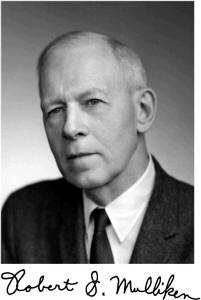
ROBERT SANDERSON MULLIKEN
June 7, 1896-October 31, 1986
BY R. STEPHEN BERRY
ROBERT S. MULLIKEN WAS a quiet, soft-spoken man, yet so single-minded and determined in his devotion to understanding molecules that he came to be called “Mr. Molecule.” If any single person's ideas and teachings dominated the development of our understanding of molecular structure and spectra, it surely was Robert Mulliken. From the beginning of his career as an independent scientist in the mid-1920s until he published his last scientific papers in the early 1980s, he guided an entire field through his penetrating solutions of outstanding puzzles, his identification (or discovery) and analysis of the new major problems ripe for study, and his creation of a school —the Laboratory of Molecular Structure and Spectroscopy or LMSS at the University of Chicago, during its existence the most important center in the world for the study of molecules.
Robert's background led him naturally into academic science. He was born in Newburyport, Massachusetts, in a house built by his great-grandfather in about 1798. His father, Samuel Parsons Mulliken, was a professor of chemistry at MIT, which made him a daily commuter between Newburyport and Boston. Samuel Mulliken and his childhood friend and later MIT colleague Arthur A. Noyes were
strong influences stirring Robert's interests in science. As a high school student, Robert decided against philosophy as a career and opted for science. He attended MIT as an undergraduate, receiving his B.S. in chemistry in 1917. He then took on a wartime job studying poison gases in a laboratory at American University under the direction of a certain Lieutenant James Bryant Conant, then of the Chemical Warfare Service. Mulliken entered the Chemical Warfare Service himself, rising to private first class, but left the service when he contracted influenza in 1918. When he recovered, he worked for the New Jersey Zinc Company until he entered graduate school at the University of Chicago in the fall of 1919.
As a graduate student in chemistry at Chicago, Robert worked under the direction of W. D. Harkins, first on surface tension and then on isotope separation, particularly of mercury isotopes. The method used in his thesis was “irreversible evaporation” and distillation. Robert found that a dirty surface on the mercury aided the separation considerably; this concept, later called a boundary layer or diffusion membrane, played an integral role in the Manhattan Project. Robert conceived and tried centrifugation, but as he said fifty-five years later, the centrifuge then was simply too crude. He also considered photochemical separation, but never published anything on the subject.
At Chicago, Robert became interested in the interpretation of valence and chemical bonding through the papers of Irving Langmuir and G. N. Lewis. He encountered the old quantum theory through two enthusiastic courses of lectures by Robert A. Millikan, but was uneasy about the theory; “a disorganized chaos” was the description Mulliken used for it in reminiscences written in 1965. Nevertheless, Robert succeeded in applying it in 1924-25 to the interpretation of a particular molecular spectrum, assigned initially
by Wilfred Jevons to the boron nitride molecule, BN. Mulliken showed that the spectrum was that of boron oxide despite the preparation involving no apparent oxygen-containing substances. Jevons was pressed by a zealous department head to publish a note insisting on the initial assignment. Then, at the urging of R. T. Birge, Mulliken wrote directly to Jevons, visited him in England in 1925, and the two men settled the matter amicably and remained friends thereafter.
Robert held a National Research Council Fellowship at that time and was working at Harvard after completing his Ph.D. in 1922. He had wanted to study beta-ray spectroscopy with Ernest Rutherford at Manchester, but the fellowship board felt that his physics background was not strong enough and urged him to select a more chemical topic. Consequently he carried out many experiments in molecular spectroscopy largely under the guidance of E. C. Kemble and F. A. Saunders. At that time, a coterie of young, enthusiastic American scientists grew up in Cambridge, a group including Mulliken, Samuel Allison, F. A. Jenkins, J. R. Oppenheimer, John Van Vleck, Gregory Breit, Harold Urey, and John Slater. They were not all in Cambridge at the same time, but for the most part they knew one another, and there were several close friendships among them.
Like most of that group, Mulliken made his early pilgrimage to Europe in the summer of 1925. This was just the threshold time of modern quantum mechanics. Robert, like several of his contemporaries, had been trying to give organization to the states and spectra of diatomic molecules. This subject was, from his later reminiscences, a lively part of many of the discussions he had with colleagues and distinguished senior scientists in London, Oxford, Cambridge, Copenhagen, and perhaps most important, Göttingen. There he met Max Born, James Franck (who, of course, later joined the faculty of the University of Chicago), Otto Oldenberg,
Hertha Sponer, V. Kondratiev, V. I. Semenov, A. Terenin, and especially Born's assistant Fredrich Hund. The relationship between them became one of the most fruitful in the twentieth century in the history of the interpretation of the structure of matter and the nature of chemical bonds.
Even in 1925, a year before the first papers were published on quantum mechanics, Mulliken and Hund began to conceive an analogue for molecules of the “building-up principle” or “Aufbauprinzip” introduced by Niels Bohr to explain the structures of atoms and the Periodic Table. Their notion was that electrons in molecules would have quantized orbits like those introduced by Bohr and developed by Sommerfeld. These orbits would define successive shells like their atomic counterparts. However, the orbits in molecules would extend throughout the molecule, encircling two or more nuclei. After their meeting, Mulliken and Hund corresponded and both published on the subject in 1926 and 1927. But, as soon as they knew of the matrix mechanics of Heisenberg and the wave mechanics of Schrödinger, both realized that would be the correct direction for them. Mulliken probably learned first about Heisenberg's work from a lecture in 1926 by Max Born. He felt quite inadequately trained, especially in mathematics, for this new kind of physics—although it seems now like something he could have learned in a week or two. Schrödinger 's formulation, which was based on the second-order differential equations that everybody learned, “was somewhat of a relief that it wasn't so bad.”
Mulliken returned to Göttingen in 1927, after the hydrogen atom had been worked out by Pauli with matrix mechanics and by Schrödinger with wave mechanics. That summer was the time Hund and Mulliken worked out their basic interpretation of the spectra of diatomic molecules and their generalization of atomic orbitals, the standing-
wave, stationary states of electrons in atoms, to “molecular orbitals,” the molecular counterparts. Robert's strengths were a deep knowledge of molecular spectra and a capacity to invent phenomenological and empirical interpretations; Hund brought quantitative and mathematical insights, a greater mastery of the new theories, and a specific vector model for quantum systems. They shared a view of stationary states of electrons in molecules and of the analogy between atoms and molecules. By 1928 they had both written their first papers that went beyond the old quantum theory, and molecular orbitals were born. Remarkably, especially in light of their long friendship and profound mutual respect, the two men never published a joint paper.
Also during the summer of 1927 in Zürich, Mulliken met Schrödinger, whose chair, Mulliken recalled later, collapsed spontaneously during their conversation. Schrödinger then introduced him to W. Heitler and F. London, who were just developing their electron pair theory of the chemical bond. This approach, close to Langmuir's and Lewis's, was to become a rival to the molecular orbital approach until John Slater, some years later, showed that both were approximations and suitable starting points from which a common, accurate theoretical picture could be achieved. Upon seeing it for the first time, Robert was not enthusiastic. However, he was deeply involved in developing his own ideas and did not care to stop to learn, evaluate, and incorporate such different ideas from others. Linus Pauling and John Slater, however, quickly absorbed the ideas and the Heitler-London-Slater-Pauling valence bond theory became another item in the theorist's bag of tools. There were difficulties inherent in valence bond theory that did not appear in the Hund-Mulliken molecular orbital theory, which Mulliken recognized. Mulliken objected particularly to how “Pauling made a special point in making everything sound as simple
as possible and in that way making it [valence bond theory] very popular with chemists but delaying their understanding of the true [complexity of molecular structure].” Mulliken's respect for Hund and Slater endured throughout his life; he felt that his Nobel Prize should most properly have been shared with them.
Between the two trips to Europe, Mulliken became an assistant professor in the Department of Physics at New York University. In 1928 he refused the chairmanship of that department, feeling quite unfit for the job. He also refused a professorship in the Physics Department at Johns Hopkins offered by R. W. Wood. Instead, he accepted an associate professorship in the Physics Department under Arthur H. Compton at the University of Chicago. He acknowledged later that his decision was heavily influenced by the warm feelings he held toward Chicago from his days as a graduate student. The University of Chicago remained his academic home and Hyde Park his domicile until about two years before he died.
In the summer of 1929, Robert met Mary Helen von Noé, the beautiful daughter of a well-known professor of paleo-botany at the University of Chicago, the man who designed the underground coal mine at the Museum of Science and Industry. She, an aspiring water-colorist, and he, the brilliant, rising young physicist, were married on Christmas Eve of the same year. They later became parents of two daughters, Lucia and Valerie.
Robert held a Guggenheim Fellowship at that time and decided to split it into two six-month segments. The first, in the spring of 1930, must have been the honeymoon that Mary Helen claimed to be the birthing time of molecular orbital theory. Our chronology would probably put it almost three years earlier, in 1927. Among the many places on the itinerary, the 1930 trip took the couple to Leipzig, where
Hund, Heisenberg, Peter Debye, and E. Hückel were, and Edward Teller too, then Heisenberg's assistant. Mulliken talked with them all, especially Hund and Teller, continuing the productive dialogue with Hund and engaging Teller, later a colleague at Chicago, in molecular problems, to which Teller later made a wide variety of very important contributions. Mulliken himself was deeply immersed in interpreting molecular spectra, writing a series of articles on the halogen molecules and another series for Reviews of Modern Physics, which gave molecular electronic spectroscopy the coherence he had been seeking since the early 1920s. Mulliken noted in 1965 that he did not bother to go to a “screaming, roaring speech” by Adolf Hitler.
The Mullikens used the second half of that Guggenheim Fellowship during the fall and winter of 1932-33. Heisenberg, Hund, and Teller were still in Leipzig. This time the atmosphere was distinctly more ominous; Hund was predicting the inevitability of Hitler's takeover. The same feeling pervaded the atmosphere in Göttingen and Berlin. A visit to Darmstadt with Gerhard Herzberg ended the German segment of the trip and cemented the long-standing, close relationship between the two men. (Herzberg later came to the University of Chicago before going to the National Research Council of Canada, the position with which he has been most identified.) The Mullikens left Germany and were in Austria on March 5, the day of Hitler's election victory; the next day, they crossed Germany to go to Amsterdam. Mulliken does not mention visiting Hund again until 1953 in Frankfurt; Hund had remained in Leipzig and then moved to Jena, both in East Germany, but was able to move to Frankfurt to accept a professorship there in about 1950.
Robert was engaged in the Manhattan Project at the “Metallurgical Laboratory” at the University of Chicago during World War II. He was one of the members of that group
who began early to explore the future consequences of nuclear weapons, and he continued to be active in his concerns regarding the use and control of nuclear energy. He and Eugene Rabinowitch were responsible for the inclusion in the Jeffries Report of a section on the need for international nuclear arms control. He and four other members of the National Academy of Sciences and the faculty of the University of Chicago—A. J. Dempster, James Franck, W. D. Harkins, and Sewell Wright—circulated the famous letter to the President endorsing the Rye Conference report, which took a position strongly opposing the May-Johnson bill to put very tight controls on all information as well as materials concerning nuclear energy. Much later, in the 1970s, he became interested in problems of population growth, arguing for NPG, his acronym for negative population growth.
Robert's profound influence on molecular science evolved partly through the several monumental series of articles he published, beginning in 1926 and continuing until the end of his active life in science in the early 1980s. The first, a series of eight papers from 1926 through 1929, on “Electronic States and Band-Spectrum Structure in Diatomic Molecules,” was designed to organize the subject; the series in Reviews of Modern Physics, “Interpretation of Band Spectra,” (1930-32) carries that analysis further, making it more encompassing and more penetrating. That series remains a standard text on the subject. In between, he wrote a three-paper series, “The Assignment of Quantum Numbers for Electrons in Molecules,” which shows the influence of Hund. Mulliken went beyond diatomic molecules with the long series —fourteen papers—entitled “Electronic Structures of Polyatomic Molecules and Valence,” which appeared between 1932 and 1935. A series of ten papers on intensities of electronic spectra appeared during 1939-40. After World War II, he wrote three more series. One dealt with the distribu-
tion of electronic charge in molecules and its relation to chemical bonding. The next, which overlapped the charge distribution series in time, took Mulliken into an area altogether new for him, the spectra of molecules in solution. A puzzling spectrum of iodine dissolved in benzene was reported in 1949 by Joel Hildebrand and H. A. Benesi; Mulliken was tantalized by the observation and told Hildebrand, “I bet I can explain that spectrum.” After one false start, he did explain it, in terms of what is now called a “charge transfer band,” an intense spectral band system due to the production by light of two ions bound together from two neutral molecules. The insight that explained the iodine-benzene spectrum led to the series “Molecular Complexes and Their Spectra” and to a book, written with Willis Person. This series has had ramifications for many aspects of photochemistry and photobiology. The last series he wrote became remarkably influential, changing much of the interpretation of molecular spectra in the ultraviolet; this set of seven papers dealt with molecular Rydberg spectra, spectra in which one electron is excited to an orbit (strictly, orbital or standing wave state) large enough to be well outside the core formed by the nuclei and the other electrons.
Certain topics aroused Robert's interest early and intrigued him throughout his career. One pervasive theme was the spectrum and structure of ethylene and species related to it. He pointed out in 1935 that the lowest excited state of ethylene had to be a “triplet,” a state in which the molecule is magnetic. The idea was not readily accepted, but eventually became a basic concept for the interpretation of not only the behavior of ethylene but of most small and medium-sized molecules. Mulliken was always adept at seeing connections between seemingly unrelated observations and systems. He recognized the close relationship of the molecules of ethylene, formaldehyde, and oxygen, and the differences
and similarities their spectra should (and do) show. He did miss one finding when he was interpreting the spectrum of oxygen in 1932. He left unassigned some weak lines, which W. F. Giauque and H. S. Johnston soon showed were due to the isotopes of oxygen with mass numbers 17 and 18 instead of 16. This led to the award of a Nobel Prize to Giauque. Thereafter, Mulliken was very careful to pay as much attention to weak bands as to strong ones!
His interest in simple olefins rekindled in the late 1970s. To pursue his new ideas, he went back to his own early papers, among others. One day he came to lunch very troubled; he thought he had found an error in one of his own early papers, considered a landmark. Two days later, he came again to lunch, this time much happier, to say, “It was all right after all. I was very clever in those days!”
Mulliken epitomized the eclectic in his scientific style. He considered himself neither a theorist nor an experimentalist—although he carried out both experimental and theoretical research—but an interpreter of observations. With this attitude, he was free to call on whatever techniques, ideas, or approaches seemed best suited for the problem at hand. Until the experimental work of his group closed down with his official retirement, his laboratory always had experimentalists studying electronic spectra of molecules. The basement of Eckhart Laboratory was the spectroscopy laboratory. Its several instruments included a very awkward home-made spectrograph for work in the far or “vacuum” ultra-violet and two other very large instruments, “Paschen circles” with 21- and 30-foot radii for the focal curve, literally using rather large rooms as the interiors of their cameras. These were used for fairly high resolution spectroscopy until the advent of laser techniques, which came into use just when the Laboratory of Molecular Structure and Spectroscopy (LMSS) was discontinuing experimental work.
Although LMSS and Robert Mulliken himself were a bit too early to participate at the leading edge of introducing the experimental methods that now dominate the field, the opposite was the case regarding the role of computations in molecular science. In 1950 Mulliken committed his group to the development of computational methods for finding molecular properties. He foresaw the role that computers could fill in transforming quantum mechanics of molecules from a formal analytic representation and a device for solving simple models into a quantitative tool with powerful predictive capabilities. In an article written in 1958 with his protégé and subsequent colleague Clemens Roothaan, he said, “Looking toward the future, it seems certain that colossal rewards lie ahead from large-scale quantum-mechanical calculations of the structure of matter And gradually, reliable computations even of quantities now inaccessible or poorly accessible to experimental observation will come more and more into the picture We think it is no exaggeration to say that the workers in this field are standing on the threshold of a new era.”
The period from 1950 to 1958 saw a qualitative change in the way computations were done. In 1950 almost the only devices available to aid computations were electrically driven mechanical calculators; some laboratories still used hand-cranked calculators. By 1958 machines such as the IBM 650 and the larger, faster Remington-Rand 1103 and Univac Scientific were available to researchers in LMSS and some places elsewhere. This meant, in Mulliken's words in 1958, “. the entire set of calculations which took [Charles] Scherr (with the help of two assistants) about a year, can now be repeated in 35 min.”; and we know that was only the beginning.
Mulliken was not alone by any means in his belief that computational molecular science was a large part of the
future of the field. His close friend from their postdoctoral days in Cambridge, Massachusetts, John C. Slater, was one of these; he founded a group at MIT in friendly rivalry with LMSS. Others with large, active groups included Masao Kotani in Tokyo and Per Olov Löwdin in Uppsala. S. F. Boys worked at Cambridge University in the U.K. environment, which at that time was one of skepticism toward elaborate computations; he had only an occasional student or postdoctoral associate, but made seminal contributions well recognized later. It was LMSS to which the pilgrimages were made. A striking majority of the important contributors to molecular theory and molecular computation spent some period as student, postdoctoral associate, or visiting faculty member in Robert Mulliken's group at the University of Chicago. One of Robert's favorite stories of this phenomenon concerns Professor Saburo Nagakura, later the director of the Institute for Molecular Science at Okazaki, Japan, and then a university president in Japan. Robert had written to Nagakura, already a professor, asking whether the latter had anyone he could recommend to come to Chicago as a postdoctoral associate to do experimental work. Nagakura replied by asking whether it would be all right if he himself came in that capacity. So, in 1965-66, he did!
In that period when Mulliken became completely persuaded of the power of computation from first principles, his allies notwithstanding, there were other strong opinions in opposition. Those who believed in elementary models and simply calculable, semiempirical descriptions expressed deep reservations about the role of “big” calculations. They questioned both the feasibility of accurate computations for all but the simplest molecules and the extent of new physical insight that could be gained from a knowledge of elaborate wave functions and some predicted values of observables. One confrontation of the two factions occurred
at a conference in Boulder, Colorado, in 1960 at a conference whose proceedings were published in the October 1960 issue of Reviews of Modern Physics. The division of viewpoints now seems shortsighted, because it seems so clear today that both approaches have important uses. But at that meeting, Charles Coulson, professor of theoretical chemistry at Oxford, in his summary talk divided theoretical chemistry into two populations: type 1, which believed the future lay with computations, and type 2, which chose simple and semiempirical models. Coulson, having made important contributions to both aspects, tried to be as tolerant as possible toward both, but his sympathies seemed to us young Americans to be with type 2, the favorite of almost all the British scientists except Boys and a few young iconoclasts. Mulliken, despite his belief in large-scale computation, straddled the field, continuing to carry out simple interpretive studies; there were often people working in LMSS on semiempirical models.
Chicago and LMSS became, ultimately, the world's most important center for molecular computations. The facilities were remarkably good; when I asked Enrico Clementi in the mid-1960s about the quality of the computing facilities at IBM (where he then was) and at Chicago, Enrico said without hesitation that Chicago 's were the best in the world; “after all,” he said, “you are customers!” Clemens Roothaan was in charge of the Computation Center; always a zealous believer that users should understand how their machines operate, he was a strong, encouraging influence for aspiring scientists for whom such knowledge would enable them to use computers at the limits of their capabilities, but seemed something of an ogre to users who wanted computers to be black boxes operating with reliable “canned” programs. The students in LMSS typically became very skilled
programmers, in addition to well-educated molecular scientists.
Mulliken himself left the programming and the machine operations to others until 1970, when he spent a summer working at the IBM laboratory in San Jose, California. This laboratory had collected several alumni of LMSS—Douglas McLean, Clementi, Yoshimine, and Bowen Liu, a group known as the “Chicago Mafia.” Robert learned to write and execute programs that summer, at age seventy-four. He had, of course, done roughly the same kinds of computations by hand years before. But the power of the computer enabled him and everyone else to realize some of the accuracy that he and Roothaan had anticipated. Sometimes the results were counterintuitive, at least counter to the intuitions we had all built up during the pre-computer years. At lunch at the Quadrangle Club early that fall of 1970, shortly after his return, Robert turned to me and said, with the naive wonderment so characteristic of his discussions, “You know, I don't think I understand molecular orbitals very well.” This, from one of the three people who did most to develop the concept of molecular orbitals and integrate them into all the thinking about molecular structure since the late 1920s.
The roll of scientists who worked in his group illustrates what an institution Robert Mulliken created. When LMSS was established, Robert was “big boss,” Clemens Roothaan was “little boss,” and Bernard Ransil was “straw boss” while Ransil was there. Others who were in the group at one time or another included W. C. Price, Christopher Longuet-Higgins, Harrison Shull, Michael Kasha, Klaus Ruedenberg, Yoshio Tanaka, Harden McConnell, Norbert Muller, Robert G. Parr, Gerhard Herzberg, Alf Lofthus, Philip G. Wilkinson (who was primarily responsible for the vacuum ultraviolet spectroscopy), Leslie Orgel, John Platt, Hiroshi Tsubomura,
T. Namioka, John Murrell, P. K. Carroll, A. C. Wahl, Paul Bagus, Willis B. Person, Anthony Merer, Joel Tellinghuisen, Marshall Ginter, Paul Cade, Juergen Hinze, and Marshall Ginter, as well as Scherr, Nagakura, Clementi, McLean, and Yoshimine. Robert enjoyed learning equally from all his faculty colleagues, whether roughly contemporaries like Weldon Brown and G. W. (Bill) Wheland or the most junior members. Because he lunched almost every day at the Quadrangle Club, usually with either the physicists or the chemists, he was as much a friend of his youngest colleagues as he was of the most senior members of the faculty. After he retired, he became more and more open and expressive of the feelings toward others that he had been reluctant to reveal in his younger days. He once described to me how he went through a personal realization of this, by saying, “That's when I became human. ”
THE AUTHOR THANKS Michael Kasha for his helpful comments and for the photograph that accompanies this memoir.
SELECTED BIBLIOGRAPHY
1921
With W. D. Harkins. The separation of mercury into isotopes. Nature 108:146.
1924
The isotope effect in line and band spectra. Nature 113:820.
1926
Systematic relations between electronic structure and band-spectrum structure in diatomic molecules. Proc. Natl. Acad. Sci. U. S. A.112:144-51
1928
The assignment of quantum numbers for electrons in molecules. I. Phys. Rev.32:186-222
1930
The interpretation of band spectra. Parts I, IIa, IIb. Rev. Mod. Phys.2:60-115
1932
Electronic structures of polyatomic molecules and valence. Phys. Rev.40:55-71
1934
New electroaffinity scale: Together with data on valence states and on valence ionization potentials and electron affinities. J. Chem. Phys.2:782-93
1942
Structure and ultraviolet spectra of ethylene, butadiene and their alkyl derivatives. Rev. Mod. Phys.14:265-74
1947
With C. C. J. Roothaan. The twisting frequency and the barrier height for free rotation in ethylene.Chem. Rev.41:219-31
1949
With C. A. Rieke, D. Orloff, and H. Orloff. Overlap integrals and chemical binding. J. Chem. Phys.17:510
With C. A. Rieke, D. Orloff, and H. Orloff. Formulas and numerical tables for overlap integrals. J. Chem. Phys.17:1248-67
1950
With R. G. Parr. LCAO self-consistent field calculations of the p-electron energy levels of cis- and trans-1,3-butadiene. J. Chem. Phys.18:1338-46
1951
With R. G. Parr. LCAO molecular orbital computations of resonance energies of benzene and butadiene with general analysis of theoretical versus thermochemical resonance energies.J. Chem. Phys.19:1271-78
1959
Conjugation and hyperconjugation: A survey with emphasis on isovalent hyperconjugation. Tetrahedron5:253-74
1964
The Rydberg states of molecules. Parts I-V.J. Am. Chem. Soc.86:3183-97
1967
Electron-donor acceptor interactions and charge-transfer spectra.Proc. R. A. Welch Foundation Conf. Chem. Res.XI:105-50
1969
With W. B. Person. Molecular Complexes. A Lecture and Reprint Volume. New York: John Wiley and Sons.
1970
The path to molecular orbital theory.Pure Appl. Chem.24:203-15
1971
The role of kinetic energy in the Franck-Condon principle. J. Chem. Phys.55:309-14
1972
The nitrogen molecule correlation diagram.Chem. Phys. Lett.14:137-40
1974
Through ZPG to NPG.Bull. At. Sci.30:9
1975
Selected Papers of Robert S. Mulliken.D. A. Ramsay and J. Hinze, eds. Chicago: University of Chicago Press.
1977
With W. C. Ermler. Diatomic Molecules. Results of ab Initio Calculations. New York: Academic Press.
1978
Chemical bonding. Annu. Rev. Phys. Chem.29:1-30
1981
With W. C. Ermler. Polyatomic Molecules. Results of ab Initio Calculations. New York: Academic Press.
1989 (POSTHUMOUS)
Life of a Scientist. B. Ransil, ed. Berlin: Springer-Verlag.


