
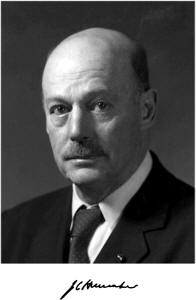
JEROME CLARKE HUNSAKER
August 26, 1886–September 10, 1984
BY JACK L. KERREBROCK
WHEN JEROME C. HUNSAKER died in September 1984 at the age of ninety-eight, his illustrious career had spanned the entire existence of the aerospace industry, from the very beginnings of aeronautics to exploration of the solar system. His colleagues had extended from the Wright Brothers to Charles Stark Draper, and included virtually all of the founders and leaders of aeronautics and astronautics. Beginning with important technical contributions, he soon turned his attention to creating and managing the new institutions needed to deal with the growth of the aeronautics industry. By the early 1930s he was at the pinnacle of the aeronautics industry with leadership roles in academia, government, and industry. In recognition of these achievements, in 1933 he was awarded the prestigious Guggenheim Medal, the fifth such recipient after Orville Wright, Ludwig Prandtl, Fredrick Lanchester, and Juan de la Cuerva. His career continued at this level for nearly three decades.
Even after his retirement in 1951 as head of the Department of Aeronautics at the Massachusetts Institute of Technology, a department he founded in 1939, Hunsaker continued as chairman of the National Advisory Committee for Aeronautics (NACA) until 1956, a position he had held
since 1941. Recognized the world over for his contributions to aeronautics, Hunsaker was also well regarded in the larger society. He was awarded the Julius Adams Stratton Prize for Cultural Achievement in 1969. In 1972 he was installed as honorary president of the American Institute of Aeronautics and Astronautics (AIAA) in commemoration of his installation 40 years earlier as president of the Institute of the Aeronautical Sciences, a parent of the AIAA. He consulted and maintained a regular presence at MIT into his nineties. The career of Jerome C. Hunsaker might be considered the epitome of success in engineering.
Hunsaker was born in Creston, Iowa, on August 26,1886, of parents Walter J. and Alma Clarke Hunsaker. His father was a newspaper publisher. Educated in the public schools of Detroit and Saginaw Michigan, he then enrolled in the U.S. Naval Academy, where he graduated at the head of his class in 1908, the same year Orville Wright successfully demonstrated the Wright Flyer to the army. Some who knew him at the time characterized him as the Einstein of the navy, awed by his brilliance.
Assigned by the navy to MIT to study ship construction, he received his master's degree in naval architecture in 1912. At about that time an aviation meet was held at Squantum, with a Bleriot flight around Boston harbor. Hunsaker did not find the design of naval super-dreadnoughts particularly stimulating, the weight of tradition oppressing him. The Bleriot flight attracted him to the fledgling field of aeronautics, and with his wife, the former Alice Porter Avery, whom he had married in 1911, he spent the summer translating for publication the classic treatise Resistance of the Air and Aviation by Gustave Eiffel. He found several mistakes in this seminal work, and so impressed Eiffel that he was invited to study in Eiffel's laboratories outside Paris. The navy had assigned Hunsaker to the Boston navy yard,
but in 1913 President Richard C. Maclaurin of MIT asked that he be detailed to MIT to develop courses in aerodynamics. He was appointed an instructor in the Department of Naval Architecture. He spent some time in Europe studying aeronautical research. In Germany he attempted to study the Zeppelin but was impeded by military restrictions, so he purchased a ride as a tourist. He met the young Dutch designer Fokker, who was building an experimental monoplane that he later sold to the German army. Moving on to England he spent some time at the National Physical Laboratory at Teddington in Middlesex. Here he studied a new wind tunnel, acquiring information that later enabled him to build a tunnel at MIT.
When he returned to MIT in 1914, Hunsaker set about the construction of this wind tunnel with the assistance of Donald W. Douglas. The wind tunnel was of modest performance, yielding a speed of about 40 miles per hour in a 4-foot-square test section, but it enabled experiments with airplane models for which Hunsaker was awarded MIT 's first doctorate in aeronautical engineering in 1916. His work in aircraft stability was published by the NACA as Technical Report No. 1 of the NACA in 1915. As such it was the first of a long series of research reports of very high quality that extended to the melding of NACA into NASA in 1958. In this same time Hunsaker developed a course of study for the degree of master of science. His first course was entitled “Aeronautics for Naval Constructors.” It formed the foundation for the later development of a course in aeronautical engineering that developed into a Department of Aeronautical Engineering.
In 1916 Hunsaker was called back to head the new Aircraft Division in the navy's Bureau of Construction and Repair, and was soon responsible for the design, construction, and procurement of all naval aircraft. By the end of the
year a thousand flying boats had been built and shipped to France. In 1918 he was charged with two special projects: to build a Zeppelin and to design and build a flying boat with the capability of crossing the Atlantic. More specifically the aircraft was intended to combat submarines, operating from land bases. This required long-range capability, which enabled the aircraft also to complete a flight across the Atlantic, the longest leg being about 1,330 miles. The flying boat became known as the NC (Navy Curtiss). It was the largest aircraft in the world at the time, with four engines and a crew of six. Of the four built, one—the NC-4—completed the Atlantic crossing by way of the Azores in 57 hours. Two others were left in the Azores. This was in May 1919. On June 14-15, 1919, Alcock and Brown completed a 16-hour nonstop flight from Newfoundland to Ireland in a Vickers Vimy bomber. (It seems that, by these examples, Hunsaker laid the groundwork for modern engineering project management.) After the armistice Hunsaker went to Germany to examine Zeppelins. When he returned he set up a team to design a helium-filled dirigible, to be named the Shenandoah. It was the first helium-filled dirigible and operated successfully for two years, breaking up in a violent storm in Ohio in 1925. By this time the Naval Bureau of Aeronautics had been organized. As chief of the Material Division he developed a number of aircraft and methods for launching them from ships. He also worked on radial air-cooled engines, and arresting gear for landing of aircraft on ships. He and Douglas developed a torpedo plane. In this period he argued for and was thus instrumental in the creation of carrier-born aviation. He believed in the need for ship-borne air power to protect ships from attack by aircraft. This brought him into some tension with Col. Billy Mitchell, who forcefully argued that the advent of air power obsoleted warships.
A new phase of his career as an industrial entrepreneur began in 1926 when Hunsaker joined Bell Telephone Laboratories to develop communication services for aircraft. With the support of the Guggenheim Foundation a model airline, Western Air Express, was established in 1927 by Harris M. Hanshue to provide scheduled daily airline service from Los Angeles to San Francisco. The communications systems developed by Hunsaker were necessary to inform the pilots of weather on the route. In the same vein he urged MIT to develop a meteorology program. In 1928 he joined the Goodyear-Zeppelin Company, which had been newly formed to launch a transatlantic airship passenger service. Two 785-foot dirigibles were built for the navy—the Akron and the Macon—each of which could store and launch five small fighter aircraft. They were helium filled and heavily strengthened in light of the experience with the Shenandoah, but they were nevertheless lost in storms. This incidents was a shattering blow to Hunsaker, who had a friend aboard. They also contributed to the growing sentiment that there was little future in lighter-than-air travel.
In 1933 Hunsaker returned to MIT as head of the Department of Mechanical Engineering. In this position he was also responsible for Course 16, Aeronautical Engineering, which was offered in the Department of Mechanical Engineering. He became head of the Department of Aeronautical Engineering when it was established in 1939, but he continued as head of mechanical engineering as well until June 1947, when he requested that he be relieved of the responsibility for the mechanical engineering department to devote his time to the aeronautical engineering department and its expanding programs in supersonic aerodynamics, aero-elasticity, automatic controls, and jet propulsion. During this time he was very active in national aeronautical affairs, replacing Vannevar Bush as chairman
of the NACA in 1941 and continuing in this position through the explosive growth of the NACA during the war years and for some years thereafter, until he was succeeded by James Doolittle.
At MIT Hunsaker was engaged in developing the academic substance of aeronautics. Recalling the pioneering studies at MIT, Hunsaker once said, “In the beginning it was not possible to teach the principles of aeronautical engineering because none of us knew them. The principles had to be discovered, which meant that we had to investigate the difficulties of the past and, having a lot of facts, we had to find out what they meant and how to find the principles.” To bring this about Hunsaker hired an able faculty, one of the first being Charles Stark Draper, who succeeded Hunsaker as head of the department in 1951. The Department of Aeronautical Engineering that Hunsaker founded became the Department of Aeronautics and Astronautics under Draper in 1961 and has continued to lead in education and research in aerospace engineering.
In addition to developing the academic program for the new discipline of aeronautical engineering, Hunsaker played an active role in the development of experimental facilities. For the Wright Brothers Wind Tunnel, dedicated in 1938, he obtained the approval of the MIT Corporation and raised funds from prominent figures in aviation. It was the seventh wind tunnel built at MIT, including Hunsaker's first tunnel built in 1914. It could provide a wind velocity of 400 miles per hour at an altitude of up to 37,000 feet. After the United States entered the war it was used almost continuously. It is still in use today as a student tunnel. Later he played a key role with John Markham in the founding of the Naval Supersonic Laboratory with its large supersonic wind tunnel, used initially for work on the Meteor missile.
During the critical years of the Second World War
Hunsaker served as chairman of the NACA, which played a major role in the explosive military aircraft development driven by the war. At the same time he was also coordinator of naval research and development.
In these positions he involved himself in all matters of technical development and was a party to discussions leading to major policy decisions. He was known to be vigorously opposed to the use of the atom bomb, taking the position that Japan was finished in any case and that Truman, Byrne, and the chiefs of staff had no real understanding of the weapon. There is no doubt that Hunsaker had strong views on the issues of the time. He opposed the development of the jet engine, on the grounds that it could not be brought into useful action before the end of the war. In this, Germany almost proved him wrong. One effect of his position on jet propulsion was that the NACA laboratories, which had been focused on aircraft aerodynamics and structures and piston engines, were far behind the Europeans in the technology of jet propulsion at the end of the war.
During the transition from war to peace Hunsaker served on the Wilson Committee, which made recommendations leading to the establishment of the Research and Development Board of the Department of Defense; the Executive Committee of the Guided Missiles Committee of the Joint Chiefs of Staff; the President's Scientific Research Board; the President 's Special Board of Inquiry on Air Safety; and the Industry Advisory Committee of the Atomic Energy Commission.
After his retirement from the MIT faculty in 1952, Hunsaker continued to be very active, serving as chair of the NACA until 1956. He is credited with the development of the Ames and Lewis (now Glenn) Laboratories of the NACA; the modernization and expansion of the Langley Laboratory; establishment of the Pilotless Aircraft Research Station at Wal-
lops Island, Virginia; and the High-Speed Flight Research Station (now Dryden Research Center) in California. He led the development of the National Aeronautical Research Policy in 1946. In 1954 Hunsaker was honored by the establishment of the Hunsaker professorship in the Department of Aeronautics and Astronautics at MIT. This visiting professorship is offered to persons distinguished in aerospace, who during their term as Hunsaker professor deliver the Minta Martin Lecture. This component of the professorship was endorsed by Glenn L. Martin in honor of his mother. In 1960 he served as a director of McGraw-Hill Publishing, Shell Oil Corp., Goodyear Tire and Rubber, and Sperry Corp., and was a regent of the Smithsonian Institution. On May 26, 1965, he delivered the second annual Sight Lecture at the Wings Club in New York. The first of these lectures had been given by Igor Sikorsky. Hunsaker's lecture is interesting to read for its historical content but also for the humility with which he presents his accomplishments, pointing out that, unlike Sikorsky, he was not an inventor but an organizer of others. In 1969 he was presented by NASA Administrator Thomas O. Paine the award of Honorable Commander of the Civil Division of the Most Excellent Order of the British Empire.
Hunsaker maintained a presence in his office in the Guggenheim Laboratory at MIT for many years, walking there from his home on Beacon Hill, even after he was in his eighties. He often delighted his younger colleagues with his witty commentary. One favorite subject of discussion between him and C. S. Draper at faculty gatherings was the relative importance of aeronautics and astronautics. Hunsaker was never an enthusiast for rockets. On one memorable occasion at the peak of the Apollo Program when Draper reminded him of this, Hunsaker commented, “and I may still be right.” His was a formidable presence to the end.
Hunsaker was married in 1911 to Alice Porter Avery. They had four children: Mrs. Sarah P. Swope, Mrs. Alice H. Bird, Jerome Clarke Hunsaker, and James Peter Hunsaker (who died as a young man).
HONORS AND AWARDS
The awards and honors received by Jerome C. Hunsaker were numerous. Among the more significant were the following.
Member:
National Academy of Sciences
National Academy of Engineering
Fellow:
American Academy of Arts and Sciences
American Physical Society
Honorary Fellow:
Imperial College of Science and Technology
Institute of the Aeronautical Sciences
Royal Aeronautical Society
Honorary Member:
American Society of Mechanical Engineers
Institute of Mechanical Engineers
Honorary Degrees:
|
1943 |
D.Sc., Williams College |
|
946 |
D.Eng., Northeastern University |
|
1955 |
D.Sc., Adelphi College |
Awards:
|
1919 |
Navy Cross |
|
1933 |
Daniel Guggenheim Medal |
|
1942 |
Franklin Medal |
|
1946 |
Presidential Medal for Merit |
|
1949 |
Legion of Honor |
|
1951 |
Wright Trophy |
|
1953 |
Godfrey L. Cabot Trophy |
|
1955 |
Langley Medal Elder Statesman of Aviation, National Aeronautic Association |
|
1957 |
Water-Based Aviation Award of the IAS NACA Distinguished Service Medal Gold Medal of the Royal Aeronautical Society |
|
1958 |
U.S. Navy Award for Distinguished Public Service |
CAREER CHRONOLOGY
|
1909-26 |
Officer, advancing to commander, Construction Corps, U.S. Navy |
|
1912-16 |
Instructor of aeronautical engineering, MIT |
|
1916-23 |
In charge of aircraft design, Navy Department, Washington, D.C. |
|
1923-26 |
Assistant naval attaché, London, Paris, Berlin, Rome, The Hague. |
|
1926-28 |
Assistant vice-president, Bell Telephone Laboratories. |
|
1928-33 |
Vice-president, Goodyear-Zeppelin Corporation |
|
1933-47 |
Professor and head, Department of Mechanical Engineering, MIT |
|
1933-51 |
Professor and head, Department of Aeronautical Engineering, MIT |
|
1938-58 |
Member, National Advisory Committee for Aeronautics (chair. 1941-57) |
|
1951-52 |
Professor of aeronautical engineering, MIT |
|
1952-84 |
Professor of aeronautical engineering, emeritus, MIT |
REFERENCES
Files of the Department of Aeronautics and Astronautics, MIT.New York Times, September 13, 1984.
Pendray, G. E., ed.The Guggenheim Medalists, Architects of the Age of Flight, the Guggenheim Medal Board of Award, 1963.
Bassler, R. E. Jerome Clark Hunsaker, USNA, 1908-Top Man.
SELECTED BIBLIOGRAPHY
1912
With R. T. Hanson.Rudder trials on U.S.S. Starrett.Am. Soc. Naval Archs. & Marine Engrs.
1913
Eiffel-The resistance of the air and aviation.Revised and Translated by J. C. Hunsaker. London:Constable.
1914
The present status of airships in Europe. J. Franklin Inst. Aeroplane design. U.S. Naval Proceedings.
1915
Inherent longitudinal stability for a typical biplane. Washington, D.C.:NACA.
1916
Dynamical stability of aeroplanes. Smithsonian Miscellaneous Collections and J. Natl. Acad. Sci.
Aeronautics.In Mechanical Engineers Handbook, Sect. 10. New York:McGraw-Hill.
Stable biplane arrangements, Engineering, London.
1919
Naval airships. J. Soc. Automot. Eng.
1923
Transportation by air, Aviation, New York.
1924
With Burgess and Truscott.Strength of rigid airships. J. R. Aeronaut. Soc.
1928
Communications as an aid to safe flying.1st National Aeronautical Safety Conference, New York.
1930
Transoceanic air travel. J. Soc. Automot. Eng.
1935
Progress report on cavitation. Trans. ASME 57:423.
1938
With J. R. Markham and H. Peters.The Wright Brothers wind tunnel.MIT.
1941
The development of the airplane. Six Lowell Lectures. Boston.
Dimensional analysis and similitude in mechanics. Von Karman Anniversary Volume. Pasadena, Calif.:Caltech.
1945
The NACA—Its contribution to victory. Army Navy J.
1947
With B. G. Rightmire.Engineering Applications of Fluid Mechanics. New York:McGraw-Hill.
Newton and fluid mechanics. Royal Society Newton Tercentenary.Cambridge University Press.
1951
Aeronautics. J. Franklin Inst. 251(1).
1952
Aeronautics, some social aspects. Aeronaut. Eng. Rev.
Aeronautics at the Mid Century.Yale University Press.
1956
Forty Years of Aeronautical Research.Smithsonian.
1961
With J. H. Doolitte, G. Loening, and J. F. Victory.Significant twelve.Pop. Mech.


