
Necessity of Reexamining the Pathogenicity and Elimination of Parasites in Rats and Mice
Toshiyuki Shibahara
Vice Director and Associate Professor
Laboratory Animal Research Center
Faculty of Medicine, Tottori University
Yonago, Japan
MICROBIOLOGIC CONTAMINATION IN LABORATORY RATS AND MICE
Recently, the Japanese Association of Laboratory Animal Facilities of National Universities (JALAN; Figure 1) addressed the issue of a possible microbiologic contamination problem upon delivery of laboratory rats and mice to national universities and associated institutions. JALAN's Working Biosafety Committee (of which I am a member) has begun an investigation, and results have indicated that the problem is caused by the discrepancy between the sterility monitoring policies of the sender and the recipient. In some institutions, potentially harmful microbes/parasites (e.g., pinworms) are considered insignificant, and laboratory animals that are comtaminated with such microbes/parasites are sent or accepted without being examined. I would like to call attention to this problem and propose countermeasures.
Contamination of laboratory animals introduced both domestically and from abroad and the discrepancy between senders' and recipients ' sterility policies were reported by Dr. Mannen (Oita Medical University, Japan) at the last US/Japan conference (Mannen 1998). Dr. Mannen stated that many members of JALAN encounter subtle differences between the required microbiologic monitoring/inspection items of animals being distributed among national, public, and private colleges, as well as other academic institutions, and that this type of problem also exists with international shipping. Problem cases are increasing particularly with the increase of transported gene-manipulated animals (e.g., transgenic/knockout mice). For this reason, the JALAN Biosafety Committee is
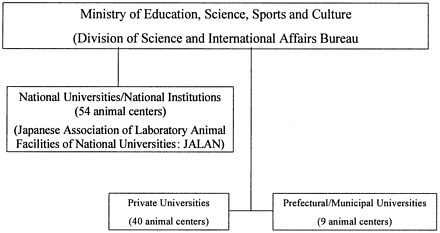
FIGURE 1 Organizational chart of animal centers in Japanese universities. Adapted from Mannen, K. 1998. Definition of microbiologic status of rats and mice: The need for methods of defining flora: International standards for terminology. In: Microbial and Phenotypic Definition of Rats and Mice: Proceedings of the 1998 US/Japan Conference. Washington DC: National Academy Press. p. 24–27.
dedicated to the difficult task of formulating guidelines on the delivery and acceptance of laboratory rats and mice in national universities in an effort to establish uniformity in microbiologic monitoring/inspection items.
The results of inspecting mice facilities at the Central Institute of Experimental Animals of Japan for parasites over 3 years are shown in Table 1. Parasites were detected in 125 of 444 facilities. Some of the parasites are nonpatho-
TABLE 1 Parasitologic Monitoring in Mice Experimental Facilities (1996-1998)
|
Parasites |
Number of Positive Facilities (%) |
|
Octomitus pulcher |
41 (9.2) |
|
Chilomastix spp. |
18 (4.1) |
|
Tritrichomonas spp. |
18 (4.1) |
|
Syphacia obvelata |
14 (3.2) |
|
Entamoeba muris |
10 (2.3) |
|
Pneumocystis carinii |
9 (2.0) |
|
Aspiculuris tetaptera |
7 (1.6) |
|
Spironucleus muris |
3 (0.7) |
|
Unknown protozoa spp. |
5 (1.1) |
genic; however, others (e.g., Aspiculuris and Spironucleus, from both domestic and international sources) are pathogenic.
Members of the Biosafety Committee have been reconsidering the pathogenicity of specific pathogens (Itoh 1998). They currently recommend monitoring for the pathogens listed in Table 2, with optional attention to nonpathogenic protozoa. Although Committee members discussed the possible deletion of nonpathogenic protozoa (e.g., trichomonads) from the list, because they are sometimes found and/or listed in health reports from outside a facility, they ultimately decided to retain the item in the list.
PINWORMS AS POSSIBLE INDICATORS OF BIOLOGICALLY CONTAMINATED ANIMAL FACILITIES
Some Committee members considered the presence of nonpathogenic protozoa to reflect the level of microbiologic control among animal facilities. In the case of pinworms, the ICLAS monitoring center has identified pinworms as category E (i.e., a nonpathogenic parasite and mere indicator). From my experience, I have no doubt that pinworms have caused diseases, have affected their physiologic functions, and have influenced experimental results. Reports of pinworm infection affecting experimental results include that of Wagner (1988), who reported definite growth differences between pinworm-free and pinworm-infected rats. Sato et al. (1995) also reported that antibodies against Syphacia obvelata somatic antigen were detected in experimental infection of pinworms in mice. Thus, it is clear that pinworms affect infected animals ' physiologic functions and thereby influence experimental results. In my opinion, laboratory animal scientists should no longer minimize the influence of parasites. Because the measures taken to combat parasitic contamination in laboratory rats and mice have conspicuously lagged behind those taken against other pathogens (e.g., viruses and bacteria), parasites may currently be found even in animal facilities that appear to be well maintained and without microbiologic problems.
From an international point of view, I highly recommend international unification and harmonization of allowable microbiologic monitoring/inspection items of animals.
NEED FOR ELIMINATION OF PARASITES
In my experience with pinworm infection of laboratory mice, parasites have been entirely eliminated from a colony by mixing anthelmintic with feed and/or spraying the animals or bedding with ivermectin. Although these methods (especially the use of ivermectin) do involve some risk and are therefore not recommended, they are easier and more convenient than the embryo-transplant method. Some researchers complain about the use of anthelmintic; however, they should not overlook the spread of parasite infections like pinworms. I believe these methods are necessary to eradicate pinworms and other parasitic infections from mouse and rat colonies.
TABLE 2 Microbes/Parasites in Mice and Rats for the Subject of Microbiologic Monitoring in University Animal Facilities
|
Mouse Pathogen |
Categorya |
Frequencyb |
Microbiological statusc |
Inspection |
|
Mouse hepatitis virus |
B |
|
Minimum |
Periodically |
|
Sendai virus |
B |
|
Minimum |
Periodically |
|
Ectromelia virus |
B |
Minimum |
Nonperiodically |
|
|
Lymphocytic choriomeningitis virus |
A |
Minimum |
Nonperiodically |
|
|
Mouse rotavirus (EDIMV) |
B/C |
|
Common |
Nonperiodically |
|
Mouse parovirus (MVM/MPV) |
C |
|
Common |
Nonperiodically |
|
Mouse encephalomyelitis virus (TMEV) |
C |
|
Common |
Nonperiodically |
|
Pneumonia virus of mice (PVM) |
C |
|
Common |
Nonperiodically |
|
Mouse adenovirus |
C |
|
Common |
Nonperiodically |
|
Reovirus type 3 |
C |
|
Common |
Nonperiodically |
|
Lactic dehydrogenase elevating virus (LDEV) |
C |
|
Common |
Nonperiodically |
|
Mycoplasma pulmonis |
B |
|
Minimum |
Periodically |
|
Salmonella spp. |
A |
|
Minimum |
Periodically |
|
Clostridium piliforme (Tyzzer's organism) |
C |
|
Minimum |
Periodically |
|
Corynebacterium kutscheri |
C |
|
Minimum |
Periodically |
|
Pasteurella pneumotropica |
C |
|
Common |
Periodically |
|
Cilia-associated respiratory (CAR) bacillus |
C |
|
Common |
Nonperiodically |
|
Escherichia coli O115a, c:K(B) |
B/C |
|
Common |
Nonperiodically |
|
Helicobacter hepaticus |
C |
|
Common |
Nonperiodically |
|
Pseudomonas aeruginosa |
D/E |
|
Excellent |
Peri./nonperi. |
|
Staphylococcus aureus |
D/E |
|
Excellent |
Periodically |
|
Pneumocystis carinii |
D |
|
Excellent |
Nonperiodically |
|
Pathogenic protozoa |
||||
|
Giardia muris |
C |
|
Common |
Periodicallyd |
|
Spironucleus muris |
C |
|
Common |
Periodicallyd |
|
Nonpathogenic protozoa |
||||
|
Trichomonads, etc. |
E |
|
Excellent |
Periodicallyd |
|
Helminths (pinworms) |
C |
|
Common |
Periodicallyd |

|
Rat Pathogen |
Categorya |
Frequencyb |
Microbiological statusc |
Inspection |
|
Sialodacryoadenitis virus (SDAV) |
B |
|
Minimum |
Periodically |
|
Sendai virus (HVJ) |
B |
|
Minimum |
Periodically |
|
Hantavirus |
A |
|
Minimum |
Periodically |
|
Rat parvovirus (KRV/H-1/RPV) |
C |
|
Common |
Nonperiodically |
|
Mouse encephalomyelitis virus (TMEV) |
C |
|
Common |
Nonperiodically |
|
Pneumonia virus of mice (PVM) |
C |
|
Common |
Nonperiodically |
|
Mouse adenovirus |
C |
|
Common |
Nonperiodically |
|
Reovirus type 3 |
C |
|
Common |
Nonperiodically |
|
Mycoplasma pulmonis |
B |
|
Minimum |
Periodically |
|
Salmonella spp. |
A |
|
Minimum |
Periodically |
|
Clostridium piliforme (Tyzzer's organism) |
C |
|
Minimum |
Periodically |
|
Corynebacterium kutscheri |
C |
|
Minimum |
Periodically |
|
Bordetella bronchiseptica |
C |
|
Minimum |
Periodically |
|
Pasteurella pneumotropica |
C |
|
Common |
Periodically |
|
Streptococcus pneumoniae |
C |
|
Common |
Nonperiodically |
|
Cilia-associated respiratory (CAR) bacillus |
C |
|
Common |
Nonperiodically |
|
Pseudomonas aeruginosa |
D/E |
|
Excellent |
Peri./nonperi. |
|
Staphylococcus aureus |
D/E |
|
Excellent |
Nonperiodically |
|
Pneumocystis carinii |
D |
|
Excellent |
Nonperiodically |
|
Pathogenic protozoa |
||||
|
Giardia muris |
C |
|
Common |
Periodicallyd |
|
Spironucleus muris |
C |
|
Common |
Periodicallyd |
|
Nonpathogenic protozoa |
||||
|
Trichomonads, etc. |
E |
|
Excellent |
Periodicallyd |
|
Helminths (pinworms) |
C |
|
Common |
Periodicallyd |
|
aCriteria used for selection of test items in the ICLAS monitoring center. bFrequency of occurrence during the past two decades in Japan. cMinimum: These pathogens should be negative. Common: It is desirable that these pathogens are negative. Excellent: It is desirable that these pathogens are negative in immuno-insufficient/deficient mice. dInspection methods to be recommended are to examine small/large intestine contents. (Modified in part from Mannen, 1998) |
||||
CONCLUSION AND RECOMMENDATIONS
-
Measures to counteract parasitic contamination in experimental animals, especially rats and mice, lag conspicuously behind those that counteract other pathogens.
-
Parasites often serve as indicators of the level of microbiologic control among animal facilities. However, because some parasites may affect experimental data, their existence and species name should be clearly indicated in the health monitoring reports.
-
The pathogenecity of parasites should be reexamined, even if they are considered nonpathogenic to the animals. An international scheme for unification/harmonization of test results and allowable conditions should be devised.
-
Parasites should be eliminated as much as possible. The methods recommended are as follows:
-
mixing anthelminthic with feed;
-
spraying animals/bedding with anthelminthic; and/or
-
cleaning the colony using a method such as embryo transplant.
-
REFERENCES
Itoh, T. 1998. Quality testing system for SPF animals in Japan and problems in the management of such systems. In: Microbial and Phenotypic Definition of Rats and Mice: Proceedings of the1998 US/Japan Conference. Washington, DC: National Academy Press. p. 15-23.
Mannen, K. 1998. Definition of microbiologic status of rats and mice: The need for methods of defining flora: International standards for terminology . In: Microbial and Phenotypic Definition of Rats and Mice: Proceedings of the 1998 US/Japan Conference. Washington DC: National Academy Press. p. 24-27.
Sato, Y., H.K. Ooi, N. Nonaka, Y. Oku, and M. Kamiya. 1995. Antibody production in Syphacia obvelata in infected mice. J. Parasitol. 81:559-562.
Wagner, M. 1988. The effect of infection with the pin worm (Syphacia muris) on rat growth. Lab. Anim. Sci. 38:476-478.


