National Academy of Sciences | 150 Year Anniversary

Questions? Call 800-624-6242

| Items in cart [0]

The National Academies Press

Read this book online, free! Click here to proceed to linked table of contents

Levees and the National Flood Insurance Program:

Improving Policies and Practices

Book Cover

Status: Prepublication Available

Size: 332 pages, 8 1/2 x 11

Publication Year:2013

E-mail this page
 
Prepublication PDFs
Prepublication - What is it?
 
Pre-order List Price Your Price  
Order online and save 10%
PAPERBACK
ISBN-10: 0-309-28290-X
ISBN-13: 978-0-309-28290-1
$61.00 $54.90 Pre-Order
What happens when I pre-order?

Important Notice:

Gerald E. Galloway, chair of the report-authoring committee will present the report's findings and, along with other committee members answer questions from the public during a free webinar on March 26, 2013 at 1 PM EST. Register for the webinar here: https://nasevents.webex.com/nasevents/onstage/g.php?t=a&d=667084346.

Expert report page http://dels.nas.edu/Report/Levees-National-Flood-Insurance/18309

To view the complete website on Levees and the National Flood Insurance Program, visit http://nas-sites.org/levees/.

Authors:
Committee on Levees and the National Flood Insurance Program Improving Policies and Practices; Water Science and Technology Board; Division on Earth and Life Studies; National Research Council
Authoring Organizations

Description:

The Federal Emergency Management Agency's (FEMA) Federal Insurance and Mitigation Administration (FIMA) manages the National Flood Insurance Program (NFIP), which is a cornerstone in the U.S. strategy to assist communities to prepare for, mitigate against, and recover from flood disasters. ...
Read More


Paste into your Web page:

Preview
Free Resources
Read

Full Text
Jump to this book's table of contents to begin reading online for free.

Research Tools
Download Free

Report In Brief
Download report in brief in PDF.

Rights & Permissions

Reprint Permission
Request permission to license or reprint the book's content through Copyright Clearance Center's Rightslink.

Request Permission to Distribute a PDF

Request Translation Rights

Questions About Rights and Permissions?

Table of Contents
Select a link below to start reading online free!
Front Matter i-xviii  
Summary 1-11 (skim)
1 Introduction 12-23 (skim)
2 Treatment of Levees within the National Flood Insurance Program 24-38 (skim)
3 Moving to Flood Risk Management and a Modern Flood Risk Analysis 39-73 (skim)
Chapter 4 The Levee Analysis and Mapping Procedure 74-81 (skim)
Chapter 5 Insuring Properties Behind Levees 82-124 (skim)
6 Implementing Flood Risk Management Strategies 125-162 (skim)
Chapter 7 Understanding and Communicating Flood Risk behind Levees 163-186 (skim)
Chapter 8 Shared Responsibility in Moving to Flood Risk Management 187-198 (skim)
Appendix A--Code of Federal Regulations Title 44: Emergency Management and Assistance, Section 65.10 Mapping of areas protect by levee systems or "44 CFR 65.10" 199-202 (skim)
Appendix B--Biographical Information, Committee on Levees and the National Flood Insurance Program: Improving Policies and Practices 203-207 (skim)
Appendix C--Glossary of Terms 208-214 (skim)
Appendix D--Contributors to the Report, Levees and the National Flood Insurance Program: Improving Policies and Practices 215-217 (skim)
Appendix E--Flood Zone Designations 218-221 (skim)
Appendix F--Levee-Related Observations, Conclusions, and Recommendations from Previous Reports 222-245 (skim)
Appendix G--FEMA Procedure Memorandums 34, 43, and 53 246-281 (skim)
Appendix H--USACE System-Wide Improvement Frameworks Program 282-292 (skim)
Appendix I--Risk Analysis Background 293-314 (skim)

Description

The Federal Emergency Management Agency's (FEMA) Federal Insurance and Mitigation Administration (FIMA) manages the National Flood Insurance Program (NFIP), which is a cornerstone in the U.S. strategy to assist communities to prepare for, mitigate against, and recover from flood disasters. The NFIP was established by Congress with passage of the National Flood Insurance Act in 1968, to help reduce future flood damages through NFIP community floodplain regulation that would control development in flood hazard areas, provide insurance for a premium to property owners, and reduce federal expenditures for disaster assistance. The flood insurance is available only to owners of insurable property located in communities that participate in the NFIP. Currently, the program has 5,555,915 million policies in 21,881 communities3 across the United States.

The NFIP defines the one percent annual chance flood (100-year or base flood) floodplain as a Special Flood Hazard Area (SFHA). The SFHA is delineated on FEMA's Flood Insurance Rate Maps (FIRM's) using topographic, meteorologic, hydrologic, and hydraulic information. Property owners with a federally back mortgage within the SFHAs are required to purchase and retain flood insurance, called the mandatory flood insurance purchase requirement (MPR). Levees and floodwalls, hereafter referred to as levees, have been part of flood management in the United States since the late 1700's because they are relatively easy to build and a reasonable infrastructure investment. A levee is a man-made structure, usually an earthen embankment, designed and constructed in accordance with sound engineering practices to contain, control, or divert the flow of water so as to provide protection from temporary flooding. A levee system is a flood protection system which consists of a levee, or levees, and associated structures, such as closure and drainage devices, which are constructed and operated in accordance with sound engineering practices.

Recognizing the need for improving the NFIP's treatment of levees, FEMA officials approached the National Research Council's (NRC) Water Science and Technology Board (WSTB) and requested this study. The NRC responded by forming the ad hoc Committee on Levee and the National Flood Insurance Program: Improving Policies and Practices, charged to examine current FEMA treatment of levees within the NFIP and provide advice on how those levee-elated policies and activities could be improved. The study addressed four broad areas, risk analysis, flood insurance, risk reduction, and risk communication, regarding how levees are considered in the NFIP. Specific issues within these areas include current risk analysis and mapping procedures behind accredited and non-accredited levees, flood insurance pricing and the mandatory flood insurance purchase requirement, mitigation options to reduce risk for communities with levees, flood risk communication efforts, and the concept of shared responsibility. The principal conclusions and recommendations are highlighted in this report.

About the Status of this Book

Prepublication - What is it?

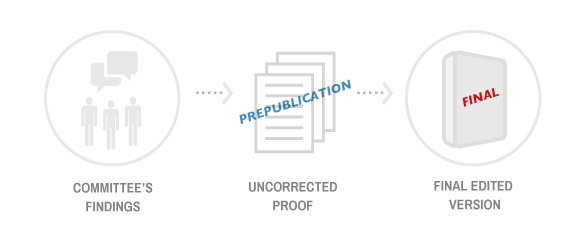
An uncorrected copy, or prepublication, is an uncorrected proof of the book. We publish prepublications to facilitate timely access to the committee's findings. You can purchase the uncorrected copy now, or pre-order the final version of the book.

Prepublication sales are final. Due to the nature of this type of publication, it is not returnable.

What happens when I pre-order?

The final version of this book has not been published yet. You can pre-order a copy of the book and we will send it to you when it becomes available. We will not charge you for the book until it ships.

Pricing for a pre-ordered book is estimated and subject to change. All backorders will be released at the final established price. As a courtesy, if the price increases by more than $3.00 we will notify you. If the price decreases, we will simply charge the lower price. Applicable discounts will be extended.

Search This Book

»Find more like this book

SIGN UP FOR...

New Title Emails
Read about the newest releases and receive special offers.