| ||||||||||||||||||||||||||||||
|
||||||||||||||||||||||||||||||
| Copyright © 2010. National Academy of Sciences. All rights reserved. Terms of Use and Privacy Statement |
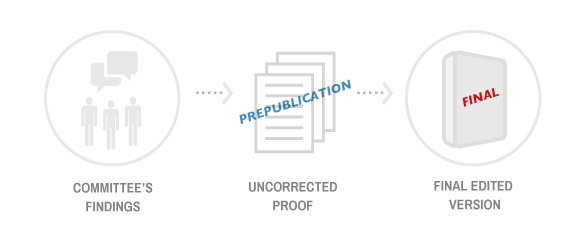
Below are the first 10 and last 10 pages of uncorrected machine-read text (when available) of this chapter, followed by the top 30 algorithmically extracted key phrases from the chapter as a whole.
Intended to provide our own search engines and external engines with highly rich, chapter-representative searchable text on the opening pages of each chapter.
Because it is UNCORRECTED material, please consider the following text as a useful but insufficient proxy for the authoritative book pages.
Do not use for reproduction, copying, pasting, or reading; exclusively for search engines.
OCR for page R1
3
1
{l
T' - 71
,`1
by Steve Olson
Board on Biology
Commission on Life Sciences
National Research Council
NATIONAL ACADEMY PRESS
Washington, D.C. 1989
OCR for page R2
NATIONAL ACADEMY PRESS ~ 2101 Constitution Avenue, NW ~ Washington, DC 20418
This book is based on a symposium sponsored by the National Academy of Sciences. It has been
reviewed according to procedures approved by a Report Review Committee consisting of members of the
National Academy of Sciences, the National Academy of Engineering, and the Institute of Medicine.
The National Academy of Sciences is a private, self-perpetuating society of distinguished scholars in
scientific and engineering research, dedicated to the furtherance of science and technology and their use
for the general welfare. Under the authority of its congressional charter of 1863, the Academy has a
working mandate that calls upon it to advise the federal government on scientific and technical matters.
Dr. Frank Press is President of the National Academy of Sciences.
The National Research Council was established by the National Academy of Sciences in 1916 to
associate the broad community of science and technology with the Academy's purposes of furthering
knowledge and of advising the federal government. The Council operates in accordance with general
policies determined by the Academy under the authority of its congressional charter of 1863. The Council
has become the principal operating agency of both the National Academy of Sciences and the National
Academy of Engineering in the conduct of their services to the government, the public, and the scientific
and engineering communities. It is administered jointly by both Academies and the Institute of Medicine.
Funding for the symposium and for the production of this book was provided by the National Research
Council Fund, a pool of private, discretionary, nonfederal funds that is used to support a program of
Academy-initiated studies of national issues in which science and technology figure significantly. The
NRC Fund consists of contributions from a consortium of private foundations including the Carnegie
Corporation of New York, the Charles E. Culpeper Foundation, the William and Flora Hewlett Foundation,
the John D. and Catherine T. MacArthur Foundation, the Andrew W. Mellon Foundation, the Rockefeller
Foundation, and the Alfred P. Sloan Foundation; the Academy Industry Program, which seeks annual
contributions from companies that are concerned with the health of U.S. science and technology and with
public policy issues with technological content; and the National Academy of Sciences and the National
Academy of Engineering endowments.
The views in this book are those of the speakers at the symposium and the author and do not necessarily
reflect the views of the National Academy of Sciences or the National Research Council.
Library of Congress Cataloging-in-Publication Data
Olson, Steve, 1956
Shaping the future: biology and human values / by
Steve Olson for the Board on Biology.
p. cm.
Includes index.
ISBN 0-309-03947-9. ISBN 0-309-03944-4 (pbk.)
1. Biology. 2. Biology Moral and ethical aspects. I. National
Research Council (U.S.). Board on Biology. II. Title.
QH311.044 1989
574-dc20
Copyright (if) 1989 by the National Academy of Sciences
89-12565
CIP
No part of this book may be reproduced by any mechanical, photographic, or electronic process, or
in the form of a phonographic recording, nor may it be stored in a retrieval system, transmitted, or otherwise
copied for public or private use, without written permission from the publisher, except for the purposes
of official use by the United States Government.
Printed in the United States of America
OCR for page R3
F1
oreworci
In studying the philosophers Benedict Spinoza and
Emmanuel Kant, we have come to realize the extent to which their
investigations of metaphysics were a prelude to their ethics. For both
of these men it was necessary to know what the world of nature was
C`really" like before asking what the world of human relations should
be.
But Spinoza on the early side and Kant on the late bracketed the
Newtonian revolution. Since that time it has been impossible to form
a view of what the world is like without including physics along with
epistemological and ontological ideas. With the publication of Darwin's
Origin of Species, biology was joined to those ~lisciplines that constitute
the is that precedes the ought to. At first, Social Darwinism became
an explanatory theory of ethics, then an epithet, and now it returns to
the arena of discourse in other forms.
We are now about a century and a half past the Darwinian revolution,
and ecology, ethology, and molecular biology have become parts of that
now vast domain that must be understood as part of our attempts to
lead a good life and fulfill our duties to others. The query 'CWhat is
life?" is very much a part of asking, C`How should it be lived?"
in light of the preceding, it seems altogether fitting that one of the
events marking the opening of the Arnold and Mabel Beckman Center
of the National Academies of Sciences and Engineering should be a
symposium on biological research and human values. Such an event
provides a chance to ask what we are and then turn to the vital question
of who we are. The first query is a part of science proper; the second
...
111
OCR for page R4
interfaces with ethics. Ant] just as science constantly changes with new
developments, we come to the startling discovery that ethics are not
rigid but must also alter in response to our changing un(lerstanding of
the world and the new technological milieu exterieur that we continually
create. The vast social and environmental consequences of scientific
discovery change the intellectual setting within which the discourse
takes place.
Thus, the ethical aspects of our inquiry are twofold: we still have the
traditional problem of understanding the woric! and using that under-
standing to determine how we should act. We also have a seconc]
obligation imposed because our scientific understanding of the worIc!
leads, through technology, to profound alterations of that world. As we
have been instructed by allegory for a long, long time, tasting of the
fruit of the tree of knowlecige is not necessarily an ethically neutral act.
Biologists have two tasks in regard to human values. The first is to
help in the constant exploration of how ethics must respond to new
views of the biological world that emerge from laboratories and field
researches. The second is ethically to monitor the effects of science
and technology on our present activities and the future of human society.
This book has many things to say about both issues. Few questions can
be fully answered, but it is important that they are confronted. Scientists
are now willing to talk self-consciously about ethics. That in itself is
an important development.
The present state of the planet and the rapidity of developments lenc!
a certain urgency to scientists' concerns with ethics. Thus, this book
on biology and human values comes at a propitious time. One is re-
mincled of the words of a much earlier ethicist, Rabbi Hillel: "If not
now, when?"
Harold Morowitz
George Mason University
iv FOREWORD
OCR for page R5
Preface
In 1988 the National Academies of Sciences and
Engineering opened a new facility in Irvine, California-the Arnold
and Mabel Beckman Center to serve as a west coast conference center
for their members and study groups ant] for those of their associated
organizations, the institute of Medicine and the National Research
Council. To commemorate the opening, a series of symposia were held
on critical scientific and technical issues facing modern society. One
considered the technologies and public policies affecting future sources
of energy. Another looked at the state of mathematical literacy in the
United States. And a third, on biological research ant] human values,
furnished the basis for this book.
As often happens within the National Academy of Sciences complex,
the theme for the symposium derived in part from an earlier project.
In 1985 the Committee on Research Opportunities in Biology, a unit
of the Board on Biology under the National Research Council's Com-
mission on Life Sciences, undertook the gargantuan task of surveying
all of biology, from molecular genetics to ecology. Under its chairman
Peter Raven, the committee sought to present the state of the art in
biology, focusing on the technical and conceptual developments that
have so greatly increased the pace of biological research. At the same
time, the committee pointed out even if it could not always discuss
in detail-the many links between scientific issues and ethical issues
in biology. Advances in biological understanding have a direct impact
on the diagnosis and treatment of disease, theories of human thought
and behavior, and ideas about humanity's history and future. So in
v
OCR for page R6
selecting a topic from the life sciences for the Beckman Center sym-
posium, the intersection between biological research ant] human values
was an obvious choice.
The Board on Biology, under its chairman Francisco Ayala ant! cli-
rector John Burris, set up an ad hoc committee to begin planning the
symposium. Consisting of Francisco Ayala, John Dowling, Harold
Horowitz, Michael Ruse, and Malcolm Steinberg, the committee sketched
out the program for the symposium and began contacting potential
speakers. Meanwhile, the Boarc! approached the National Research
Council for funds to convert the basic materials presented at the sym-
posium into a book. In this, the Boarc] was extending an effort that the
Academy complex has macle in recent years to disseminate its work to
a broac! audience by publishing a series of books written for nonscien-
t~sts.
The symposium brought together many of the leading hio]~io.~1 re
~L ~_ _ 1 ¢1 · · . · AT .1 ~-
~ _ C~ ~
err ana e~n~c~s~s In moron Americas both as presenters and at-
tendees. As the list of speakers shows, four broad areas were covered
during the two days of presentations: genetics, development, neuro-
biology and behavior, ant! evolution and diversity. in general, the first
two speakers in each session acIdresse`d the more technical aspects of
biological knowledge, while the final speaker addressed ethical issues
relating to that knowlecige.
Genetics and Humankind
Paul Berg, Stanford University
Leroy Hood, California Institute of Technology
Maxine Singer, Carnegie Institution of Washington
Development and Health
Marc Kirschner, University of California, San Francisco
Barry Pierce, University of Colorado
Arthur Caplan, University of Minnesota
Neurobiology and Behavior
Vernon Mountcastle, Johns Hopkins University
Fernando Nottebohm, Rockefeller University
Michael Ruse, University of Guelph
Evolution and Diversity
William Schopf, University of California, Los Angeles
Francisco Ayala, University of California, Irvine
Edward Wilson, Harvard University
vi PREFACE
OCR for page R7
Each of the final three sessions concluded with a pane! cliscussion-
moderatecl by Malcolm Steinberg' John Dowling, ant! Harold Morowitz'
respectively-in which speakers took questions and elaborated on their
presentations. Alan Walker of Johns Hopkins University contributed a
lively after-dinner speech on human evolution. Peter Raven concluded
the symposium by summing up the remarks of the speakers ant! placing
them in a global context.
This book was written using a variety of materials' inclucling the
transcripts of the symposium, the publisher! books and articles of the
speakers, and additional interviews with the speakers. Though it takes
its overall form from the symposium' it departs from it in several ways.
In particular' it includes enough background information to be read by
relative newcomers to biology. As such' it seeks to present some of the
leading ideas of biological research and ethical thought in a cIear'
nontechnical fashion.
All of the speakers at the symposium gave generously of their time,
both before the symposium and after. Within the Commission on Life
Sciences' Frances Walton ant! Kathy Marshall provided the adminis-
trative help essential to organizing and holding the symposium. Several
people at the National Academy Press worked hare] to see the book into
print. Michael Edington edited the manuscript and shepherclec3 it through
the production process. Dawn EichenIaub and Francesca Moghari de-
signed the book and its cover.
Two people deserve special mention. John Burris' director of the
Board on Biology and executive director of the Commission on Life
Sciences' was the guiding light behinc] the project from beginning to
encI. Without his boundless energy anc] good judgment' this book would
never have been possible. Finally, Betsy Turvene, executive editor of
the National Academy Press7 offered the author invaluable encourage-
ment and advice throughout the writing and publication of this book,
as she has on many previous occasions.
Steve Olson
Washington, D.C.
PREFACE vii
OCR for page R8
T0 Arnold and Mabel Beckman for their
vision in establishing the Beckman Center
and for their interest in the ethical issues
affecting science, technology' and medicine.
OCR for page R9
Contents
Tntrocluction
Genetics and the Human Genome
Essay: Science and Scientists from
the Public~s Perspective
1
r
28
2 Biological Development ant! Cancer 33
Essay: Ethical Considerations in the
Use of Human Materials
3 Neuroscience and Neuronal
Replacement
Essay: The Evolution of Ethics
4 Evolution and the Biosphere
Essay: Preserving Biological Diversity
Afterword
Index
47
53
75
81
100
107
111
IX
OCR for page R10