
Improving Climate Assessment
ROBERT W. CORELL
How do we as a nation, particularly the engineering and technology communities, address the opportunities and challenges posed by changes in climate? Global climate change affects every sector of our economy and society, from the quality and availability of food and water to human health, coastal and ocean processes, forests, ecosystems, and energy demand and supply. In the last decade, a methodology has been designed to provide decision makers in the public and private arenas with an independent, multiscale assessment of the state of scientific knowledge. The policy community has always sought scientific advice and counsel through consultations with small, often informal groups of experts. The new “assessment model” provides a more structured approach that connects new discoveries and predictive capabilities with decision-making processes. This assessment process was designed to provide a consensus of the scientific and technical community of the problem and to estimate the consequences.
However, this assessment strategy has some weaknesses because it does not account for the hidden factors that, combined with climate change, produce an effect. These hidden factors include land use and land cover, shifts in population and demographics, socioeconomic trends, energy policies and practices, and available resources. Despite these weaknesses, however, this methodology has served us well. Recent reports by the International Panel on Climate Change (Watson et al., 1996), a companion assessment of climate change in the United States by the National Assessment Synthesis Team (NAST, 2001), and the International Assessment of Ozone Depleting Compounds by the World Meteorological Organization (1994) were all based on this model.
An alternative model, the so-called “vulnerability model,” accounts directly for all of the factors contributing to an effect. The vulnerability model is based on a simple framework that integrates impacts with mitigation and adaptation strategies (Figure 1). We intuitively understand the concept of vulnerability. For example, if a health threat, such as a new infectious disease arises, the public health community rapidly provides drugs or therapies to address the threat. The smaller the difference between the impact (the potential for a disease) and the adaptation strategy (the effectiveness of the drug) the smaller the vulnerability to this health threat. Occasionally, a virulent, highly contagious disease like the Ebola virus arises. This virus acts so quickly that there is virtually nothing we can do to adapt. Hence, in this case, our vulnerability is very great.
In responding to climate change, the engineering and technological community can both mitigate the effects and adapt our capabilities. Mitigation strategies can reduce the impacts, thereby reducing vulnerabilities; vulnerabilities can be reduced further by improving our adaptative capacities. We need a new “calculus,” an improved vulnerability model that connects these three elements (the climate change, mitigation strategies, and adaptations), both conceptually and analytically, that would enable us to address our vulnerabilities more holistically.
The vulnerability approach is based on an understanding that accelerating rates of change in the Earth’s climate, air and water quality, and humankind’s use of land, natural resources, and ecosystems affect the well-being of societies and
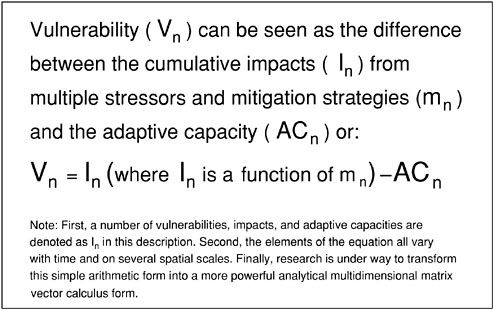
FIGURE 1 The vulnerability model.
the overall quality of life on our planet. Addressing this complex reality will require better models and methodologies. Many governments, businesses and industries, communities, and individuals are looking for ways to understand the ultimate consequences of these changes and develop strategies for coping with them. As we become more aware of the complexity of these changes, our need for a better assessment methodology increases. As vulnerability analysis evolves, other factors, such as social inequities, poor health, inadequate environmental services, and lack of access to state services, infrastructure, and other essential resources, that contribute to the effects of climate change are being identified and integrated.
This conceptual framework has been improved by the development of powerful quantitative methods and mathematical models that have enabled the scientific and engineering community to analyze how causes and impacts overlap, cluster, aggregate, and interact. Qualitative variables that complement the quantitative elements and methodologies are central to the model. Vulnerability analyses can also take into account the interests of individuals, groups, sectors, and nations, as well as the systems in which they are embedded, to determine the vulnerability of a specific community or environmental system to multiple social stresses, environmental stresses, and climate changes.
The report by the National Assessment Synthesis Team included 10 key findings suggesting opportunities and challenges for the engineering and technological communities (NAST, 2000).
-
Increased Warming. Assuming continued growth in world greenhouse gas emissions, the primary climate models used in this Assessment project are that temperatures in the U.S. will rise 5° to 9°F (3° to 5°C) on average in the next 100 years. A wider range of outcomes is possible.
-
Differing Regional Impacts. Climate change will vary widely across the United States. Temperature increases will vary somewhat from one region to the next. Heavy and extreme precipitation events are likely to become more frequent, yet some regions will get drier. The potential impacts of climate change will also vary widely across the nation.
-
Vulnerable Ecosystems. Many ecosystems are highly vulnerable to the projected rate and magnitude of climate change. A few, such as alpine meadows in the Rocky Mountains and some barrier islands, are likely to disappear entirely in some areas. Others, such as forests of the Southeast, are likely to experience major species shifts or break up into a mosaic of grasslands, woodlands, and forests. The goods and services lost through the disappearance or fragmentation of certain ecosystems are likely to be costly or impossible to replace.
-
Widespread Water Concerns. Water is an issue in every region, but the nature of the vulnerabilities varies. Drought is an important concern in
-
every region. Floods and water quality are concerns in many regions. Snowpack changes are especially important in the West, Pacific Northwest, and Alaska.
-
Secure Food Supply. At the national level, the agriculture sector is likely to be able to adapt to climate change. Overall, U.S. crop productivity is very likely to increase over the next few decades, but the gains will not be uniform across the nation. Falling prices and competitive pressures are very likely to stress some farmers, while benefiting consumers.
-
Near-Term Increase in Forest Growth. Forest productivity is likely to increase over the next several decades in some areas as trees respond to higher carbon dioxide levels. Over the longer term, changes in larger-scale processes such as fire, insects, droughts, and disease will possibly decrease forest productivity. In addition, climate change is likely to cause long-term shifts in forest species, such as sugar maples moving north out of the United States.
-
Increased Damage in Coastal and Permafrost Areas. Climate change and the resulting rise in sea level are likely to exacerbate threats to buildings, roads, power lines, and other infrastructure in climatically sensitive places. For example, infrastructure damage is related to permafrost melting in Alaska, and to sea-level rise and storm surge in low-lying coastal areas.
-
Adaptation Determines Health Outcomes. A range of negative health impacts is possible from climate change, but adaptation is likely to help protect much of the U.S. population. Maintaining our nation’s public health and community infrastructure, from water treatment systems to emergency shelters, will be important for minimizing the impacts of water-borne diseases, heat stress, air pollution, extreme weather events, and diseases transmitted by insects, ticks, and rodents.
-
Other Stresses Magnified by Climate Change. Climate change will very likely magnify the cumulative impacts of other stresses, such as air and water pollution and habitat destruction due to human development patterns. For some systems, such as coral reefs, the combined effects of climate change, and other stresses are very likely to exceed a critical threshold, bringing large, possibly irreversible impacts.
-
Uncertainties Remain and Surprises Are Expected. Significant uncertainties remain in the science underlying regional climate changes and their impacts. Further research would improve understanding and our ability to project societal and ecosystem impacts, and provide the public with additional useful information about options for adaptation. However, it is likely that some aspects and impacts of climate change will be totally unanticipated as complex systems respond to ongoing climate change in unforeseeable ways.
In some geographical areas, such as coastal regions, the report concluded that engineering strategies could help communities adapt to the multiple effects of climate change in coming decades. The report also concluded that the adaptive capacity of agricultural systems could be increased through biotechnology, which could provide drought-resistant seeds, and through adaptive planting strategies. For rare ecosystems, such as coral reefs, which have very little capacity to adapt, mitigation strategies are a more likely way to reduce vulnerabilities. A number of these ecosystems are expected to migrate northward as temperatures rise and precipitation increases.
The fundamental purpose of all of these analyses is to improve our understanding of how the climate system works. Over a period of decades the science and technology community has made substantial progress in modeling the climate system and projecting changes. With the advent of Earth systems engineering and improved vulnerability models, the engineering and technology communities can contribute to solutions. With continued improvements in Earth systems engineering, we should be able to adapt to and mitigate climate changes in the coming decades.
REFERENCES
NAST (National Assessment Synthesis Team). 2000. Climate Change Impacts on the United States: An Overview. Cambridge, U.K.: Cambridge University Press.
Watson, R.T., M.C. Zinyowera, and R.H. Moss, eds. 1996. Climate Change 1995: Impacts, Adaptations, and Mitigation of Climate Change. Cambridge, U.K.: Cambridge University Press.
World Meteorological Organization. 1994. Scientific Assessment of Stratospheric Ozone, 1994. Report No. 37. Geneva, Switzerland: World Meteorological Organization.


