
5
Climate-Change-Related Technical Issues Impacting U.S. Naval Operations
The technological infrastructure that supports naval operations is sophisticated, widely available, and reliable throughout the temperate and tropical oceans. It is, therefore, often taken for granted. However, the effects of climate change mandate that naval forces operate in areas that present challenges for the existing support systems and technologies. In particular, there is a high likelihood that a warming climate will increase the operational tempo in polar regions; consequently, the demands on navigation systems, communication systems, and nautical charts in polar regions will intensify. The initial increase in tempo will be driven by scientific and exploratory missions, especially so in the Arctic. As the degree of precision required by military combat operations can be more extreme than that required by peacetime operations, if tensions in the Arctic increase, the technical challenges will be multiplied. This chapter begins with an overview of naval navigation systems infrastructure and the resulting related climate change technical issues. The chapter then discusses communication systems performance in polar regions, followed by an examination of current nautical products and systems; also discussed is the critical role of ice characterization in operational safety in Arctic navigation. The chapter concludes by discussing climate-change-related antisubmarine warfare (ASW) impacts. The special challenges of submarine operations and ASW are of particular interest in the Arctic setting and are discussed separately.
CURRENT STATE OF NAVIGATION SYSTEMS INFRASTRUCTURE WITH RESPECT TO ARCTIC NAVIGATION
Navigation in the polar regions is challenging not only due to sea-ice and adverse weather conditions but also due to limitations of current navigation systems and infrastructure at high latitudes, which are degraded relative to performance in other regions of the world. This performance degradation affects surface, subsurface, and aircraft operations to varying degrees. Its significance to mission execution depends upon each mission’s requirements for safe navigation in restricted water/airspace, precision localization and mapping, and the underlying accuracy of reference navigation charts.
Specifically, Global Positioning System (GPS) performance is degraded due to poor satellite geometry, larger ionospheric effects, and multipath interference. Similarly, the radio-navigation infrastructure that provides GPS corrections and/or position reference does not routinely extend to the polar regions. Magnetic heading becomes unstable and inertial navigation systems (INSs) suffer poor alignment above 70º north latitude due to the reduced effect of Earth’s rotation. To prepare for expanded operations in the Arctic, the Navy should assess current military navigation system performance in polar regions and how it might inhibit operations. In addition, the Navy should seek to enhance the navigation infrastructure as necessary to prevent such limitations. Precision navigation is particularly crucial for combat military operations (precise tracking and targeting) and certain search and rescue operations.
GPS Performance Issues
Global Positioning System satellite orbit inclinations are at 55º to optimize performance in temperate and tropical regions of high activity. This results in low satellite elevation angles in polar areas, with approximately 45º being the highest satellite elevation angle possible at the poles. Data for satellites at low-elevation angles are more susceptible to ionospheric refraction and provide especially poor geometry for determination of a vertical position. The overall effect is minor for surface platform navigation, but it may be problematic for precision surveying and certain aircraft operations.
GPS coverage for surface navigation is only slightly degraded in the high latitudes (50 ft. horizontal precision has been demonstrated at the North Pole), but this accuracy is adequate for the navigational purposes of surface ships, aircraft, and submarines rising to the surface to obtain a navigation fix for undersea navigation systems. On the other hand, the degradation in vertical dilution of precision (VDOP) is much more significant and can result in altitude errors of up to 150 to 250 feet, which in turn could affect some Navy operations or system performance. Due to low-elevation angles, some attention to ensure clear lines of sight for the GPS antenna orientation is warranted for optimum performance.
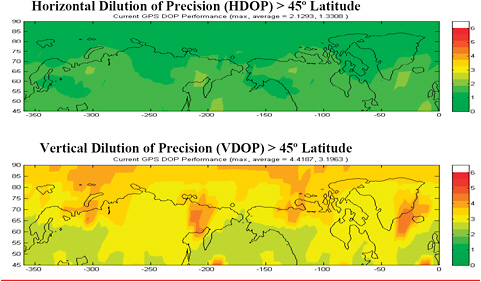
FIGURE 5.1 Horizontal and vertical dilution of precision above 45° latitude. Dilution-of-precision values of 1 to 2 are ideal. Values of 2 to 5 represent the minimum required for reliable navigation. Values above 5 represent low fix quality and may not be acceptable for certain military operations. SOURCE: Courtesy of The Boeing Company, Seal Beach, Calif.
Similarly, depending upon the placement of the antenna on a projectile versus the position of the GPS satellites on the horizon, guided munitions performance could also be adversely affected. Increased VDOP can also affect targeting when inaccurate height of target can transpose into horizontal error, depending upon the trajectory of the weapon. Figure 5.1 shows both horizontal dilution of precision (HDOP) and VDOP above 45° north latitude.1
Ionospheric Effects
Errors introduced by ionospheric delays are more pronounced in higher latitudes because of the reliance on low-elevation satellites. The ionosphere can affect GPS receivers by degrading the signal strength, in some cases causing code delay, phase advance, and loss of carrier lock. Additionally, irregularities in electron density, known as scintillation effects, can lead to significant phase and amplitude fluctuations in GPS signals as they pass through the ionosphere.
|
1 |
For a more detailed discussion of GPS performance issues, see Dennis Milbert, 2009, “Improving Dilution of Precision,” GPS World, November 1. Available at http://www.gpsworld.com/gnss-system/algorithms-methods/innovation-improving-dilution-precision-9100?page_id=3. Accessed August 2, 2010. |
Military GPS receivers are dual frequency and can compensate for ionospheric delays; therefore, the real issue is the potential for GPS signal track loss. Because ionospheric compensation models are tuned for temperate regions, even dual-frequency receivers may experience more frequent GPS signal track loss.2
Multipath
GPS signals in the Arctic are subject to multipath effects where the GPS signal is reflected off the ocean and ice surfaces. This is due to the geometry caused by low-elevation satellites. These reflected signals can significantly affect the performance of GPS receivers, causing the systems to miscalculate position and speed. Depending upon the nature of the multipath effect, position error can persist for some time—as either a stable offset from truth, or an intermittent condition causing the GPS position and speed to fluctuate as the multipath signal comes and goes. In scenarios where many satellites are visible with good satellite geometry, the GPS receiver can discard “bad” values and multipath effects can be minimized. At higher latitudes, satellite geometry and visibility are already degraded; therefore, multipath effects are difficult to overcome.3
Inertial Navigation Systems
Many early generation navigation systems incorporate magnetic measurements for heading determinations. However, heading error can grow to unacceptable levels at very high latitudes because Earth’s magnetic field lines are nearly vertical as one approaches the poles. More advanced integrated inertial navigation systems with GPS augmentation are advisable. It should be noted, however, that high-latitude operation poses a number of problems for INSs. Some of these problems are fundamental, such as the greatly reduced ability to determine azimuth by gyro-compassing at high latitudes, thus affecting self-calibration and alignment.4
Possible Solutions to Address Arctic Navigation Challenges
As explained above, GPS is an essential worldwide navigation aid that (due to ionospheric conditions and satellite geometry) provides slightly degraded service in the Arctic region, particularly increasing vertical navigation error with latitude
|
2 |
For a more detailed discussion of ionospheric effects, see John A. Koubuchar, 1991, “Ionospheric Effects on GPS,” GPS World, April. Available at http://gauss.gge.unb.ca/gpsworld/EarlyInnovationColumns/Innov.1991.04.pdf. Accessed June 4, 2010. |
|
3 |
For additional discussion of multipath effects, see “Sources of Error in GPS,” April 19, 2009. Available at http://www.kowoma.de/en/gps/errors.htm. Accessed June 4, 2010. |
|
4 |
For additional discussion of inertial navigation systems, see “Inertial Navigation: Forty Years of Evolution.” Available at http://www.imar-navigation.de/download/inertial_navigation_introduction.pdf. Accessed June 4, 2010. |
increase. Meanwhile, other navigation sensors become more severely limited (inertial navigation systems do not align properly) or inoperable (magnetic heading error of 75 degrees is possible) at high latitudes. A combination of the effects of navigation sensor degradation could impact maritime operations, both from a charting and a naval forces’ mission perspective.
Table 5.1 illustrates several alternatives to improve satellite-based navigation system performance at high latitudes. The table also considers the potential change to Navy user equipment, how well the solution would address the current
TABLE 5.1 Improvement Options for High-Latitude Satellite-Based Navigation
|
|
Change in U.S. Navy User Equipment |
Improve VDOP |
Transmit Corrections |
Comments |
|
Add high-inclination satellites to GPS constellation |
Low to medium impact |
High impact |
No |
Additions beyond 32 satellites would require changes to receivers. |
|
Use other GNSS constellations |
High impact |
Medium impact |
No |
Galileo-(56) Europe, GLONASS-(64.8)—Russian system satellite geometry better due to higher inclination. |
|
MEO satellites using WAAS signalsa |
Medium impact |
High impact |
Yes |
|
|
Integrate GEO + LEO satellites for WAAS correctionsb |
Low impact (sidecar unit, backward compatible) |
High impact |
Yes |
High-integrity GPS augmentation system (NRL R&D program) |
|
Long-persistence UAVs |
Medium impact |
High impact |
Yes |
|
|
Land-based beacons |
Medium impact |
Low impact |
Yes |
|
|
NOTE: Acronyms are defined in Appendix B. aWide area augmentation system (WAAS) is a system of satellites and ground stations that provide GPS signal corrections, giving improved position accuracy. bLow Earth orbit (LEO) satellites operate in orbits of around 100 km to 1,000 km above Earth’s surface—much lower than traditional communications satellites—which bring them into frequent radio contact with ground stations. Because of their low orbits, a fleet of LEO satellites is required to maintain communications over a single point. In contrast, geostationary (GEO) satellites orbit at 35,786 km (22,236 miles) above Earth’s equatorial plane, enabling the satellite to maintain the same position above Earth’s surface at all times. |
||||
GPS VDOP challenges, and whether the improvement would accommodate the transmission of GPS error corrections to enable more precise navigation.
Options to improve satellite-based navigation fall into two categories: (1) using new satellites at higher orbit inclinations to cover the polar regions or (2) augmenting the GPS signal by transmitting corrections from either land-based beacons or a high-latitude overhead presence (such as other satellite systems or long-persistence unmanned aerial vehicles [UAVs]). Adding more satellites to the GPS constellation or using the satellite network put in place by other countries would require changes in user equipment and present logistics challenges that are likely unacceptable. The better solution involves transmitting GPS error corrections.
One such solution has been prototyped by the U.S. Navy’s Naval Research Laboratory (NRL) High Integrity GPS Augmentation Demonstration Program—known more commonly as iGPS (see Figure 5.2). The program is developing techniques that enable faster acquisition time and augment GPS for military applications by exploiting the Iridium low Earth orbit (LEO) communications satellite system. Field tests have shown vast improvements in VDOP through use
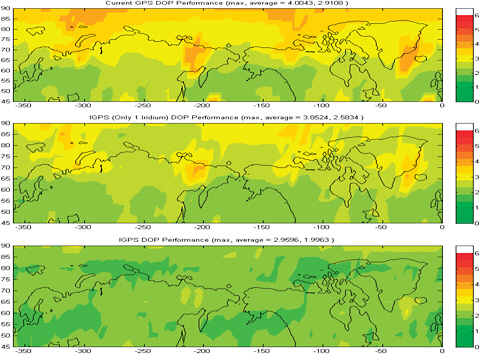
FIGURE 5.2 High-integrity Global Positioning System (GPS) augmentation system (Iridium-based) GPS vertical-dilution-of-precision improvement. SOURCE: Courtesy of The Boeing Company, Seal Beach, Calif.
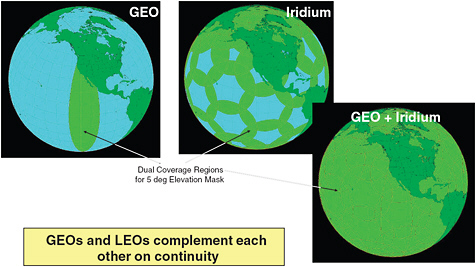
FIGURE 5.3 Wide area augmentation system data link coverage. SOURCE: Courtesy of the Federal Aviation Administration.
of the integrated geostationary/low Earth orbit (GEO/LEO) satellite network to provide expanded wide area augmentation system (WAAS) data link coverage for the polar regions (see Figure 5.3).
COMMUNICATION SYSTEMS INFRASTRUCTURE AND PERFORMANCE IN POLAR REGIONS
Although the impacts of climate change are not expected to directly impact radio frequency (RF) communication systems, there is a high likelihood that a warming climate will ultimately increase the operational tempo in Arctic regions and thus the demands on communication systems to operate in a familiar fashion and with performance standards similar to those that the naval forces have trained with and become accustomed to. Today’s U.S. naval network-centric mobile communications architecture is designed around a mix of satellites for non-line-of-sight communications and line-of-sight (point-to-point) communication systems.
Line-of-Sight Communications
The line-of-sight communication systems employed by U.S. naval platforms provide horizon-limited local communications between Marine ground forces and among naval ships over useful ranges of 30 miles and between airborne assets up to hundreds of miles. These military communication and networking systems consist of multiple legacy systems and are characterized by the older Link
11 (high frequency [HF], very high frequency [VHF], and ultrahigh frequency [UHF] bands) and Link 16 (L-band frequency).5 Throughout the world’s oceans, but exacerbated in the Arctic, the HF and VHF bands are frequently degraded. Depending on asset location, HF and VHF bands can sometimes be of marginal naval platform use. This is due to both the scintillation of the ionosphere caused by solar wind electrons interacting with Earth’s magnetosphere and the noise emanating from the galactic plane of the Milky Way.6
HF is known to be very sporadic and unreliable in the high-latitude environments due to the active ionosphere. Little can be done to mitigate these effects, and current operations typically suffer many hours of frequency outage. The HF systems are also expert operator-manpower-intensive and represent a skill set that is increasingly difficult to maintain. It is not uncommon for Coast Guard operations at higher latitudes to depend on low-elevation communications to GEO satellites—even if they require special positioning of the ship to gain favorable geometries—as opposed to struggling with HF systems.
Ionospheric disturbances of VHF voice and data communications are less intense than for HF bands, but they are still very problematic in the high Arctic (northward of 80º north latitude). The UHF and L-band frequencies are only slightly degraded while operating in the polar regions and are actively used by the Coast Guard in its deployments into the polar regions above Alaska.7
Over-the-Horizon Satellite Communications
The inherent limitations of line-of-sight communications systems have driven the military to adopt communication satellites to a bent-pipe relay system for over-the-horizon communication. The non-line-of-sight satellite communication systems are intended to provide communication for operational forces using a relay mode where two users are connected via an RF link relayed through a GEO satellite.8 These GEO communications satellites are capable of both a one-to-one communication mode and a one-to-many, or broadcast, mode. They typically operate in higher microwave frequency regions.9 These higher operating
|
5 |
Link 11 operates at HF (10 to 30 MHz), VHF (120 to 225 MHz), and UHF (225 to 400 MHz); and Link 16 at L band (960 to 1215 MHz). |
|
6 |
See Norman Cohen and Kenneth Davies, 1994, Radio Wave Propagation, U.S. Space Environmental Laboratory, NOAA; available at http://www.swpc.noaa.gov/info/Radio.pdf. Accessed June 4, 2010. |
|
7 |
See United States Coast Guard Strategic Spectrum Plan, December 2007; available at http://www.ntia.doc.gov/osmhome/spectrumreform/Spectrum_Plans_2007/Coast%20Guard_Stategic_Spectrum_Plan_Nov2007.pdf. Accessed June 4, 2010. See also David N. Anderson, 2003, “Forecasting the Occurrence of Ionospheric Scintillation Activity in the Equatorial Ionosphere on a Day-to-Day Basis,” GPS Solutions, Vol. 7, No. 3. |
|
8 |
See Executive Summary of the Commercial Satellite Communications (SATCOM) Report; available at http://www.fas.org/spp/military/docops/navy/commrept/index.html. Accessed June 4, 2010. |
|
9 |
See Geostationary Satellite History; available at http://www.geo-orbit.org/sizepgs/geodef.html. Accessed June 4, 2010. |
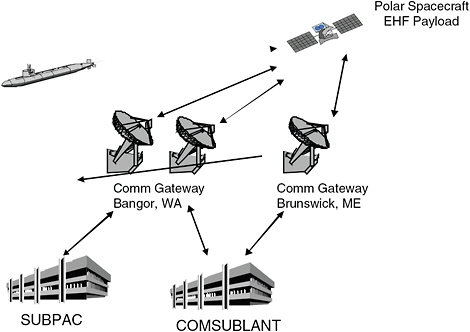
FIGURE 5.4 Current connectivity to submarine force worldwide with the addition of the Polar Interim Adjunct system. NOTE: Acronyms are defined in Appendix B.
frequencies are minimally impacted by Arctic environmental phenomena, but the geometry imposed by the high-latitude antenna coverage is the key limitation.
The two primary causes of over-the-horizon satellite communication degradation are the increased atmospheric RF losses due to increased path length at low antenna elevation angles and increased system noise due to antenna beam interception of the warm Earth as opposed to the cold background of space. Today’s satellite systems are typically designed to function below 72º–65º latitude, depending on the time of day, due to the slight inclination (worst case 6º), which allows some visibility to extreme polar regions during portions of the day when spacecraft are at peak northern inclination.
The Submarine Satellite Information Exchange System (UHF) is also known to have limited reliability due to the orbital inclination residue of the GEO orbits.10 (See Figure 5.4.) To support submarines operating at high latitudes above 65º north latitude, and as part of the submarine ice exercise (SUBICEX) 103 in
|
10 |
GEO orbits are not stationary in inclination, and the satellites actually precess in a figure-eight pattern normal to the GEO plane. Satellite operators typically control this to keep within 6 degrees of the equatorial plane. See Submarine Satellite Master Plan; available at http://www.fas.org/man/dod-101/navy/docs/scmp/index.html. Accessed June 4, 2010. |
January 2003, the Navy demonstrated limited communication coverage where visibility to GEO satellites is poor or impossible. Although limited, this communication capability is critical to submarine forces and allows consistent and reliable worldwide communications.
Polar Region Nautical Charting Products and Systems
General maritime operations and specialized contingency operations such as search and rescue in the polar regions are challenged in two key supporting areas: (1) nautical charting products that include coastal bathymetry, shoreline mapping, and coastal topography and (2) charts or maps that provide information on sea-ice conditions.
Accurate nautical charts in the polar regions are limited. In particular, nautical charts of the Alaska region show vast areas that have never been surveyed or have not been surveyed using modern instrumentation.11 For example, Figure 5.5 shows the vintage National Oceanic and Atmospheric Administration (NOAA) charts for northern Alaska as of June 2008.12 Many of the charts in those coastal areas are based on soundings from the 1940s or 1950s, with single-beam soundings, visual navigation, and surveys at small scale with line spacing of greater than 200 meters. The gaps extend to tidal data and tidal-current-prediction coverage.13 These limitations in bathymetric soundings, coupled with shoreline data based on manual methods and poor topographic maps of near-coastal regions, are insufficient to support more widespread maritime operations.
Ice Characterization and Arctic Navigation
Knowledge of current ice conditions is crucial to safe maritime operations in the polar regions. The tri-agency Navy/NOAA/Coast Guard National Ice Center (NIC) produces various ice-related navigational products such as ice extent, daily ice edge and marginal ice zone, ice charts, and links to northern and southern
|
11 |
As a typical example, see NOAA nautical chart 16549, Cold Bay and Approaches (Alaskan Peninsula); available at http://www.charts.noaa.gov/OnLineViewer/16549.shtml. Accessed August 2, 2010. |
|
12 |
“Maritime-Relevant Arctic Science at NOAA,” briefing by John A. Calder, NOAA Climate Program Office, as contained in “Impact of Climate Change on Naval Operations in the Arctic,” CNA annotated briefing CAB D0020034.A3/1REV April 2009 by Michael D. Bowes. |
|
13 |
NOAA is responsible for providing nautical charts of the Alaska region. The fundamental geospatial infrastructure that NOAA provides for the rest of the nation is lacking for Alaska and the Arctic, in particular. Alaska is the only state without digital shoreline imagery and elevation maps that meet nationally accepted standards. Also, the state’s reference system has neither the density of control points to support submeter-level accuracies for surveying and positioning activities, nor vertical data coverage for the western half of the state to support the accurate determination of elevation heights. See CAPT James J. Fisher, USCG, Chief, Office of Policy Integration, Headquarters, “Waterways Management in the Arctic,” presentation to the committee, September 25, 2009. |
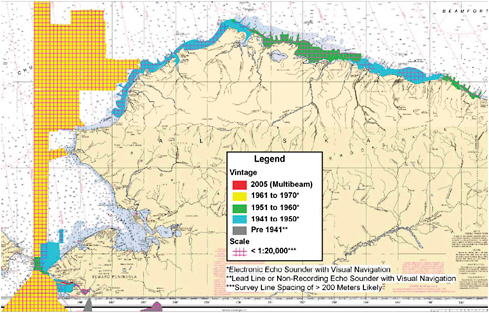
FIGURE 5.5 Vintage National Oceanic and Atmospheric Administration (NOAA) hydrography chart—North Slope (June 2008). SOURCE: Courtesy of the National Ice Center.
iceberg reports—all of which offer excellent information for operational planning. (The NIC also works with the Canadian Ice Service to jointly produce the North American Ice Service products.) The NIC ocean ice and iceberg products are based principally on satellite passive microwave and synthetic aperture radar (SAR) data. The ice charts include a rough characterization of ice thickness and types where available.
Ice conditions in the marginal ice zone can change very quickly, generally as a result of new ice formation and breakup, the latter coming principally from current year ice, known as seasonal ice. Since seasonal ice is more prone to breaking up and creating dangerously dynamic ice floe conditions than is multiyear ice, augmentation of sea-ice coverage charts with ice thickness estimates would be very useful for maritime operations safety—including surface, subsurface, and certain air operations. Similarly, near-real-time characterization of ice concentration and features in the marginal ice zones would greatly enhance operational safety. However, distinguishing between seasonal and multiyear ice is challenging via remote sensing, as new ice is generally less than 2 meters thick and old ice 3 meters or more. Therefore, ice thickness measurements must be accurate to within 0.5 to 1.0 meter for this purpose. Even then the classification between seasonal and multiyear ice is not straightforward.
As mentioned above, the thickness and temporal and spatial distribution of sea ice can dramatically affect navigation decisions. Unfortunately, it is difficult
TABLE 5.2 Currently Operating Spaceborne Synthetic Aperture Radars (SARs)
|
SAR |
Launch Date |
Frequency |
Polarization |
Resolution |
|
ERS-2 |
1995 |
C-band |
VV |
25 m |
|
Radarsat-1 |
1995 |
C-band |
HH |
25 to 50 m |
|
Envisat |
2002 |
C-band |
HH.VV, VV/HH, HV/HH, VH/VV |
30 to 1,000 m |
|
ALOS PALSAR |
2006 |
L-band |
Full-polarization |
7 to 88 |
|
TerraSAR-X |
2007 |
X-band |
Full-polarization |
3 |
|
Radarsat-2 |
2007 |
C-band |
Full-polarization |
3 to 100 |
|
Cosmos SkyMed |
2007 |
C-band |
Full-polarization |
3 |
to directly measure ice thickness from space. Lidars, like the ones on IceSat and all-weather radar altimeters from SeaSat (1978) to the recently launched CryoSat, can measure sea-ice freeboard.14 Freeboard, the distance from the water line to the top of the ice, is correlated with total thickness. The limitation of altimeters is that they sample only single points at the nadir along the satellite ground tracks. Altimeters can create a very narrow grid of measurements over many months or revisit the same spots more frequently, albeit with a thinner grid. In addition, the presence of snow or ice crystals on the surface of the ice biases the inference of thickness as there is a 10:1 amplification of the bias.
The last few years have proven to be a golden age in spaceborne synthetic aperture radars that create radar cross-section images. Table 5.2 lists the currently operating spaceborne SARs. In 2012, the European Space Agency (ESA) plans to launch Sentennial-1, which will provide C-band SAR imagery on an operational basis. The United States hopes to launch the L-band DESDYNI (deformation, ecosystem structure, and dynamics of ice) SAR15 within a decade. Both of these SARs can operate in a variety of modes from narrow to wide swath and at a variety of polarizations or even multiple polarizations.
SAR imagery can be used to find ice-free areas and to infer ice age from both absolute radar cross section and image texture. Ice age/type estimation is aided when the same areas are imaged at different frequencies and polarizations. Ice type is correlated, though imperfectly, to ice thickness. SARs can also operate in cross track interferometry mode, which can make vertical height measurements of 1 meter resolution, depending on a number of system factors. DESDYNI will be an interferometric SAR. In addition, though limited by clouds, optical and infrared imagery from NOAA weather satellites and NASA’s Moderate Resolution Imaging Spectrometer (MODIS) instrument help in estimating sea-ice extent.
|
14 |
A lidar (light detection and ranging) is a remote sensing system used to collect topographic data. |
|
15 |
The DESDYNI satellites, sponsored by NASA, will be a dedicated U.S. interferometric SAR and lidar mission optimized for studying hazards and global environmental change. More information is available at http://desdyni.jpl.nasa.gov/. Accessed June 4, 2010. |
No single instrument or instrument type yields high-resolution, timely measurements of ice thickness. Lidars and altimeters make the most direct measurement of ice thickness, but they are thinly spread. SARs and other imaging instruments can measure over relatively large areas at high resolution, but they provide indirect inference of ice thickness except when they are in an interferometry mode.
It is clear that the best approach is to combine the measurements, perhaps linked by a sea-ice model, using the imaging sensors to create ice thickness images that are tied to fiducial measurements by lidars and radars. The optimum combination of instruments, operating frequencies, polarizations, operating mode, and orbit patterns to provide these measurements is an area where additional research should be applied and a proof-of-principle demonstration should be performed. It may turn out that a modest modification of operating modes or the launch of key sensors at key times would have significant impact on the timeliness and accuracy of operational ice thickness estimates.
Additionally, analysts play a key role in translation of sea-ice data from multiple sources—text or verbal ice reports, in addition to remote sensing data sources—into useful products to support Arctic navigation. The work of the NIC analyst operations will continue to grow in importance as the operational tempo in the Arctic increases. In the committee’s opinion, real-time ice characterization and maps in emergent Arctic routes are needed now to avoid emergencies that would require Navy or Coast Guard involvement, and to support such involvement if and when it happens.
FINDING 5.1: U.S. military navigation and communications systems have been optimized to support operations in non-polar regions. Likewise, data on terrain elevation and bathymetry to support military operations and nautical charting are of low resolution and sparse in the Arctic. Moreover, while accurate ice coverage charts are available to guide surface navigation, reliable real-time ice characterization and maps in emergent Arctic transit routes are not. The combined effect of degraded navigation, communications, and charting systems could impact safe operations and reduce the performance of military systems in the polar regions.
RECOMMENDATION 5.1: The Assistant Secretary of the Navy for Research, Development, and Acquisition should increase research and development efforts at the Office of Naval Research and the Naval Research Laboratory to address the operational shortfalls of existing and planned navigation, communications, and charting systems, leveraging both local and global augmentation technologies. In conjunction with the National Oceanic and Atmospheric Administration, the Department of the Navy should increase priority for extending modern navigation, communications, and charting coverage to include the Arctic region.
ANTISUBMARINE WARFARE
Global Antisubmarine Warfare Operations
There are no significant first-order effects from climate change on U.S. antisubmarine warfare capabilities. A robust infrastructure that collects, analyzes, and distributes oceanographic data essential to ASW effectiveness is in place and covers active submarine operating areas adequately. Climate change will, however, mandate that submarine and ASW operations become more robust in the Arctic Ocean, where essential data are sparse or nonexistent in both special and temporal senses. Moreover, as potential adversarial submarines have become acoustically more quiet, ASW operations have evolved away from a pure submarine-on-submarine mission to a cooperative, coordinated mission involving fixed and mobile sensors and surface, subsurface, and air platforms.
This extensive and deployable ASW infrastructure that supports the principal nuclear-powered attack submarine (SSN) hunter platforms is generally deployed in the temperate oceans, but it would be challenged to operate in the Arctic. As well, the supporting tactical oceanographic data collection, analysis, and distribution system does not extend to the Arctic. Additional support infrastructure must be established or restored to enable more effective ASW operations in that region, which will become an inevitable national imperative.
Ocean acoustics are fundamental to submarine operations and antisubmarine warfare. The speed of sound in seawater is a function of pressure (depth), temperature, and salinity. Acoustic waves reflect off the sea surface and seafloor boundaries, and seawater absorbs acoustical energy at a rate proportional to frequency squared. There are two net effects of these properties upon ocean acoustics, which can be summarized as follows: (1) the refractive properties can lead to a sound fixing and ranging (SOFAR) duct that traps energy and leads to very-long-range propagation of signals at low frequencies, and (2) the combination of boundary losses and absorption losses leads to an optimal frequency for efficient sound propagation.16 These effects, plus the ambient noise environment and capabilities of the sonar system, determine the performance (for example, detection range) of an ASW system. For concerns of this report, ocean climatology impacts both of these major effects as well as the ambient noise.
Refraction (and the resulting SOFAR duct) is a phenomenon that can lead to long-range detection of submarines. In temperate oceans, the SOFAR duct is typically at a depth of 1 km, but as one goes to higher latitudes and colder water, it gradually migrates to the surface, which is the case in the Arctic Ocean. The dominant trade-off for the depth of the SOFAR duct is between hydrostatic pres-
sure and temperature, with salinity playing a lesser role. Salinity is more important for determining absorption rates and the optimal frequency.
There is nothing novel about these processes. The U.S. Navy and other world navies have invested large sums to acquire field measurements of temperature and salinity, as well as bathymetry, to produce climatological “atlases” available as a function of time of year for strategically and tactically important regions throughout the world. These atlases are maintained by the Naval Oceanographic Office (NAVOCEANO) by collecting the data produced daily through expendable bathythermographs (XBTs) and expendable conductivity temperature and depth (XCTD) from ships at sea. The atlases are critical in ASW detecting, localizing, and tracking potential adversarial submarines.
In addition, NAVOCEANO maintains a set of sophisticated prediction codes that forecast oceanographic conditions for use by the fleet.17 These “nowcasting” and forecasting models also merge archival data and in situ data in an optimum statistical manner accounting for currents, winds, historic sound speed profiles, and the accuracy of the in situ data. These are available to U.S. Navy ships on a 24-hours-a-day, 7-days-a-week basis.
The major issue here is that ocean temperature and salinity are highly spatially and temporally variable, so an ongoing and expensive measurement campaign is needed to keep these atlases up to date.18 It would be comforting to assume that climate-induced ocean changes will be slow, and that the impact on current data atlases will be minimal; however, not enough is known about climate change to be assured of these assumptions.
One can also make similar claims about the ambient noise environment. Ocean noise is primarily a function of shipping density, ice noise, and animal/sea life vocalizations. It is known that shipping noise is increasing and that wind stress will change as the climate changes. Simply not enough is known about potential climate-change-related impacts on marine animals to make any predictions related to the noise environment, except that temperature and salinity changes will almost certainly lead to changes of habitat.
Arctic Antisubmarine Warfare Operations
The reduction in Arctic sea ice and the increased exploration accessibility to potential natural resources has already led to the Arctic nations posting overlapping and disputed claims of territory, as discussed in earlier chapters of this
report.19 The claim by Russia of virtually the entire basin from its Siberian coast to the North Pole is the most audacious (dramatized by placing a titanium Russian flag beneath the North Pole on the Lomonosov Ridge). The basis of Russia’s claim is that the Lomonosov Ridge is a continental fragment split from Siberia due to seafloor spreading and hence part of Russia’s continental margin even though it is completely submerged. This is the major, but one of four, disputes among the Arctic nations.20 Others involve the disputes over status of the Northwest Passage and Northern Sea route and involve questions such as whether the Northwest Passage is similar to an extended strait between two seas through which, therefore, innocent passage is assured. Also, is the Northern Sea route, while within Russia’s exclusive economic zone (EEZ), subject to rules governing innocent passage?
Where does ASW enter? Submarines are a primary U.S. Navy asset that can assert the national will in an international “hot war” dispute in the Arctic. It is hard to consider a scenario escalating to this level, but a credible ASW threat in the Arctic could be needed as part of negotiations. Even during peacetime, many countries attempt to know the location of submarines of potential adversaries. Sometimes this includes submarine-on-submarine events in which both could be doing ASW on the other. One can easily envision a peacetime situation in which countries deploy submarines as a statement of territorial interest and capability, just as Russian bombers and icebreakers have done recently within their newly claimed territory. This might lead to ASW-like operations in which everything is done except armed engagement. One does not have to have a “hot war” for ASW missions to take place.
Arctic Antisubmarine Warfare
Arctic Ocean ASW is especially sensitive to the issues outlined above. Currently, virtually all knowledge of Arctic climatology is from submarine transits. While there have been many transits, they do not come close to the number needed for a high-resolution atlas. The most extensive and up-to-date data are for bathymetry, since the seafloor changes slowly; however, temperature and salinity data are largely dependent upon historical data gathered at ice camps primarily by the former Soviet Union (FSU) and the United States. While more data are becoming available as icebreakers are sent for scientific use into the Arctic, U.S. naval forces still are far short of the fidelity of temperate ocean atlases. Consequently, the aspects of Arctic Ocean ASW dependent upon the environment are already
|
19 |
Jon D. Carlson, Christopher Hubach, Joseph Long, Kellen Minteer, and Shane Young. 2009. “The Scramble for the Arctic: The United Nations Convention on the Law of the Sea and Extending National Seabed Claims,” paper presented at the annual meeting of the Midwest Political Science Association 67th Annual National Conference, April 2, The Palmer House Hilton, Chicago, Ill.; available at http://www.allacademic.com/meta/p363540_index.html. Accessed June 4, 2010. |
|
20 |
See Ronald O’Rourke, 2010, Changes in the Arctic: Background and Issues for Congress, March 30, Congressional Research Service Report for Congress, Washington, D.C., pp. 7-12. |
data poor, and this deficit will certainly increase with climate change. Most of the models for predicting climate change indicate the high latitudes will respond the earliest. This is being observed with the retreat of the seasonal Arctic sea ice.21 In summary, there is a sparse data set, and the committee notes that it will need to be updated more frequently because of the more rapid changes at the polar latitudes.
The United States had a robust Arctic research program corresponding to the era when the FSU conducted extensive operations there. This continued until the end of the Cold War, when the Office of Naval Research (ONR) and most other Navy program offices closed their Arctic operations. The Science Ice Exercise Program (SCICEX) cruises in which the U.S. Navy sent an SSN on transits across the Arctic for the scientific community continued until 2000, when the last of the SSN 637 class strengthened for Arctic surfacing was retired. Since then there have been some SSN Arctic transits between the Atlantic and the Pacific, but not for scientific purposes. The U.S. Navy research program in the Arctic has atrophied to the point that there is no infrastructure to support it. The National Science Foundation (NSF) is the current primary U.S. federal source of support for Arctic science and technology.
The SSN transits, nevertheless, have been extremely valuable for surveying the Arctic Ocean bathymetry. The data from these transits have been compiled by NAVOCEANO with those from other sources such as icebreakers and ice camps. Nevertheless, these data are still sparse and certainly not suitable for routine navigation, especially near the shelf break. The sparse bathymetric charts lead to the challenge of SSNs avoiding undiscovered seamounts, which are still being identified.22
Detection, Classification, Localization, and Tracking in the Arctic
ASW is often divided according to the tasks of detection, classification, localization, and tracking. The committee examined how the Arctic and impact of climate change can affect these tasks.
Detection is fundamentally a signal-to-noise issue, so the transmission loss from a target, or source of acoustic power, is strongly influenced by the refractions and reflection taken by the path before being received. Most of the time,
|
21 |
In addition to the retreat of the ice cap, a warming of 0.4ºC for the Atlantic intermediate water mass north of Greenland has been measured by acoustic tomography (P.N. Mikhalevsky, A.B. Baggeroer, A. Gavrilov, and M. Slavinsky, 1995, “Experiment Tests Use of Acoustics to Monitor Temperature and Ice in Arctic Ocean,” EOS, Transactions American Geophysical Union, Vol. 76, No. 27, p. 265) and directly by SCICEX transits. |
|
22 |
For example, the Coast Guard icebreaker Healy discovered a seamount during a cruise in 1989. While it shoaled to 3,200 meters from 5,000 meters and was not a navigation hazard, it was in the middle of the Canada Abyssal Plain and completely unexpected geologically. See Arctic Mapping and the Law of the Sea; available at http://arctic-healy-baker-2008.blogspot.com/2009/09/new-seamount.html. Accessed August 2, 2010. |
both the source and the receiver are within the upper part of the water column where the halocline and thermocline exist.23 The propagation is described as refracted-surface reflected (RSR). Acoustical energy reflects off the ice canopy and is refracted by the sound speed gradient at depth. Climate warming will lead to more freshwater from sea ice, glacier runoff, and the northern rivers, which will affect salinity distribution. In addition, surface heat will warm the upper waters, increasing the speed of sound. This will weaken the surface duct and cause sound to refract away from the water or ice surface, leading to changes in transmission loss and detection levels depending upon where the source and receiver are in the water column.
For ASW purposes, classification is the task of determining the source of a detected sound (for example, a submarine, commercial shipping, marine life, or even ice movement or wind). Outside the Arctic, interference from commercial shipping leads to a lot of “clutter” on displays. This makes identifying a target difficult. There are currently few ships in the Arctic, but warming may lead to increased maritime trade, more ships, and more difficulty in classification, although this will probably not reach the level of difficulty seen in sea lines of communication in the temperate oceans.24 Biologic noise, as well as that due to ice activity in the marginal ice zone, is very high and can aggravate classification efforts.
The impact of ambient noise for Arctic ASW leads to some interesting questions and speculations. As noted above, in temperate oceans the noise in the interesting ASW bands is dominated by shipping and rain/wind noise. In the Arctic, with an ice canopy, there is virtually no shipping and the rain/wind is isolated by the ice cap. The dominant noise is the ice grinding against itself and the seabed; this is especially loud in the marginal ice zone, the transition from open water to the ice pack. Arctic ambient noise can be very quiet or very loud. If shipping increases, the ambient noise will likely increase; however, it is uncertain whether it will be a factor in all but the quietest days for ASW. It is possible that the newly opened part of the Arctic Ocean will be similar to sections of the southern hemisphere, which is noted for low ambient noise.
Localization and tracking are the tasks of determining the range, bearing, speed, and course of a submarine. While these tasks certainly depend upon signal-to-noise ratios as well as interferences, the issues are not different in the polar regions from those of temperate waters. To the first order, these efforts should not depend upon Arctic Ocean warming.
Another important component of ASW is weapons performance, usually a torpedo. Torpedo operation would not be materially affected by changes in salin-
ity and its impact on absorption; however, the additional complications of the stratification of the halocline and thermocline, plus scattering from the underside of the ice, will cause tracking problems for the homing system on a torpedo. By far the biggest problem for a torpedo is reverberation from the ice canopy, so more open water implies larger regions where the torpedo would not suffer performance degradation from the ice canopy. The United States already has a program for assessing the performance of torpedoes under the ice.
ASW is best done by submarine, but the submarine does rely upon an infrastructure to provide a set of cues to help vector it to a target. Maritime patrol aircraft (P3s and now P8s) drop sonobuoys to assist in a prosecution, but they will be disadvantaged because of the long ranges from an airfield and the existing ice canopy. These systems could provide surveillance at important choke points and yield valuable cues. In summary, ASW is in many ways a team effort needing the cooperation of many systems to cue an attacking submarine to a target. If these supporting systems or infrastructures are not available, ASW reverts to submarine-on-submarine engagement that disadvantages the pursuer.
As mentioned earlier, the Virginia-class submarines were not constructed to penetrate thick ice. Locations for surfacing need to be carefully checked to make sure the ice is thin enough for these submarines to penetrate without damage. This implies that there is a capability for finding regions of thin ice for surfacing opportunities, and this needs to be put in place based either on data from the upward looking sonar or by somehow transmitting satellite reconnaissance information.
Finally, many of the personnel who had the skills to operate in the Arctic have gradually retired or otherwise left the ASW community. There is no formal program for training to develop the Arctic skill sets needed.
FINDING 5.2a: Arctic ASW is difficult because of the complications of the environment—the submarine and a source are typically in the section of the sound fixing and ranging (SOFAR) channel that has the most variability in sound speed. While the bathymetry does not change, it is poorly sampled in terms of both coverage and accuracy, and the ice canopy prevents routine submarine surfacing for emergencies and satellite communication. In addition, an ice cover scatters sound, which limits detection and torpedo performance.
FINDING 5.2b: The United States had an Arctic research program during the Cold War that has essentially ceased. Moreover, there is no infrastructure to support antisubmarine warfare (ASW) in the Arctic. While there are no significant ASW activities now in the Arctic, U.S. naval forces need to be prepared to operate there safely. The United States’ diminished Arctic research program and capabilities from what existed during the Cold War—plus the need for even better performance from its ASW systems—put U.S. naval forces’ ability to operate as needed in the Arctic at risk if the United States does not keep pace with the
capabilities of other Arctic nations, especially Russia with its extensive claims of Arctic sovereignty, as well as with non-Arctic nations, such as China.
RECOMMENDATION 5.2: Given that climate change may drive the U.S. naval forces to conduct antisubmarine warfare (ASW) operations in the Arctic, the Department of the Navy should increase its submarine Arctic presence for training purposes, extend its supporting ASW oceanographic data infrastructure to the Arctic Ocean, and begin to conduct multiplatform ASW training exercises in the Arctic. Specifically, this should include:
-
Increased research for Arctic passive and active sonars;
-
Long-range planning to install facilities that support Arctic ASW, such as refurbishing and expanding the fixed array systems;
-
Planning for aircraft support from the new P8;
-
Development of high-latitude communications systems for relaying tactical and environmental data;
-
Identifying ports for emergencies; and
-
Incorporation of a more robust under-ice capability on Virginia-class submarines.


