
2
Naval Capabilities and Potential Climate-Change-Related Operational Issues
INTRODUCTION
This committee has found strong scientific evidence to support naval leadership’s initiatives to study and act on the implications of climate change and its effects on naval missions, operations, and capabilities. Numerous peer-reviewed assessments indicate increasing global stresses due to the effects of climate change alone and in combination with other environmental stressors, such as global population growth.1,2 These reports and scientific models suggest more severe or frequent droughts, floods, storms, and other events with negative consequences for
food and water supplies, possibly leading to even greater stress on the expanded human population.3
This chapter begins with an examination of climate change impacts on naval forces’ missions and operations—including increased humanitarian assistance/disaster relief (HA/DR) and the resulting implications for such units as U.S. Navy hospital ships, Naval Mobile Construction Battalions (NMCBs), and Marine Expeditionary Units (MEUs). The report then focuses on climate-change-related operational impact and challenges in the Arctic, highlighting Arctic command issues and an examination of U.S. icebreaker needs. This chapter concludes with a discussion of the implications of a changing climate on health and disease and the impact that this may have for future naval missions.
Viewed from a national security standpoint, the above changes would likely amplify stresses on weaker nations and generate geopolitical instability in already vulnerable regions.4 A range of naval mission impacts may result from such conditions, including the sorts of antipiracy and counterterrorism missions now being conducted off Somalia. However, the clearest implications are for a potential increase in the frequency of HA/DR missions. These additional HA/DR demands have the potential to strain military transportation resources and supporting force structures.
The U.S. Navy, as a forward-deployed force, is in position to reach disaster relief sites faster than other agencies and will almost assuredly experience increased demand for assistance if disasters increase due to climate change.5 The
|
3 |
See Intergovernmental Panel on Climate Change, 2007, “Climate Change 2007: The Physical Science Basis,” Working Group I contribution to the Fourth Assessment Report of the Intergovernmental Panel on Climate Change (Susan Solomon, Dahe Qin, Martin Manning, Zhenlin Chen, Melinda Marquis, Kristen B. Averyt, Melinda M.B. Tignor, and Henry LeRoy Miller [eds.]), Cambridge University Press, Cambridge, United Kingdom, and New York. See also Catherine P. McMullen and Jason Jabbour, 2009, Climate Change Science Compendium, United Nations Environment Programme, EarthPrint, Nairobi, Kenya. |
|
4 |
See Statement of the Record of Dr. Thomas Fingar, Deputy Director of National Intelligence for Analysis and Chairman of the National Intelligence Council, before the Permanent Select Committee on Energy Independence and Global Warming, House of Representatives, “National Intelligence Assessment on the National Security Implications of Global Climate Change to 2030,” June 25, 2008. Available at http://www.dni.gov/testimonies/20080625_testimony.pdf. Accessed November 24, 2009. See also Military Advisory Board, 2007, National Security and the Threat of Climate Change. CNA Corporation, Alexandria, Va. |
|
5 |
Naval Operations Concept 2010 (NOC 10)—a joint maritime strategy document for the U.S. Navy, Marine Corps, and Coast Guard—calls out “humanitarian assistance and disaster response” as one of six capabilities that constitute the core of U.S. maritime power and that “reflect an increased emphasis on those activities that prevent war and build partnerships.” See Department of the Navy and U.S. Coast Guard (ADM Gary Roughead, USN; Gen James T. Conway, USMC; and ADM Thad W. Allen, USCG), 2010, Naval Operations Concepts 2010, Implementing the Maritime Strategy, June. Available at http://www.navy.mil/maritime/noc/NOC2010.pdf. Accessed June 4, 2010. However, it is not the sole responsibility of the U.S. military to respond to national and international humanitarian and disaster-relief emergencies; many U.S. and international governmental and private agencies may be engaged in any given relief operation. |
demand for Naval Construction Force capability in support of HA/DR operations is likely to increase in proportion to the operational tempo of U.S.-sponsored international HA/DR operations.6 Likewise, the U.S. Marine Corps, with its forward-deployed MEUs, should expect to be called upon to assist with extreme-weather-related HA/DR. However, the pace and extent of this increase are as yet unknown.
The committee sees three fundamental challenges facing U.S. naval forces regarding climate change impacts on missions, capabilities, and operations:
-
The need to develop capabilities, including logistics and training, to support new missions that climate change may bring;
-
The need to respond to an increase in the demand for certain types of existing missions; and
-
The need to maintain current warfighting capabilities as the operating environment changes.
Regarding new or expanding missions, the committee considers the need to operate in the Arctic and the expected increase in demand for HA/DR missions and operations related to mass migrations to be most likely. Regarding the maintenance of current capabilities in a changing operational environment, the ability of the Navy to project power under harsher climate conditions and the robustness of its antisubmarine warfare (ASW) capability as the acoustic environment changes are among the major issues. Each of these challenges is discussed below. ASW and other technical operational issues are discussed more fully in Chapter 5 of this report.
NAVAL FORCES’ RESPONSES TO FUTURE POTENTIAL CLIMATE-INDUCED EVENTS
Humanitarian Assistance/Disaster Relief
All U.S. military services and many other federal agencies could be involved in supporting HA/DR missions brought on by climate change, depending upon the nature of the crisis, its location, and the severity of the event. Forward-deployed naval forces (Navy, Marines, and Coast Guard) are likely to be in the best position to respond rapidly to developing HA/DR crises and are therefore very likely to be called upon by the President. It is also probable that naval forces of coalition partners would be involved as part of the effort to bring relief to the affected area. Examples of international HA/DR efforts are the 2010 earthquake in Haiti, Tropi-
cal Storm Ketsana striking the Philippines in 2009, and the tsunami in Indonesia in 2004.
Navy forces afloat, Amphibious Ready Groups (ARGs) with embarked MEUs, and Maritime Prepositioning Force (MPF) squadrons can all bring a unique level of rapid response capability in support of Combatant Commander (COCOM) requirements for HA/DR missions that are over and above traditional warfighting capability. The most recent example of this would be the deployment of the aircraft carrier USS Carl Vinson, which operated as a sea base for helicopters that were moving personnel and supplies into the disaster area in Haiti, in addition to two ARGs with embarked MEUs. In the future, other Navy surface elements—such as littoral combat ships (LCSs), joint high-speed vessels, and Navy support ships—might also play a role depending on the nature of the mission. At this point in time, it is difficult to project what these relief forces may look like in the decades ahead; however, the current organizational structure as well as the platforms may be essentially the same.
Hospital Ships
The U.S. Navy’s hospital ships are one of the best examples of Navy “soft power” as the United States faces an uncertain future in the 21st century. Navy hospital ships have played a significant role in HA/DR missions in the Pacific as well as the Caribbean, and they will continue to do so as long as they are in active service. Their unmatched medical capacity and capability utilized in support of COCOM requirements could be increasingly in demand should the effects of climate change create circumstances in which massive medical assistance is needed. However, manning these platforms with the requisite medical expertise may require an innovative program whereby staffing comes from the United States, the host nation, or nongovernmental organizations (NGOs) on a contingency basis. Most importantly, while to the knowledge of this committee no retirement of these hospital ships has been officially discussed, the capability that these ships bring to the COCOM must be preserved in some form when they are eventually decommissioned. Without the hospital ships, the requirement to provide medical support would reside with medical capabilities located in large-deck amphibious ships (LHA/LHD classes), aircraft carriers, and possibly the LPD-17-class amphibious ships. It could require several of these ships to be in the area of HA/DR operations to match the capacity of a single hospital ship. That may not always be feasible due to COCOM requirements elsewhere in the world.
Another related issue involves the use of host-nation medical teams and NGOs on U.S. ships. While this integration has been successful on U.S. hospital ships, it will not work so easily or smoothly on U.S. combatant or amphibious ships, due to the nature of these ships’ primary missions.
Maintaining the capabilities provided by the hospital ships goes beyond just ensuring an equivalent bed capacity. The Haiti earthquake disaster demonstrated
the increasing need for timely and sophisticated surgical/trauma care. Many of the land-based hospitals—including those brought in by other governments and U.S. NGO groups—could not handle severely injured patients. Fortunately, within a few days of the arrival of USNS Comfort, protocols were developed for the transfer of the most seriously injured.7 It will be important in future planning for HA/DR to focus not only on the number of beds but also on the number of operating rooms and provision for sophisticated trauma care. Equally important will be the speed with which the services can be on station.
One potential solution to the requirement for hospital ships for HA/DR could be the use of contracted afloat services, potentially provided by large, private shipping companies. The committee has reviewed reports on such an option studied as part of the Chief of Naval Operations (CNO)-directed study of sea basing options, or the afloat forward staging base concept. This committee believes that such a potential third-party arrangement deserves consideration as the Department of Defense (DOD) and naval forces study their options for HA/DR support and capacity. Preliminary projections of a hypothesized converted commercial ship’s capabilities are as follows: command, control, communications, and computers—capabilities robust enough to support the on-scene commander and staff; berthing/hotel facilities for 3,000 responders; medical facilities that range from operating rooms to a 1,000-bed hospital ward; potable water making/bottling; ice making; transport and discharge for wheeled responder vehicles; transport for amphibious response craft; aviation facilities (including refueling) for all rotary wing aircraft (up to 14 landing spots); and an enormous amount of cargo space for food, medical supplies, and the like.8 Such a potential third-party commercial ship-leasing arrangement might also be based on shared-cost bilateral or multilateral HA/DR agreements and might possibly bring cost savings benefits. Any such arrangements must meet all requirements in a short time frame. The length of time between injury and care is a critical variable in medical outcome.
FINDING 2.1: The unique capability provided by the U.S. Navy hospital ships will become even more important in supporting potential humanitarian assistance/disaster relief (HA/DR)-related missions that will likely occur as a result of crises created by climate change. The Navy needs to maintain this capability beyond the life of its current two-ship hospital fleet.
RECOMMENDATION 2.1: The Program Executive Office for Ships (PEO-Ships), the Naval Sea Systems Command (NAVSEA), and the Military Sealift
Command (MSC) should analyze alternatives to retain the medical capability of the current hospital ships into the future. The analysis should address construction of new military or commercial platforms like the Mobile Landing Platform (MLP) that will join the Maritime Prepositioning Force (MPF); modification to current surface platforms or amphibious “big-decks”; or construction of next-generation Navy fleet hospitals to meet the requirements. In this context, PEO-Ships, NAVSEA, and MSC should also explore the feasibility of leasing commercial ships and crews to meet the requirements, but in doing so must ensure that the provisions for operating rooms, sophisticated trauma care, and guaranteed availability on very short notice are included.
Marine Expeditionary Units
There are usually at least three Amphibious Ready Groups with their Marine Expeditionary Units forward-deployed on presence missions at all times in support of COCOM requirements. Each MEU is trained in a variety of noncombat missions to include HA/DR, noncombatant evacuation orders, and security force operations.
Each MEU maintains 15 days of sustainability in a self-contained sea base. The large-deck amphibious ship in each ARG has a medical capability as well as a platform for sustained helicopter and MV-22 military transport aircraft operations that can operate independently or in conjunction with other naval elements, including a hospital ship. It can respond rapidly to a crisis area and also function as the command and control headquarters until a shore-based force arrives on the scene. If the nature of the HA/DR crises requires the commitment of additional naval forces, decisions can be made to flow two or possibly three of the deployed ARGs/MEUs to the area in question. This force could merge into a larger Marine Expeditionary Brigade (MEB) that would conduct operations from an expanded sea base with some 45 days of sustainability plus embarked engineer assets for light engineering tasks. At some point, and as part of the committee’s recommendation for risk analysis, naval planners may need to develop contingency plans in preparation for such deployments as events created by climate change become clearer in specific regions of the world. Logistics requirements for sustaining the force as well as supply and medical assistance for the affected population in the area of operations could be very different from what is routine for conventional operations today.
The Maritime Prepositioning Force
The MPF, which is forward-deployed with elements of the fleet, can provide a significant logistics capability that can move rapidly to an area in the event of an HA/DR crisis. This force, which is composed of three squadrons of five ships each, is generally located in the Pacific, the Indian Ocean, and the Mediterranean.
Each squadron contains a 30-day supply for an MEB; the support for one Naval Mobile Construction Battalion, or Seabees; materials for a 3,700-foot runway and control equipment for an expeditionary airfield (EAF); and a Navy fleet hospital (NFH) with a 273-bed capacity that can be deployed ashore. Each MPF squadron contains 374,000 gallons of bulk water and can produce 122,000 gallons of water per day that can be moved ashore. One of these MPF squadrons could become the logistics hub for an expanded sea base that can support Marine and NMCB operations ashore as well as provide assistance for NGOs, as was done in Haiti. If a major crisis like mass migration, conflicts over water, or a natural disaster occurs, decisions could be made to put a second MPF squadron into an area for extended operations from both the sea base and ashore.
Each MPF squadron has a Naval Support Element (NSE) that has the mission of facilitating the off-loading of MPF shipping in stream or pierside. Within the NSE are several units, including an Amphibious Construction Battalion that has the capacity to build its own camp as well as move equipment ashore. This particular organization of Seabees could be utilized to assist in HA/DR operations if the requirement for assistance expands ashore and inland.
Naval Mobile Construction Battalions
The Navy’s NMCB units are capable of a wide range of heavy construction and should be considered a national asset that would be available in response to HA/DR missions or crises brought on by the effects of climate change.9 Each NMCB unit is self-contained, with its own support structure, and it can provide an expeditionary brigade with a wide range of construction capabilities to include site preparation, roads, airfields, and buildings if necessary. One Seabee unit will support a Navy fleet hospital ashore as well as construct the expeditionary airfield if there is a requirement to build one in an area of operations. The NMCB has the capability for drilling wells for water that might be critical if a crisis involves mass migration or famine as a result of severe drought. The role of the Seabees could increase considerably if there is a requirement to move operations inland in order to manage the crises. Additional Naval Mobile Construction Battalion units can also be flown into the area of operations to expand current capabilities if the need arises.
The Coast Guard
The U.S. Coast Guard’s (USCG’s) core roles are to protect the public, the environment, and the U.S. economic and security interests in any maritime region in which those interests may be at risk, including international waters and
America’s coasts, ports, and inland waterways.10 In doing so, the Coast Guard has organized its responsibilities into five fundamental areas: (1) maritime safety, (2) national defense, (3) maritime security, (4) maritime mobility, and (5) protection of natural resources, and a unique mission in ice operations in which ice-breakers play a key role. The Coast Guard will play a role in HA/DR operations, especially in the Caribbean and Eastern Pacific regions. It will often be the primary responder to a natural disaster or mass migration in North America, as recently seen in Hurricane Katrina (2005) and the Haitian earthquake (2010). The Coast Guard has the initial responsibility to manage mass migrations by sea, primarily in the Caribbean, until the number of migrants requires the Navy to provide support. The Coast Guard will also provide expertise for port operations, aids to navigation, maritime search and rescue, and vessel traffic control.
Mass Migrations
The CNA study of 200711 and the 2010 Quadrennial Defense Review (QDR)12 noted that climate change is likely to be an accelerant of instability. A similar document from the United Kingdom Ministry of Defence13 noted that climate change is “likely to be most severe where it coincides with other stresses such as poverty, demographic growth and resource shortages.” Increasing mass migrations can occur as a result of resource shortfall, conflict, or sea-level rise, all of which are likely to increase with climate change. Recent estimates are that in 2050 the world’s population will be 9 billion people, and that 200 million people could be newly mobilized as climate migrants due to climate change effects.14 These mass migration increases will not only affect the humanitarian assistance requirements of the naval forces, but could also result in instability as well as unrest and regional conflict. One possible outflow of these events is the evacuation of U.S. citizens in the impacted region and rendering of assistance in quelling unrest.
Regarding migration driven by sea-level rise, southern Asia (particularly Bangladesh) and Africa are most often mentioned; however, one of the great questions facing the international community is the potential disaster of small island nations that may disappear completely as sea level rises. This is an extreme, but nonetheless potential, scenario that may require naval evacuations. Small island
|
10 |
See U.S. Coast Guard Missions, available on the U.S. Coast Guard/U.S. Department of Homeland Security website at http://www.uscg.mil/top/missions/. Accessed July 28, 2010. |
|
11 |
Military Advisory Board. 2007. National Security and the Threat of Climate Change, CNA Corporation, Alexandria, Va. |
|
12 |
Secretary of Defense (Robert M. Gates). 2010. Quadrennial Defense Review, Department of Defense, Washington, D.C., February, p. xv. |
|
13 |
“Adaptability and Partnership: Issues for the Strategic Defence Review,” presented to Parliament by the Secretary of State for Defence, February 2010. |
|
14 |
Michael Werz and Karl Manlove. 2009. “Climate Change on the Move: Climate Migration Will Affect the World’s Security,” Center for American Progress, Washington, D.C., December 8. |
nations are already losing freshwater resources as a result of salt water intrusion from a rising ocean.
The primary responsibility for dealing with (maritime) mass migrations to the United States now rests with the Coast Guard and the State Department. However, when the level of migrants reaches 1,000 per day, the Navy is called upon to assist the Coast Guard.
Plans, Training, and Provisioning of Forces
As the committee reviewed the impacts of climate change on the operations of naval forces, it became apparent that changes in mission, increased operations in existing missions, and operating in the new environment that might be expected in 20 years’ time should affect how the Navy plans, trains, and equips its forces. The committee suggests that planning scenarios be revised to include climate change effects, and war gaming be conducted to test the functionality of the plans in light of the new challenges to operations. The lessons learned from these war games can then be used to review the adequacy of current force structure and training to meet the future challenges presented by climate change. This should result in a gap analysis and changes to the required skills and capabilities that drive force planning. A similar gap analysis will provide insight on the current provisioning and equipping of the various forces, particularly the contingency forces that will most likely be utilized in responding to HA/DR missions. Finally, the adequacy of logistical support for new and increased operations should be reviewed and the appropriate resources devoted to modifying policy for and funding of logistical support.
FINDING 2.2: Global climate change projections from the Intergovernmental Panel on Climate Change Fourth Assessment Report (AR4) suggest damaging impacts in developing and developed nations that may be destabilizing in many parts of the world. These projections would affect U.S. national security and stress naval resources. In particular, naval forces will likely be required to carry out more frequent humanitarian assistance/disaster relief (HA/DR)-related missions. At the same time, U.S. naval forces would be expected to execute their ongoing national security military missions and to position themselves for supporting missions in destabilized regions around the globe. It is also expected that the demand for U.S. Naval Construction Force and Marine Expeditionary Unit capabilities will increase in proportion to the operational tempo of U.S.-sponsored international HA/DR missions.
RECOMMENDATION 2.2: In the near term, the Chief of Naval Operations (CNO) should not specifically fund new force-structure capabilities to deal with the effects of projected climate change; however, the CNO should begin to hedge against climate change impacts through planning for modifications of the existing
force structure as climate change requirements become clearer. The U.S. naval forces (the U.S. Navy, Marine Corps, and Coast Guard) should begin to consider potential specific force-structure capabilities and training standards for conducting missions arising from, or affected by, climate change, particularly HA/DR-related missions.
Naval Capabilities and Potential Climate-Change-Related Operational Issues in the Arctic
Changes in Arctic Ice Cover and Its Implications
Recent climate change may have the most immediate and obvious implications for maritime operations in the Arctic region.15 The Arctic is experiencing significant reductions in sea-ice cover in the Arctic Ocean and the disappearance of older, thicker, multiyear ice.16 The loss of sea-ice area in summer months is about three times faster than in winter. As a result, the vast Arctic is rapidly acquiring the types of maritime activities that normally occur elsewhere in the world’s ice-free oceans.
Projected sea-ice retreat will offer a longer season of maritime availability. At the same time, community resupply demands are expected to rise with increasing development, migration, and population growth.17 The U.S. Geological Survey notes that significant natural resources (oil, natural gas, and nonfuel minerals) may become increasingly available for exploitation as ice melts and climate tempers.18 Tourism is expanding, especially around Greenland and Svalbard, but also in recent years in the Northwest Passage and around Arctic Alaska. There is evidence that commercially valuable fish stocks are moving north, and although U.S. waters north of the Bering Strait have been closed to fishing for the immediate future, the
|
15 |
As discussed in Chapter 1, in this report the Arctic region is defined as the land and sea area north of the Arctic Circle. |
|
16 |
On September 12, 2009, sea-ice extent reached a 2009 minimum of 5.1 million km2. The summer minimum is the third-lowest recorded since 1979. While the 2009 minimum was an increase over that of the two previous years, it was still 1.6 million km2 below the 1979-2000 average minimum. The March 2009 ice extent was 15.2 million km2, the same as in 2008 and only 4 percent less than the 1979-2000 average of 15.8 million km2. March is historically the month of maximum sea-ice extent. See Arctic Report Card: Update for 2009; available at http://www.arctic.noaa.gov/reportcard/ArcticReportCard_full_report.pdf. Accessed November 24, 2009. See also Julienne A. Maslanik, C. Fowler, J. Stroeve, S. Drobot, J. Zwally, D. Yi, and William J. Emery, 2007, “A Younger, Thinner Arctic Ice Cover: Increased Potential for Rapid, Extensive Sea-Ice Loss,” Geophysical Research Letters, Vol. 34, L24501. |
|
17 |
Arctic Council. 2009. Arctic Marine Shipping Assessment 2009 Report; available at http://www.nrf.is/index.php/news/15-2009/60-arctic-marine-shipping-assessment-report-2009. Accessed November 24, 2009. |
|
18 |
See July 23, 2008, U.S. Geological Survey press release, “90 Billion Barrels of Oil and 1670 Trillion Cubic Feet of Natural Gas Assessed in the Arctic”; available at http://www.usgs.gov/newsroom/article.asp?ID=1980&from=rss_home. Accessed November 23, 2009. |
fishing area may expand.19 A map of the Arctic region is shown in Figure 2.1; a profile of recent monthly Arctic sea-ice extent is provided in Figure 2.2.
Climate model projections are especially uncertain at regional scales and in regions with very rapid projected change such as the Arctic. The sea ice in most climate models retreats more slowly than what has been observed during the satellite era (since 1979).20 Of the two models that are consistent with the satellite observations, one shown in Figure 2.3 projects an open Northern Sea Route in August and September and an approximate 50 percent ice concentration in the months of July and October by 2030. This same model has a significant rise in the year-to-year variability in sea-ice cover as the sea ice retreats in the 21st century.21 This model suggests that large anomalies in the sea-ice cover as observed in 2007 may be increasingly common as the sea ice continues to retreat. Hence, these models support the likelihood of an Arctic maritime area increasingly accessible to surface shipping.
This committee believes that U.S. naval leadership should expect the decline in Arctic summer sea ice to continue at the current rate (10 percent per decade) or more in the next few decades. This would allow “ice-free” access over large stretches of the Arctic in late summer by 2030 that are sufficient for reliable cross-Arctic transit.22 (See also Figure 2.3, and Figure 6.2 in Chapter 6 of this report.) In the near term, ice-laden Arctic waters will continue to have an ice cover of variable thickness and duration and will continue to pose navigational hazards for non-ice-hardened vessels.
Geopolitical and Military Issues
Essentially ignored since the end of the Cold War, the geopolitical situation in the Arctic has become complex and nuanced. Of the five nations that border the Arctic Ocean—Canada, Denmark (by virtue of its responsibilities for Greenland),
|
19 |
Arctic Council. 2009. Arctic Marine Shipping Assessment 2009 Report; available at http://www.nrf.is/index.php/news/15-2009/60-arctic-marine-shipping-assessment-report-2009. Accessed November 24, 2009. |
|
20 |
Julienne Stroeve, Marika M. Holland, Walt Meier, Ted Scambos, and Mark Serreze. 2007. “Arctic Sea Ice Decline: Faster Than Forecast,” Geophysical Research Letters, Vol. 34. |
|
21 |
Marika M. Holland, Cecilia M. Bitz, L.-Bruno Tremblay, and David A. Bailey. 2008. “The Role of Natural Versus Forced Change in Future Rapid Summer Arctic Ice Loss,” Geophysical Monograph Series 180, American Geophysical Union. |
|
22 |
Throughout this report, the term “ice-free” is used to mean that multiyear ice has nearly (or completely) disappeared; however, to date, in what is termed “ice free” conditions, sufficient ice is present to remain a hazard to ordinary ships and routine marine operations. The Navy Task Force Climate Change also uses a projection of ice-free summer months in the Arctic by the year 2030 based on work conducted for the Department of Defense by the Oak Ridge National Laboratory using outputs from the Community Climate System Model version 3 (CCSM3). See Karsten Steinhaeuser, Esther Parish, Alex Sorokine, and Auroop R. Ganguly, 2009, “Projected State of Arctic Sea Ice and Permafrost by 2030,” Oak Ridge National Laboratory, Oak Ridge, Tenn. |
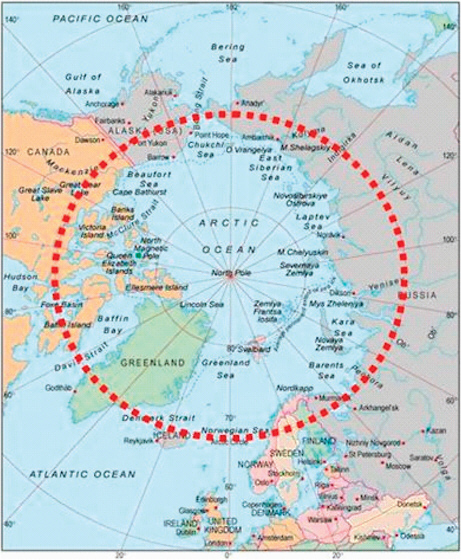
FIGURE 2.1 Map of the Arctic region. The Arctic region, in this report, is defined as the area north of the Arctic Circle (highlighted on this map in red).
Norway, Russia, and the United States—all are NATO members except Russia. The Arctic Council, a governmental forum of these five nations plus Iceland, Sweden, and Finland, offers a diplomatic vehicle for addressing contemporary Arctic issues. However, maritime boundary disputes abound. Canada and the United States, and Canada and Denmark, have unresolved territorial sea and exclusive economic zone (EEZ) disputes in the Arctic. Norway and Russia disagree over
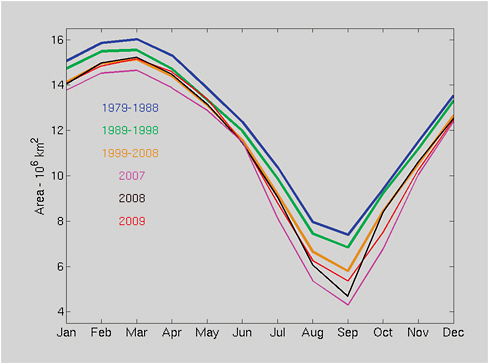
FIGURE 2.2 Sea-ice-extent data by month for 2007 through 2009 with decade averages to illustrate the trends by month. The year 2007 was the record low in nearly every month. Sea-ice extent during 2008 and 2009 recovered toward the average of the 1999-2008 decade. Data are available at http://nsidc.org/data/docs/noaa/g02135_seaice_index/. SOURCE: F. Fetterer, K. Knowles, W. Meier, and M. Savoie. 2002, updated 2009. Sea Ice Index. Boulder, Colorado, USA: National Snow and Ice Data Center. Digital media.
offshore areas around Svalbard. The status of the Northwest Passage through the Canadian archipelago—internal Canadian waters or an international strait—has been a Canadian concern since at least 1985. The issue is not resolved. Currently, icebreaker transits are allowed through nation-to-nation bilateral agreements.23 The most notable issues involve existing and potential claims of the extended outer continental shelf under provisions of the United Nations Convention on the Law of the Sea (UNCLOS). Russia’s dramatic planting of a titanium flag on the Arctic Ocean sea bottom at the North Pole in 2007 prompted a U.S. policy review resulting in National Security Presidential Directive (NSPD)-66/Homeland Security Presidential Directive (HSPD)-25, and raised the possibility that Arctic issues will require national security attention from U.S. naval forces in the future.
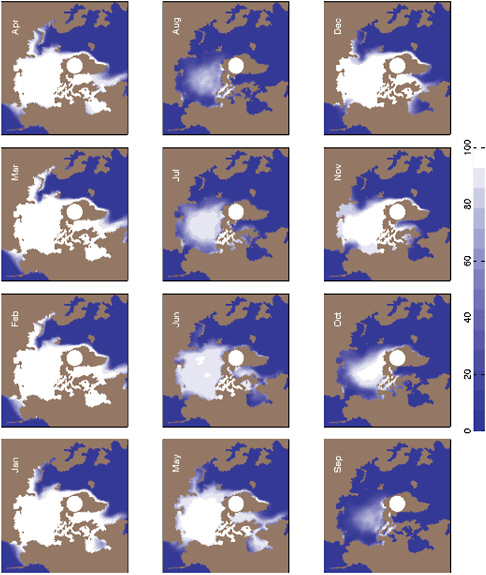
FIGURE 2.3 Possible sea-ice concentration in 2030, by month. The projection is a seven-member ensemble average from the Community Climate System Model Version 3 (CCSM3). A 50 percent ice concentration could mean that one out of two days will be sea-ice free or that on a given day the cover is 50 percent sea ice and 50 percent open water. The greenhouse gas scenario is from the Special Report on Emissions Scenarios (SRES) A1B, the moderate scenario used by climate models for the Fourth Assessment Report (AR4) of the Intergovernmental Panel on Climate Change (IPCC). In the 20-year time frame, the greenhouse gas scenario has only a moderate bearing on the results.
International focus on the Arctic, including military and naval activities, has increased considerably over the past 3 years. A March 2009 Arctic policy statement from the Russian Security Council highlighted Russia’s continued interests in the Arctic, including the need for maintaining combat potential and special Arctic military formations.24 Russian military activities, such as resumption of Bear bomber flights, have indicated an increasingly assertive Russian posture. Canada, a strong U.S. ally, is preparing and planning to build six armed, ice-strengthened patrol vessels for Arctic sovereignty operations, establish a high-latitude logistics base, and construct a high-Arctic training facility.25 Canadian naval forces are exercised each summer in Operation Nanook in northern Baffin Bay, with increasing U.S. participation. Norway, also an ally and NATO member, has moved its armed forces operations center to a more northern area of the country, and it utilizes aircraft and ice-strengthened vessels to actively patrol its Arctic waters. A Danish 2010-2104 defense plan envisions an Arctic military command and task force.26 China and Korea, while not Arctic nations, have signaled their interest and intent to participate in the Arctic, including routine deployments of an icebreaking research vessel and a physical presence on the ground at Svalbard.
Key Arctic Operational Challenges
All of these developments in the Arctic have ramifications for future operations of U.S. naval forces. The Navy has many years of Cold War operating experience in the Arctic Ocean and sub-Arctic seas with submarines, and Marines trained regularly for deployment in northern Norway until the early 1990s. Surface and air operations have not been a priority for the Navy in the high latitudes for almost 25 years; so, today’s naval forces lack experience and procedures for the challenges of these northern environments.
However, the demand for Coast Guard missions is evident and increasing. NSPD-66/HSPD-25’s discussion of U.S. national security interests includes maritime presence and maritime security operations, homeland security, asserting a more active and influential presence, and exercising control over the U.S. EEZ, the continental shelf, and the contiguous zone.27 These policy statements speak directly to Coast Guard responsibilities, reflecting aspects of the Coast Guard’s 11 statutory missions. Since 2007, the Coast Guard has surged cutters, aircraft, boats, and special detachments to Arctic Alaska during the summer season to
|
24 |
Katarzyna Zysk. 2010. “Russia’s Arctic Strategy,” Joint Forces Quarterly, Issue 57. |
|
25 |
Ross Graham, Director General Defence Research and Development Canada, Center for Operational Research and Analysis, “Impact of Climate Change on Canadian Naval Operations in the Arctic,” presentation to the committee, February 4, 2010, Washington, D.C. |
|
26 |
BBC News, “Denmark Plans Forces for the Arctic,” July 16, 2009; available at http://news.bbc.co.uk/2/hi/8154181.stm. Accessed July 28, 2010. |
|
27 |
See National Security Presidential Directive-66, Article III B 1; available at http://www.fas.org/irp/offdocs/nspd/nspd-66.htm. Accessed July 28, 2010. |
increase competencies, develop Arctic operating procedures, and evaluate asset capabilities.
Unclassified national intelligence assessments suggest a low likelihood of significant conflict in the Arctic region in the foreseeable future.28 Nevertheless, as a hedge against a more extreme scenario, the committee believes that as access to Arctic and sub-Arctic seas increases, the U.S. Navy and Coast Guard must be prepared for the potential requirement to exercise the full range of their capabilities in the Arctic. Establishing and maintaining U.S. naval capabilities in the Arctic will require attention to shore-based infrastructure, communications capabilities, competencies and operating experience, icebreakers and ice-capable ships, and combatant command issues.
Shore-Based Infrastructure
The Arctic encompasses vast areas with long distances between outposts. An infrastructure capable of supporting surface and air operations is sparse, particularly in Alaska and the western Arctic waters. This shortcoming especially affects the Coast Guard and its ability to execute mission responsibilities in the Bering, Chukchi, and Beaufort Seas. The distance from the Coast Guard’s principal Alaskan base in Kodiak (a World War II–era naval air station) to the North Slope is approximately 800 nautical miles. The Coast Guard has used the concept of a “forward operating location,” such as an Army National Guard hangar in Nome and commercial air facilities in remote communities, to support aircraft operations. But it is clear that for routine Arctic operations, the Coast Guard will have to develop a more robust methodology of supporting deployed assets. Given the high cost of constructing shore-side infrastructure and the reality that conventional piers are not feasible due to ice movement, using the inherent capabilities of a polar icebreaker as a mobile, multimission platform may be an attractive alternative. A major review of Coast Guard requirements now under way will address support infrastructure as well as better inform the need for protecting U.S. national security interests in the Alaskan Arctic.29
|
28 |
As discussed in Chapter 4, the committee’s independent evaluation, based on direct discussion with representatives from select Arctic nations and the April 2010 recent settlement of a long-standing territorial dispute between Russia and Norway, supports these assessments. See National Intelligence Council, 2025 Global Trends Report, November 2008, p. 53; available at http://www.dni.gov/nic/PDF_2025/2025_Global _Trends_Final_Report.pdf. Accessed November 24, 2009. This unclassified report states, in part: “Although serious near-term tension could result in small-scale confrontation over contested claims, the Arctic is unlikely to spawn major armed conflict. Circumpolar states have other major ports on other bodies of water, so the Arctic does not pose any lifeblood blockade dangers. Additionally, these states share a common interest in regulating access to the Arctic by hostile powers, states of concern or dangerous non-state actors; and by their shared need for assistance from high-tech companies to exploit the Arctic’s resources.” |
|
29 |
The U.S. Coast Guard has commissioned a study—the U.S. Coast Guard High Latitude Region Mission Analysis, anticipated to be completed by the fourth quarter of 2010—to better define its |
In the eastern Arctic (Baffin Bay plus the Greenland, Norwegian, and Barents seas, etc.), U.S. naval forces will clearly depend on allied nations for necessary shore-side support. The United States is well served by the time-tested NATO alliance, a history of operating with Canada, Norway, and Denmark, and established bases in the area (e.g., Thule in northeastern Greenland and Keflavik in Iceland). See Chapter 4 for a more complete discussion of allied forces.
Command, Control, Communications, Computers, Intelligence, Surveillance, and Reconnaissance Infrastructure
Effective operations by naval forces in the high latitudes will require improvements in command, control, communications, computers, intelligence, surveillance, and reconnaissance (C4ISR) capabilities for these areas. The robust set of geosynchronous Earth orbit (GEO) satellites provides reliable communications for latitudes between 65ºN and 65ºS. High-data-rate satellite communications are sparse over the polar regions. However, commercial low-rate service is available. Additionally, Global Positioning System (GPS) constellation coverage is not optimized for polar regions, and so its accuracy is reduced, but it still provides adequate performance for surface navigation. The committee believes that particular attention to the enhancement of satellite communications is vital because the requirements will become more compelling as Arctic operations increase.30 See Chapter 5 for a discussion of C4ISR technical issues.
High-Latitude Competencies and Experience
The lack of operating experience by naval surface and air forces in cold-weather environments has resulted in a generation of naval personnel unfamiliar with the demands of operating in far-north areas, both at sea and ashore. The submarine community has generally avoided this geographic operations experience gap, although Arctic Ocean submarine operations have recently been conducted at a lower tempo than during the height of the Cold War. When the Coast Guard began to deploy air and non-icebreaker surface ships to the North Slope in 2007, the lack of practical operating experience was noteworthy. For example, the U.S. Coast Guard reported that it encountered a variety of challenges with operating the 25-ft Defender-class boat and the MH-65 helicopter from the temporary forward operating location during the 2007 North Slope training exercise. The challenges include a lack of communications networks, which limited the range
|
30 |
Related to this, the committee reviewed information on national imaging capabilities that may become increasingly important as Arctic activities increase. Information on national imaging capabilities and the Global Fiducials Library is available at http://gfl.usgs.gov/. Accessed April 12, 2010. |
of operations to 60 miles. The unpredictability of sea ice and the prevailing sea state in the U.S. Arctic render the Coast Guard’s current portfolio of small boats ineffective for safe operations.31
As naval forces confront the possibility of future operational requirements in Arctic and sub-Arctic areas, it is clear that a base of operating experience and competencies must be established. For Navy fleet surface and air assets, this could best be accomplished by exercises in open-water northern extensions of the North Atlantic. The opportunity to exercise with the forces of other NATO (or even non-NATO) nations is attractive. For example, the Canadian forces’ annual Operation Nanook provides a venue for U.S. fleet forces to continue to build allied partnerships and gain Arctic operational experience. The Coast Guard should continue, at increasing tempos, the deployment of assets in Arctic Alaska and should extend these operations beyond the summer season to the degree possible.
In addition to Navy and Coast Guard operations in the Arctic, the Marine Corps should consider returning to northern engagement with allied partners as the current operations tempo in Central Command begins to diminish. The initial goal would be to develop a training program for individual Marines and small units whereby they are capable of surviving and sustaining themselves in the Arctic. Following the establishment of the training program, consideration should be given to potentially embarking small units with Navy and Coast Guard ships as they deploy in the Arctic, to conduct low-level exercises with allied forces. As examples, a small Marine unit might be inserted ashore from a Coast Guard icebreaker in an ice-covered waterway on a search and rescue mission; or an amphibious ship with landing crafts and Marines might conduct HA/DR or noncombat security exercises with Canadian forces.
Polar Icebreakers and Ice-Capable Combatant Ships
The Navy has no surface combatants hardened for ice operations. Additionally, a recent report by the National Research Council highlighted the fact that two of the nation’s three multimission polar icebreakers are at the end of their designed service lives and that the icebreaker operating budgets are controlled by the National Science Foundation.32 Considering projected increases in resource
|
31 |
See Report to Congress: U.S. Coast Guard Polar Operations, 2008, p. 12. Available at http://www.uscg.mil/hq/cg5/cg513/docs/FY08_OMNIBUS_Polar_Ops_Report.pdf. Accessed June 4, 2010. |
|
32 |
The three U.S. Coast Guard icebreakers are the Polar Star, commissioned into service in 1976; the Polar Sea, commissioned in 1978; and the Healy, commissioned in 2000. Each vessel was designed for a 30-year service life. The Polar Star has been in caretaker status since 2006. The Polar Sea is in operational condition but, because of its age, requires increasing amounts of maintenance to remain in operation. See National Research Council, 2007, Polar Icebreakers in a Changing World: An Assessment of U.S. Needs, The National Academies Press, Washington, D.C. See also Ronald O’Rourke, 2009, Coast Guard Polar Icebreaker Modernization: Background, Issues, and Options for Congress, CRS 7-5700, RL34391, Congressional Research Service, Washington, D.C., May 29. |
development, maritime transportation, and international competition in the Arctic, U.S. icebreaking resources are clearly inadequate to meet national needs. This deficiency is particularly significant given the recent and continuing investment in icebreaking resources by other countries, including China, Russia, Japan, South Korea, and the European Union (see Table 2.1 and Box 2.1).33
Icebreakers provide important naval force capabilities. These ships permit year-round access to Arctic waters, and their design includes high endurance and lengthy on-station patrol times. They can escort ice-strengthened vessels, hangar and support helicopters, carry cargo, accommodate embarked detachments, conduct scientific research, refuel and re-provision other vessels, and provide contingency command, control, and communications services. Polar icebreakers may also be an economical alternative for executing Coast Guard missions in the ice-influenced EEZ around Alaska. In general, icebreakers provide the nation with its only sovereign surface presence in the Arctic, complementing U.S. submarine and air capabilities.
Unfortunately, the Coast Guard has found that maintaining a core fleet of icebreaking capability has been challenging. Construction of the newest of the three icebreakers required 25 years of studies and budget requests before USCGC Healy was commissioned in 2000. Due to waning Cold War requirements and the use of icebreakers in supporting research, the Office of Management and Budget transferred the icebreaker operating budgets to the National Science Foundation in 2005. As the challenges of a transforming Arctic grew more apparent, the Commandant of the Coast Guard argued strongly for recapitalization of the older icebreakers, an initiative that has been supported by a 2007 NRC report, the Joint Chiefs of Staff, and NSPD-66/HSPD-25. The Coast Guard’s Acquisition Directorate has commissioned a polar icebreaker business-case analysis, reportedly to be completed in late 2010, to evaluate recapitalization alternatives as the foundation for a possible acquisition project.
Related to this, the Navy should evaluate requirements for future surface combatants and auxiliaries to operate in ice-covered waters. A recent report by the Center for Naval Analyses noted that current surface combatants might be modified or retrofitted for Arctic operations by having steel added around the
|
33 |
For example, a 2007 National Research Council report that lists a world inventory estimate of polar and Baltic icebreakers states that Russia has by far the largest fleet of icebreakers, although some of them are aging and some are used to keep supply lines open to Russia’s Arctic coastal settlements. Data in the 2007 study indicate that Russia has 18 icebreakers, 7 of which are nuclear powered; Finland and Sweden are reported to have 7 icebreakers each; and Canada is reported to have 6 icebreakers. See National Research Council, 2007, Polar Icebreakers in a Changing World: An Assessment of U.S. Needs, The National Academies Press, Washington, D.C., pp. 57-59. China, Japan, and South Korea have also made recent investments in new icebreakers targeted for polar research. For example, see “China to Build Own Icebreakers for Poles”; available at http://www.shanghaidaily.com/sp/article/2009/200910/20091008/article_415716.htm. Accessed November 24, 2009. |
TABLE 2.1 Global Polar Icebreaker Inventory by Countrya
|
Country of Ownership |
Total Icebreakers |
Inventory by Age (Decade of Entering Service) |
Propulsionb |
|
Russia |
18 |
5—1970s |
7—N |
|
|
|
8—1980s |
7—DE |
|
|
|
3—1990s |
4—D |
|
|
|
2—2000s |
|
|
Finland |
7 |
2—1970s |
7—DE |
|
|
|
2—1980s |
|
|
|
|
3—1990s |
|
|
Sweden |
7 |
3—1970s |
6—DE |
|
|
|
1—1980s |
1—D |
|
|
|
3—2000s |
|
|
Canada |
6 |
1—1970s |
5—DE |
|
|
|
3—1980s |
1—D |
|
|
|
1—1990s |
|
|
|
|
1—2000s |
|
|
Netherlands |
3 |
1—1970s |
1—DE |
|
|
|
2—1980s |
2—D |
|
3 |
2—1970s |
3—DE |
|
|
|
|
1—2000s |
|
|
aIn addition to the inventory listed in this table, the following countries own and operate at least one operational icebreaker: Argentina, Australia, China, Germany, Japan, and Norway. China, Japan, and South Korea are also reportedly investing in additional icebreaker capacity for polar research. bN = nuclear, DE = diesel electric, and D = geared diesel. c The Nathaniel B. Palmer, commissioned in 1992, is a 308-ft-long, geared diesel vessel, chartered and operated by the U.S. National Science Foundation. The Palmer has limited icebreaking capability (3 feet thick at speeds of 3 knots) and is used exclusively as a research vessel in the Antarctic. As a single-mission research vessel with limited icebreaking capability, it is considered by many to be more of an oceanographic research ship than a true icebreaker. The Palmer is not included in these numbers. dOn June 25, 2010, the U.S. Coast Guard announced that its only operational heavy icebreaker, the Polar Sea, suffered an unexpected engine casualty and will be unable to deploy on its scheduled fall 2010 Arctic patrol. Polar Sea will likely be in a maintenance status and unavailable for operation until at least January 2011. Polar Sea was commissioned into service in 1978 with a 30-year service life. In 2006 the Coast Guard completed a rehabilitation project that extended its service life to 2014. Polar Star, the Coast Guard’s other heavy icebreaker, commissioned in 1976, is currently in the process of being reactivated but will not be operational for deployment until 2013. The Polar Star was placed in a caretaker status in 2006. Currently, the 420-foot USCGC Healy, commissioned in 2000, is the service’s sole operational polar region icebreaker. While the Healy is capable of supporting a wide range of Coast Guard missions in the polar regions, it is a medium icebreaker capable of breaking ice up to 4.5-feet thick at three knots. (USCG Compass, June 25, 2010, and USCGC Healy website). SOURCE: Derived from Arctic Marine Shipping Assessment Data Base, National Research Council, 2007, Polar Icebreakers in a Changing World: An Assessment of U.S. Needs, The National Academies Press, Washington, D.C.; and Ronald O’Rourke, 2009, Coast Guard Polar Icebreaker Modernization: Background, Issues, and Options for Congress, CRS 7-5700, RL34391, Congressional Research Service, Washington, D.C., May 29. |
|||
|
BOX 2.1 Conclusions and Recommendations from 2007 NRC Report on U.S. Coast Guard Polar Icebreaker Needs The following conclusions and recommendations are reprinted from National Research Council, 2007, Polar Icebreakers in a Changing World: An Assessment of U.S. Needs, The National Academies Press, Washington, D.C., pp. 2-3: [B]oth operations and maintenance of the polar icebreaker fleet have been underfunded for many years, and the capabilities of the nation’s icebreaking fleet have diminished substantially. Deferred long-term maintenance and failure to execute a plan for replacement or refurbishment of the nation’s icebreaking ships have placed national interests in the polar regions at risk. The nation needs the capability to operate in both polar regions reliably and at will. Specifically, the [2007] committee recommends the following:
|
waterline, but that this would provide only marginal capability.34 Effective vessel operation in sea ice, even in ice concentrations less than 10 percent, requires not only hull protection but also strengthened and upgraded propellers, rudders, seawater intakes, and hull-mounted sensors. In this committee’s opinion, it is better to build ice-capable ships from the keel up, either by incorporating the capability into current designs or by designing a new class of vessels, as other nations have chosen to do. For example, the Canadian Navy is designing a class of armed, ice-capable patrol vessels.35 As future U.S. Navy surface ships’ needs are evaluated, existing ship classes modified and upgraded for operating in sea ice may offer the right level of naval capability. It may also be wise to build more robust under-ice capability into some fraction of future Virginia-class nuclear-powered attack submarines to support the projected increase in under-ice missions.36
FINDING 2.3: The nation has very limited icebreaker capability, which could limit the U.S. ability to train, operate, and engage in the Arctic. Furthermore, as noted in a 2007 National Research Council report, “both operations and maintenance of [the] polar icebreaker fleet have been underfunded for many years, and the capabilities of the nation’s icebreaking fleet have diminished substantially” and, among other things, “the U.S. Coast Guard [USCG] should be provided sufficient operations and maintenance budget[s] to support an increased, regular, and influential presence in the Arctic.”37 Moreover, U.S. national icebreaker assets are old, obsolete, and under the control of another agency that does not have a national security operational mandate. The present committee believes that future USCG missions in the Arctic will require autonomy and command of their vessels.
RECOMMENDATION 2.3: In order to support the U.S. naval forces’ missions in the Arctic, the U.S. Coast Guard (USCG) needs icebreaker capabilities under
its operational control. While there are other national requirements for such ships, action should be taken to provide these operational capabilities to the USCG. Therefore, the Chief of Naval Operations should support the initiatives of the Commandant of the Coast Guard to define future USCG icebreaker needs. As such, future U.S. national icebreaker assets should be defined as part of a holistic force structure that also accommodates ongoing National Science Foundation-sponsored polar research needs.
Arctic Command Issues
As world conditions and defense needs evolve, the Unified Command Plan (UCP) is occasionally updated. For example, in 2004 U.S. COCOM responsibilities in the Middle East were realigned. The more recent creation of Africa Command was a major realignment of COCOM responsibilities. The committee believes that it is time to review the Arctic in this regard.
The Arctic contains areas of responsibility of three combatant commanders—Commander, U.S. European Command (EUCOM); Commander, U.S. Northern Command (NORTHCOM); and Commander, U.S. Pacific Command (PACOM). Because Arctic boundaries are so complex and are subject to change, the U.S. command structure for this region should be reviewed. Many international and interagency issues are in play in the Arctic, including search and rescue, navigation, and environmental rules related to operations at sea. The primary issues in the Arctic at the current time are legal as opposed to military in nature, so a review of the U.S. command structure should involve the State Department, Coast Guard, and perhaps other agencies as well. Because defense posture, particularly in the Arctic, is now more focused on engagement rather than on military force, DOD combatant command authority structure for the Arctic region should be as consistent as possible with State Department areas of responsibility.
FINDING 2.4: The current situation of three combatant commanders—Commander, U.S. European Command; Commander, U.S. Northern Command; and Commander, U.S. Pacific Command—having overlapping areas of responsibility for the Arctic was perhaps workable when the Arctic was less important than it is rapidly becoming. This division of responsibility in the Arctic is inconsistent with U.S. national interests and does not match the command structure of other U.S. agencies (such as the Department of Homeland Security and the U.S. Department of State) in this increasingly significant region of the world.
RECOMMENDATION 2.4: The Chief of Naval Operations should engage the Joint Chiefs of Staff in a review of combatant commanders’ responsibilities for the Arctic, with the goal of ensuring the most effective command structure. Interagency considerations, including but not limited to the U.S. Department of State, should be included in these deliberations.
MAINTAINING CAPABILITIES
As the operating environment changes, the Navy needs to understand how its ability to project power will be impacted. For example, regarding strike warfare, a 2003 study by the Center for Naval Analyses looked at the susceptibility of carrier flight deck personnel to heat stress.38 This study was unrelated to climate change consideration and was driven by requirements at that time for prolonged carrier summer operations in the Arabian Gulf. The study found that under such high-temperature conditions (heat indices reaching 140ºF on the flight deck), crew become fatigued more quickly than under normal conditions, and crew endurance became the limiting factor in the ability of the airwing to maintain high-tempo operations. The study estimated that the firepower potential of the airwing (sorties per hour) was reduced to about two-thirds of that possible in temperate climates.
As stated in the Navy’s Climate Change Roadmap,39 one of the Navy’s priorities is to ensure that it is fully mission capable as climate changes. Because virtually all Navy operations are subject to the effects of weather, climate change could prove challenging. If severe weather becomes more frequent as climate changes, training and readiness can also be affected. Although there is not too much that the Navy can do to prevent this or create more weather-resilient platforms, it will be increasingly important for the Navy to ensure a robust weather monitoring and prediction capability. These are critical capabilities now and will, perhaps, become even more critical in the future.
FINDING 2.5: In the post–Cold War era, the U.S. Navy has had a very limited surface ship presence in true northern latitude, cold-weather conditions. According to information presented to the committee, the U.S. military as a whole has lost most of its competence in cold-weather operations for high-Arctic warfare.
RECOMMENDATION 2.5: The Chief of Naval Operations, the Commandant of the Marine Corps, and the Commandant of the Coast Guard should establish a strong and consistently funded effort to increase Arctic operations and share lessons, including with allies. In the immediate term, the Navy should begin Arctic training and the Marine Corps should also reestablish a cold-weather training program.
HEALTH, DISEASE, AND CLIMATE
During its deliberations, the committee was briefed on the significant implications of climate change on health.40 These changes may also have an impact on global hot spots or cause concern for U.S. naval forces. The implications are from both the primary effects of changes in patterns and intensity of disease and the secondary effects of disease on populations already stressed by malnutrition and a burden of chronic disease. An example is a situation where a chronically undernourished infant becomes afflicted with acute diarrheal disease. The threat is immediate from the acute disease and long term due to the known deleterious effects of disease on growth and development.
The spectrum of climate change impacts on human health and disease is wide, including the European heat wave of 2003, which took over 30,000 lives, and extreme precipitation events leading to outbreaks of disease—such as the diarrheal disease outbreak caused by Cryptosporidium in Milwaukee, Wisconsin, following heavy spring rains in 1993.41 On the other hand, drought can be just as harmful, because it leads to a diminished and more likely contaminated water supply resulting in outbreaks of diseases such as cholera and the spread of disease such as Rift Valley Fever in Africa, or the hantavirus. There are also several cited examples suggesting that climate change has resulted in the introduction of certain infectious diseases into previously unaffected areas. Examples include outbreaks of malaria in the highlands of East Africa, the spread of Dengue fever into Mexico and most likely soon the United States, and the discovery for the first time of two known pathogens—cryptococcosis and Vibrio vulnificus—in the Pacific Northwest and Vancouver.42 (As an example of recent regional climate
|
40 |
RADM Ali S. Khan, MD, MPH (U.S. Public Health Service), Assistant Surgeon General and Deputy Director (acting), National Center for Emerging and Zoonotic Infectious Diseases, Department of Health and Human Services/Centers for Disease Control and Prevention, “Climate and Health: Preparing for and Communicating Complexity”; and Eileen Choffnes, Scholar/Director, Forum on Microbial Threats, The National Academies Institute of Medicine, “Ecological, Environmental, and Infectious Disease Implications of Global Climate Change and Extreme Weather Events”—presentations to the committee, February 4, 2010, Washington, D.C. |
|
41 |
See, for example, “The 2003 Heat Wave in Europe: A Shape of Things to Come? An Analysis Based on Swiss Climatological Data and Model Simulations,” Geophysical Research Letters, Vol. 31, 2004; available at http://www.agu.org/pubs/crossref/2004/2003GL018857.shtml. See also “A Massive Outbreak in Milwaukee of Cryptosporidium Infection Transmitted Through the Public Water Supply,” New England Journal of Medicine, July, Vol. 331, No. 3, pp. 161-167, 1994. |
|
42 |
Cryptococcosis is a potentially fatal fungus disease. This fungus is ordinarily found in soil. It is the cause of the most common life-threatening meningitis in AIDS patients. Early in the epidemic, approximately 5 to 8 percent of patients with AIDS developed cryptococcal infection. Cryptococcosis mainly occurs in the tissues covering the brain, spinal cord in the lungs, and on the skin. Vibrio vulnificus is a gram-negative bacillus that only affects humans and other primates. It is in the same family as bacteria that cause cholera. The first documented case of disease caused by the organism was in 1979. V vulnificus is usually found in warm, shallow, coastal salt water in temperate climates throughout most of the world. |
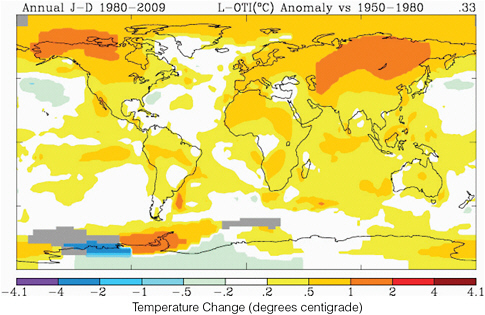
FIGURE 2.4 Regional variation in global temperature trends over the past 30 years. Yellow, orange, and red designate average increase in temperate (ºC) from 1980 through 2009, compared with the previous three decades. Warming has been the greatest in the Northern Hemisphere. SOURCE: NASA Goddard Institute for Space Studies, http://data.giss.nasa.gov/gistemp/.
change differences, Figure 2.4 provides a view of variation in regional temperature change over the past 30 years.)
Both the National Research Council and the World Health Organization (WHO) have released reports regarding the estimated effects of climate change on disease vectors and human health.43 According to these reports, the impacts of climate on human health will not be evenly distributed around the world. Developing countries, particularly in small island states, arid and high mountain zones, and densely populated coastal areas, are considered to be particularly vulnerable to these impacts. Based on these studies, human health and disease effects may exacerbate climate change impacts in certain regions of the globe, impacting the United States and its allies, and they are also cause for U.S. naval forces to consider new-disease vectors when preparing to respond to new missions.
FINDING 2.6: Climate change is impacting the geographic distribution of disease and, in many instances, its intensity. As disease vectors change their distribution, the result is larger populations at risk. In addition, previously unexposed populations may be more severely affected, particularly when they carry the burdens of malnutrition and chronic disease.
RECOMMENDATION 2.6: U.S. naval leadership should consider the impact of changing disease vectors on the population when forecasting the impact of climate change, and should also consider climate-change-related changing disease vectors in preparing troops for response to missions around the globe.


