
MORRIS HOWARD HANSEN
December 15, 1910-October 9, 1990
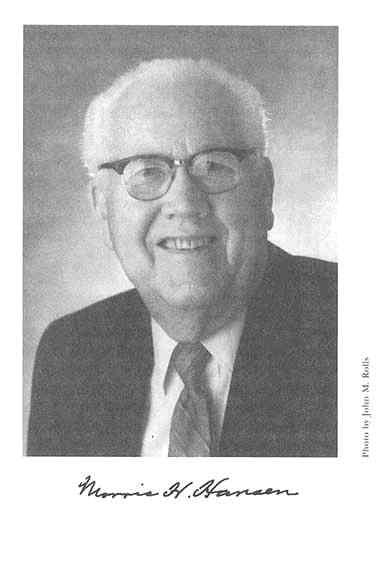
BY JOSEPH WAKSBERG AND EDWIN D. GOLDFIELD
MORRIS HANSEN WAS THE most influential statistician in the evolution of survey methodology in the twentieth century. Early in his career at the Census Bureau he put together and directed a staff of mathematical statisticians and other survey methodologists whose aim was to systematically define the principal problems in the conduct of surveys, carry out research on these problems, and develop the statistical methods necessary to overcome them. This work included the development of sampling theory necessary for the efficient conduct of large-scale national surveys, the establishment of formal quality control methods for surveys, and the derivation of theory and models for analyses of nonsampling errors.
Hansen prodded the Census Bureau into accepting such innovations as the purchase of the first computer for statistical purposes, the development of optical scanning equipment, the introduction of self-enumeration and mail in both demographic and economic censuses, and other survey techniques now commonly used by both government and private organizations. He anticipated the concern that would arise over the completeness of coverage in decennial population censuses and, long before the current interest in the subject, he persuaded the bureau to adopt procedures de-
signed to improve coverage; and he directed research on coverage problems. Both the statistical methods he and his staff developed and the form of research staff he organized had a profound effect on statistical agencies all over the world.
Morris H. Hansen was born on December 15, 1910, in Thermopolis, Wyoming. His parents, Hans C. and Maud E. Hansen, lived in the nearby town of Worland, Wyoming, where Morris was raised. Although Morris left Wyoming soon after graduating college, he retained fond memories of Worland, and would talk about his childhood and adolescent experiences to his friends. At the time of Morris's birth Worland had a population of 265 and Wyoming's population was 145,965. In the eight decades following, Worland's population grew twenty-fold and Wyoming tripled its size; Morris's stature increased much more. He became one of this country's, and the world's, most prominent statisticians.
He majored in accounting at the University of Wyoming, obtaining a B.S. degree in 1934. His stay at the university was interrupted in midstream while he took a year's absence in order to work to earn some money. The only statistics courses the university offered were a couple of courses in economic statistics. Morris took the courses, taught by a very good teacher, Forrest Hall, who stimulated Morris's interest in statistics. He decided that he would attempt to make a career in statistics, not a common profession in those days. Morris's subsequent formal training in statistics consisted of after-hours courses taken at the Graduate School of the U.S. Department of Agriculture and at American University, where he received a master's degree in statistics in 1940. (He was later granted an honorary doctorate by the University of Wyoming in recognition of his contribution to survey research.) By that time he had made himself into a highly skilled statistician, learning his trade both at
school and at work. Throughout his career he continued to learn from those he worked with, from those he conversed with, and most of all, from himself. Much of what we now know about sample survey theory and methodology was developed by Morris Hansen, using his great ability to absorb and develop and apply.
When Morris graduated from college in 1934 there were few jobs available. He found some temporary employment with the Wyoming State Emergency Relief Administration, and took federal civil service examinations. His high ratings on the examinations and the fact that Wyoming was below its quota for federal jobs brought him an employment offer from the Bureau of the Census in Washington. He began work in the bureau's Personnel Division in 1935, and the following year was transferred to the Statistical Research Division, then headed by Calvert L. Dedrick. This marked the real beginning of what was to be a long and productive career in statistical surveys and censuses.
During the depression of the 1930s emergency relief agencies were handicapped by a lack of good information about the extent of unemployment and the characteristics of the unemployed. In August 1937 the U.S. Congress, with the strong support of President Roosevelt, authorized a national voluntary census of the unemployed and partially unemployed. The census was conducted in the fall of 1937. Postal workers delivered to every household on postal routes a questionnaire to be filled out and returned.
It soon became evident that there were problems in getting complete and accurate response in the census. Knowledgeable statisticians, including Dedrick and project consultants Samuel A. Stouffer and Frederick F. Stephan, recommended that a follow-on sample survey be conducted by direct person-to-person interview to check on the validity of the census. The administration endorsed the sugges-
tion. Dedrick, who was serving as chief of the technical staff of the unemployment census, directed the project, called officially the enumerative check census. He brought Morris, then not quite twenty-seven years old, into the project. Morris helped design the sample and the statistical procedures to generate estimates of unemployment and estimates of the standard errors of the unemployment estimates, and to project sample estimates to smaller areas through regression relationships. All of this, in fact the very idea of sample surveys for official governmental guidance, was quite new.
On a very fast track, the survey was conducted in mid-November 1937. The census itself produced three large volumes of detailed data, reporting for the nation as a whole 7.8 million totally unemployed and 3.2 million partially unemployed. The sample survey results were published as Volume IV, ''The Enumerative Check Census," written by Dedrick and Hansen. It reported estimates of 11.0 million totally unemployed and 5.5 million partially unemployed. The volume IV statistics were generally accepted and used much more than the three volumes of the census itself, which were referred to mainly for the geographic detail they provided. This experience significantly contributed to the acceptance of sampling by the government. Ingram Olkin in an interview with Morris commented,1 "This was really a major innovation in the philosophy of sampling and censuses." This experience encouraged the Works Progress Administration to sponsor the development of a monthly sample survey of households beginning in 1940 to provide estimates of employment and unemployment, which under the Census Bureau became known as the Current Population Survey.
In 1941 Morris became the assistant chief of the Statistical Research Division at the Census Bureau. William N. Hurwitz had joined the staff in 1940, beginning a close
collaboration with Morris that lasted for almost thirty years and produced a steady stream of notable contributions to statistical science and practice. Hansen-Hurwitz put together and directed a staff of bright young statisticians that led the way in developing modern scientific techniques in sampling and other survey-related methodology.
When the Census Bureau became responsible for the government's monthly household sample survey that had become relied upon as the barometer of employment and unemployment, Hansen and his team set about to improve it and to put it on a sound basis, both in terms of mathematical theory and in terms of the efficiency of field and processing operations. In so doing, they made it into a model for other government agencies, the private sector, and many other countries whose statisticians came to the Bureau of the Census for training.
In examining the methodology for conducting sample surveys that was considered state of the art in the 1930s, Hansen and Hurwitz realized that the mathematical-statistical theory underlying sampling methods was inadequate. They started to work on the development of the necessary theory. The seminal paper that resulted from this work was one of the first articles on the general theory of finite sampling2 As stated in the book Revolution in United States Government Statistics (1926-1976), 3 "[T]he importance of the article goes well beyond the one survey . . . [I]t represented a major breakthrough in the theory as well as the practice of finite sampling in the social and economic fields." This paper was followed by a number of others which developed sampling theory in more detail. The papers included the extension of theory to cluster sampling in which the number of elementary units is not the same in all clusters. The work pointed out the advantages of very large primary sampling units in a multistage sample when costs and adminis-
trative restrictions are taken into account. The statistical properties of sampling units at various stages of a multistage sample drawn with probability proportionate to some measure of size of the sampling unit received attention. Emphasis on the acceptability of an estimator was shifted from unbiasedness to consideration of consistency and mean square error. Hansen was an advocate of the principle that in most cases inference from sample surveys should be based on the design of the surveys rather than on assumed models of the population, and co-authored a number of papers on the subject; however, he had an open mind on this topic (as well as on most other statistical issues) and recognized conditions under which models were useful.
In 1953 there was issued what quickly became, and remained for a long time, the bible for sample survey practitioners: the two—volume work Sample Survey Methods and Theory.4 It is still considered a standard reference on the theory and application of probability sampling. The publisher, Wiley, reissued the book in 1993 in the Wiley Classics Library. The distinguished British statistician T. M. F. Smith, in a lecture on sample surveys in 1991,5 likened the contribution of Morris and his colleagues to sample surveys as equivalent to R. A. Fisher's contribution in other areas of statistical science, saying, "I now realize that the contributions of Morris and his colleagues to sample surveys represent an equivalent contribution from statistics to social science and more generally to all forms of observational study."
Even the relatively advanced western European countries were fallow ground for education in the new techniques, some developed by Hansen and Hurwitz, and others by the staff they had put together and who considered themselves disciples. One of the authors of this memoir recalls that in the early 1950s he (E.D.G.) traveled to the western European countries to spread the gospel and then organized
and directed an extended training course for senior European government statistical officials at the Bureau of the Census in household sample survey techniques and the use of such surveys to produce current labor force statistics. A book published by the Bureau of the Census included the lectures given in the course by Morris and others and a subsequent book, Labour Force Statistics: Sample Survey Methods, was published by the Organization for European Economic Cooperation. The seeds thus planted yielded a crop of sample survey programs, modeled after the United States, in many European countries and later in other countries.
With the established success of sampling in population surveys Morris turned his attention to business surveys. He encountered the attitude that, while sampling would work with populations that were relatively homogeneous, it would not work with business surveys, where the units were very diverse in size and characteristics and the distributions were very skewed. Hansen and his associates were able to show how to take advantage of this skewness with differential sampling rates and approximately optimum allocation of the sample. Sampling was successfully extended, with new principles, methods, and theory developed as needed, to data gathering on manufacturing, retail trade, wholesale trade, agriculture, government units, and other subjects, making it possible to compile more and better information on the state of the economy.
A parallel development was the introduction of sampling into the major censuses. Until 1940, all items of information in the decennial censuses of population and the more frequent censuses of the various economic sectors were collected on a 100% basis. This was costly, burdensome to respondents, time-consuming, and imposed constraints on the number of questions that could be included in the censuses.
Morris's first contribution to census-taking was to work with W. Edwards Deming, Philip M. Hauser, and Frederick F. Stephan in developing the sample to be used within the 1940 decennial census of population. Some of the questions in that census were asked of only a sample of the population. Morris and his team later were major participants in the redesign of all the major censuses. Sample schemes were devised not only for collecting some of the information on a sample basis, but also for tabulation and for quality control of the census operations. Studies by Hansen and his staff led to the conversion of the decennial census from door-to-door canvassing by enumerators to a census now largely done by mail with self-enumeration by the household respondents. The change in procedure not only introduced operational gains, but also gains in the quality of the data. The Hansen team's experimental studies for the control of measurement errors in the decennial census had demonstrated that correlated errors within the work of enumerators constituted a serious problem (e.g., an enumerator who consistently misinterpreted a particular question could destroy the validity of that item for the entire area that he or she covered), and that self-enumeration substantially reduced this kind of bias and also improved accuracy of response on most items. The innovations under Morris's leadership radically changed census procedures that had been in effect for 150 years.
The revolutionary changes in census methodology came about as a result of two approaches that Morris and his colleagues pioneered. The first was the introduction of the concept of total survey design. This meant the incorporation of nonsampling error into the consideration of choices among alternative survey designs. In other words, this implied recognition that when the errors resulting from simple response and interviewer variance and the biases resulting
from the use of relatively untrained interviewers were already large, sampling errors could be introduced, even in small areas, with very little additional impact on quality. On the basis of this research it became clear that better quality would result from resorting to sampling, and using the cost savings to improve interviewer training, supervision, and quality control.
The second approach was related to the importance of research in the work of statistical agencies. Morris emphasized the need to conduct both short-term research to solve immediate problems and long-term research required to identify issues and to look for solutions. An implicit assumption in total survey design is that data are available to analyze components of error and unit costs. Morris's intellect and drive led to a tacit acceptance of the fact that research and development are essential parts of a census program, and that a reasonable proportion of the total budget should be assigned to these functions. Hansen and his associates developed theory that reflects the contribution of data collectors and data editors to the total mean square error of an estimate. The theory is widely known as the Census Bureau model of survey error. On the basis of that model, the Bureau of the Census has implemented the estimation of the error contributions of enumerators in the population census and current population survey, as well as from coders of occupational categories, and in the economic censuses.
An illustration of how this approach was applied in practice occurs in the considerations that led to the decision to extend the use of sampling to most items collected in the 1960 U.S. census. (The wide use of sampling was continued in subsequent U.S. censuses and has also been adopted as an almost international standard.) The studies of sampling, response, and interviewer errors carried out on the 1950
census indicated that for most census items the total mean square error was only slightly affected by the introduction of a moderate amount of sampling error.6
Morris was a leader in bringing the electronic era into statistics. J. Presper Eckert and John W. Mauchly, who were involved in the building of ENIAC, an electronic computer built for specific military purposes in the early 1940s, saw the possibility of adapting the technology into the design and construction of a large-scale general-purpose electronic computer with the capacity to process large quantities of data such as those collected in a census. They recognized that the Census Bureau might be interested in having such a computer and initiated discussions with Morris, who quickly realized the potential importance to statistical applications. Together they formulated a plan for the design and building of a data processing computer with the sponsorship of the Bureau of the Census. With the assistance of the National Bureau of Standards (now called the National Institute of Standards and Technology) negotiations were conducted that led to the building by Eckert and Mauchly of Univac I, with input into the design decisions by the Hansen staff. Univac I was the first electronic statistical computer. The first of what became a series was received by the Bureau of the Census in early 1951 and was put to work twenty-four hours a day, seven days a week on parts of the data processing of the 1950 census.
The next major electronic advance that the Hansen team undertook was the development of mark-reading electronic equipment that could replace manual card punching and handle the massive data conversion job for the 1960 census. The result was FOSDIC—Film Optical Sensing Device for Input to Computers—invented and produced by the joint effort of the staff of the Bureau of the Census and the Bureau of Standards. The equipment was designed, tested,
and constructed in time for its highly successful use in the 1960 census. With successive improvements it has been used in every decennial census since.
Hansen was the dominant force in the design of sample surveys in the Bureau of the Census. His first major contribution was the design of the Enumerative Check Census of unemployment in 1937 which involved a probability sample of postal delivery routes and ratio estimators. Sampling for some items was introduced in a decennial census in the 1940 census of population and housing and has been an integral part of decennial censuses ever since. The 1943 redesign of the labor force survey, now known as the Current Population Survey, is largely based on the theoretical developments mentioned above. This is also true for the bureau's retail trade survey and the other periodic sample surveys conducted by the bureau. Both the methods of integrating sample data with 100% data in censuses and the design of intercensal sample surveys have been adopted by national statistical agencies worldwide.
Upon his retirement from the Bureau of the Census in 1968 Hansen was invited by Edward C. Bryant, president and one of the founders of Westat, Inc., to join the company. Westat was at that time a fairly small statistical research company specializing in U.S. government contract work. It was established a few years earlier by Ed Bryant, at that time chairman of the department of statistics at the University of Wyoming, and several colleagues at the university. Ed knew Morris personally as well as professionally and, of course, by 1968 Morris's reputation was well-established. In addition, the two had University of Wyoming connections. (Another alumnus of the University of Wyoming was W. Edwards Deming. It is curious that the University of Wyoming, a relatively small institution that did not have a particularly strong department of statistics, produced three
distinguished statisticians. The university was apparently a close bond among the three—Hansen, Bryant, and Deming—and they were good friends as well as professional colleagues.)
Morris accepted Ed Bryant's invitation and was appointed senior vice-president of Westat. Later, when Ed Bryant retired from active participation in the company management, Hansen was elected chairman of the board of directors. In the next few years a number of Morris's former associates from the Census Bureau joined Westat, primarily because of the intellectual stimulation of working with him. His insistence on exacting standards, his leadership in inspiring the professional staff, and his personal involvement in the design of some of Westat's major projects were important factors in the company's success. At Westat he had a lead role in the design of many important national surveys carried out by U.S. government agencies and by Westat, such as the consumer price index (CPI) and the national assessment of educational progress (NAEP).
He was particularly proud of his contribution to the CPI. The prevailing philosophy regarding the CPI was similar to earlier beliefs with respect to sampling from highly skewed distributions for business establishments, that is, "you can't do probability sampling; it applies to other areas but it doesn't apply here." With Benjamin J. Tepping, a frequent collaborator, Morris proposed procedures for selecting samples of establishments and of items to price within the establishment that followed principles of probability sampling. Because of changes that constantly take place and the need to keep the same sample in operation constantly, the sample could not be kept up to date in a probability sample sense. Nevertheless, it was a substantial advance over procedures used previously. The Bureau of Labor Statistics adopted the new methods and later extended them to other areas, the
producers price index and the international trade price index.
While at Westat, Morris made important advances in methods used for quality control on welfare programs run by the states including aid to families with dependent children (AFDC) and food stamps. Hansen, working with Ben Tepping, proposed federal monitoring programs using subsamples of cases that had been examined by state quality control reviewers. Estimates of errors were then prepared from both the statedata and those reported by the subsequent federal monitors using a double sample regression estimator. The procedure got the maximum information possible from the data available in the estimation of overpayments to recipients. It also made the sanctions on the states depend on the federal investigations, not the states. These procedures were soon adopted by the agencies responsible for the programs.
He continued his interest in sampling theory as well as in practical application of accepted methods. A paper he prepared with Ben Tepping and William Madow was an important contribution to a controversy among researchers in sampling theory and estimation on the role of models in making inferences from survey data.7 He wrote a number of papers relating to historical developments in sampling theory and, more generally, to survey methods. He also continued his role as advisor to a number of government statistical agencies (both in the United States and Canada) and activities in statistical societies.
A special feature of Morris's approach to his work, which helped make him not only respected but beloved by those who worked with him, was his strong belief in teamwork. He did not merely direct; he collaborated. Ideas were crystallized in one-on-one encounters and in group discussions. Morris was exceedingly generous in sharing credit and in
acknowledging contributions. He was modest and a good listener. He earned, and received, the steadfast loyalty of all who worked with him. He was a major influence in the direction of the professional careers of his staff and was a personal friend to most of them.
Morris was much in demand as an advisor and teacher. He taught statistics courses at the Graduate School of the U.S. Department of Agriculture. He was a member of the Advisory Committee to the U.S. Office of Statistical Policy, an advisor to the Program for National Assessment of Educational Progress, a member of the Committee on Statisticians in Governmental Service (advisory to the Civil Service Commission), a contributor to the report of the President's Commission on Federal Statistics (1971), and a consultant to UNESCO and to the U.N. Food and Agriculture Organization. He visited a number of countries on consultation missions, including Canada, Sweden, Japan, and India. In India on one occasion he met with Prime Minister Nehru and on another occasion with Chinese Premier Chouen-Lai, who was visiting India at the time.
Morris was one of the founders of the International Association of Survey Statisticians and, virtually by acclamation, its first president.
Among the many honors and awards Morris received are the following:
Elected to National Academy of Sciences, 1976
Honorary LL.D, University of Wyoming, 1959
Rockefeller Public Service Award, 1962
Department of Commerce Distinguished Service Award
Fellow of the American Statistical Association (vice-president, 1951-53; president, 1960)
Honorary fellow of the Royal Statistical Society
Honorary member of the International Statistical Institute
Fellow of the Institute of Mathematical Statistics (vice-president, 1947; president, 1953)
First president of the International Association of Survey Statisticians, 1973-77
Morris was also a member of AAAS, the Inter-American Statistical Institute, the Population Association of America, and of the Sigma Xi, Alpha Tau Omega, and Phi Kappa Phi fraternities.
Morris's principal services to the National Academy of Sciences and the National Research Council were:
Member-at Large of the NRC Division of Behavioral Sciences, 1968-70
Member of the Advisory Committee on Problems of Census Enumeration, Division of Behavioral Sciences, 1969-71
Member of the Committee on National Statistics, 1972-76
Member of the Panel on Incomplete Data, Committee on National Statistics, 1977-84
Member of the Committee on Ocean Science Manpower Trends and Curriculum Needs, Ocean Sciences Board, 1978-79
Member of the NAS Report Review Committee, 1978-82
Member of the Board on International Comparative Studies in Education, Commission on Behavioral and Social Sciences and Education, 1988-90
Morris had remarkable energy, most of which he devoted to his work, but he found time to be a good friend to many and a good family man, and to get some recreation in boating and hiking. He married Mildred R. Latham in 1930, and they had four children: Evelyn Maxine, Morris Howard, James Hans, and Kristine Ellen. (With good statistical tech-
nique, they were stratified evenly into two boys and two girls.) Mildred died in 1983. Morris married Eleonore Lamb in 1986; she survives him and remains as stepmother to Morris's children.
Morris never retired. He continued to be active as a company executive, working statistician, consultant, author, and member of advisory committees to the time of his death. His last paper (with Benjamin J. Tepping) appeared only a week before he died in the September 1990 issue of the Journal of the American Statistical Association.
His death was followed by memorials throughout the statistical world. The March 1991 issue of the International Journal of Official Statistics was dedicated to his memory. So was the December 1990 issue of the Canadian journal, Survey Methodology, whose dedication said, ''This issue is dedicated to the memory of Morris H. Hansen, a pioneer, innovator and leader who made fundamental and lasting contributions to many aspects of survey methodology." An international conference on measurement errors in surveys and a book8 containing the invited papers presented at the conference were dedicated to his memory. Westat provided funds to the Washington Statistical Society to establish an annual Morris Hansen lecture, featuring eminent statisticians from the United States and other countries.
THIS MEMOIR IS BASED on the personal recollections and files of the authors; the files of the history branch and of Mary Ann Cochran of the Bureau of the Census; brief biographies in standard reference volumes and in The American Statistician of February 1991; an article of reminiscences by Morris Hansen and an interview of Morris Hansen by Ingram Olkin, both in Statistical Science of May 1987; an unpublished interview of Morris Hansen by James L. O'Brien conducted on June 22, 1983; Revolution in United States Government Statistics 1926-1976 by Joseph W. Duncan and William C. Shelton, published in October 1978 by the Office of Federal Statistical Policy
and Standards, U.S. Department of Commerce; various statistical reports of the Bureau of the Census; records of the National Academy of Sciences; and other sources.
NOTES
SELECTED BIBLIOGRAPHY
1938 With C. L. Dedrick. Census of Partial Employment, Unemployment and Occupations: 1937, vol. IV, The Enumerative Check Census. Washington, D.C.: U.S. Government Printing Office.
1940 With F. F. Stephan and W. E. Deming. The sampling procedure of the 1940 population census. J. Am. Stat. Assoc. 35:615-30.
1942 With W. N. Hurwitz. Relative efficiencies of various sampling units in population inquiries. J. Am. Stat. Assoc. 37:89-94.
1943 With W. N. Hurwitz. On the theory of sampling from finite populations. Ann. Math. Stat. 14(4):333-62.
1945 With P. M. Hauser. Area sampling—some principles of sample design. Public Opin. Q. 8(2):183-93.
1946 With W. N. Hurwitz and M. Gurney. Problems and methods of the sample survey of business . J. Am. Stat. Assoc. 41:173-89. Reprinted in Estadistica VII(23), June 1949.
With W. N. Hurwitz. The problem of non-response in sample surveys. J. Am. Stat. Assoc. 41:517-29.
1947 Sampling of human populations. Bull. Int. Stat. Inst. 3(Part A):11328.
1949 With W. N. Hurwitz. On the determination of optimum probabilities in sampling. Ann. Math. Stat. 20(3):426-32.
1951 With W. N. Hurwitz, E. S. Marks, and W. P. Mauldin. Response errors in surveys. J. Am. Stat. Assoc. 46:147-90.
1953 With W. N. Hurwitz and L. Pritzker. The accuracy of census results. Am. Sociol. Rev. 18(4):416-23. Also in Estadistica 13(46):74-85.
With W. N. Hurwitz and W. G. Madow. Sample Survey Methods and Theory, vol. I: Methods and Applications; vol. II: Theory. New York: John Wiley and Sons.
1956 With J. Steinberg. Control of errors in surveys. Biometrics 12:462-74.
1961 Cooperation among statistical and other societies, presidential address delivered at the 120th annual meeting of the American Statistical Association, Stanford University, Stanford, California, August 25, 1960. J. Am. Stat. Assoc. 56:1-10.
With W. N. Hurwitz and M. A. Bershad. Measurement errors in censuses and surveys. Bull. Int. Stat. Inst. 38(Part 2):359-74.
1964 With W. N. Hurwitz and L. Pritzker. The estimation and interpretation of gross differences and the simple response variance. In Contributions to Statistics, pp. 111-36. Oxford: Pergamon Press. Presented to Professor P. C. Mahalanobis on the occasion of his seventieth birthday.
1969 A memorial for William N. Hurwitz. Washington Statistical Society memorial meeting for William N. Hurwitz. J. Am. Stat. Assoc. 64:112-228.
1976 With W. G. Madow. Some important events in the historical development of sample surveys (dedicated to the memory of W. N. Hurwitz). In: On the History of Statistics and Probability, ed. D. B. Owen, pp. 75-102. New York: Marcel Dekker, Inc.
1978 With W. G. Madow. Estimation and inferences from sample surveys: some comments on recent developments. In Survey Sampling and Measurement, ed. N. K. Namboodiri, pp. 341-57. New York: Academic Press, Inc.
1983 With W. G. Madow and B. J. Tepping. An evaluation of model-dependent and probability sampling inferences in sample surveys. J. Am. Stat. Assoc. 78:776-93. Originally presented at the 1978 annual meeting of the American Statistical Association at a session dedicated to the memory of W. N. Hurwitz.
1984 With T. Dalenius and B. J. Tepping. Some recollections and expectations on survey sampling. In Statistics: An Appraisal, Proceedings of the 50th Anniversary Conference, Iowa State Statistical Laboratory, eds. H. A. David and H. T. David, pp. 527-54. Ames: Iowa State University Press.
1985 With T. Dalenius and B. J. Tepping. The development of sample surveys of finite populations. In A Celebration of Statistics—The ISI Centenary Volume, eds. A. C. Atkinson and S. E. Fienberg, pp. 32754. New York: Springer-Verlag.
1987 Some history and reminiscences on survey sampling. Stat. Sci. 2(2):18090. Originally presented in the videotaped Pfizer Colloquium lecture, University of Connecticut, October 30, 1985; videotape in the American Statistical Association collection of lectures by distinguished statisticians.
1989 With B. A. Bailar. How to count better: using statistics to improve the census. In Statistics: A Guide to the Unknown, 3rd ed., eds. J. Tanur, et al., pp. 208-17. Belmont, Calif.: Wadsworth, Inc.


