
A Comparative Study of Conventional and Tip-Fin Propeller Performance
P.Anderson (Technical University of Denmark, Denmark)
ABSTRACT
During more than a decade several attempts have been made to obtain higher propeller efficiencies by radically modifying the geometry in the tip region of the blade. In the tip-fin propeller a tip fin or winglet is attached to the blade tip and integrated into the blade in such a way that the blade tip is softly curved towards the suction side.
Whereas the developments previously have been concentrated mainly on increasing the efficiency of the propeller, the emphasis of current efforts has been on both high efficiency as well as good cavitation properties. This has resulted in a design with a combination of skew and tip fin. To evaluate the design, open-water, self-propulsion and cavitation model tests have been carried out. The tests are done for the conventional propeller originally designed for the ship and for a tip-fin propeller designed for the same ship under the same operating conditions.
The results of the model tests show higher open-water efficiency of the tip-fin propeller as well as higher over-all propulsive efficiency. Depending on the method used in the full-scale extrapolation this corresponds to a reduction in propulsive power of 3.7 to 4.7 per cent. Both propellers suffer from slight suction side sheet cavitation in the inhomogeneous wake field behind the ship. The tip-fin propeller suffered a little more from cavitation than the conventional propeller which gave rise to maximum, measured, first-order pressure pulses of 1.3 to 1.4 times those of the conventional propeller.
INTRODUCTION
The idea of obtaining higher efficiencies of ship propellers by modifying the tip of the blades, which lead to the present design, was originally initiated by a paper by Prandtl and Betz [1]. In 1924 they conducted a series of wind tunnel tests with aircraft wings fitted with elliptical end plates and found considerably improved lift-drag ratios at higher loadings. About 50 years later, in the mid seventies, NASA took up the idea of wing tip modifications and developed aerodynamically shaped fins called winglets that were fitted to the wing tips [2]. Many modern airliners now feature such winglets. During the adoption of the concept of winglets to propellers it soon became apparent that a rational criterion would be necessary if a successful design should be achieved. The reason is that adding blade area in the tip region gives larger frictional drag, which must be more than annulled by the otherwise beneficial effects of the tip modifications. A theoretical procedure was established by which it was possible to carry out calculations for optimum propellers with winglets or tip fins [3]. It was found that the winglet should be integrated in the blade by a curved transition area ending in the tip fin. Moreover, the tip fin should point towards the suction side of the blade. These basic guidelines characterize the tip-fin propeller and have been retained in later work.
Other concepts of blade-tip modification use pressure-and-suction-side pointing bladelets [4], [5] or end plates towards the suction side [6]. The latter is based on a design using a “Cascades Theory” and several successful full-scale applications are claimed. Optimally designed propellers with two-sided shifted end plates on the blades have been developed by highly sophisticated lifting-surface theory [7] and increases in efficiency are confirmed by model tests [8].
For tip-fin propellers designed according to the guidelines outlined above, experimental verification of predicted improvements in efficiency was reported in [9]. Although the propellers of the small series tested were designed for open water conditions, experiments with a propeller in behind condition and cavitation experiments gave promising results in form of predicted power savings of 5 to 6 per cent for a 225 m, 22 knot container ship.
The examination reported in the present paper was conducted to see, whether the promises would be fulfilled for a tip-fin propeller designed for a given ship. The idea was to make a complete tip-fin propeller design computation and model tests consisting of resistance, open-water, self-propulsion and cavitation tests and compare and analyse those results with similar results for the conventional propeller, designed for the same ship. Although such model tests with the conventional propeller had been conducted earlier, all tests were repeated to exclude as many errors and inaccuracies as possible. This comparative study with analyses of results will be presented in the following sections after an outline of the tip-fin propeller design method which is given next.
DESIGN METHOD
In the first publications on tip-fin propellers in which the present author was involved [3], [9], a simple criterion was used to find the optimum distribution of loading over the span of the blade and tip fin. Since then improvements have been implemented and now a numerical method is used based on a variational approach. It is essentially the same procedure as that published by Kerwin and his colleagues [10] but modified to suit the special geometry. It will be outlined below.
The mid-chord line is given and is described in a cylindrical coordinate system by its coordinates (x(s), r(s), θ(s)), all functions of the arc length s, cf. Figure 1. The velocity in a point on this line is
Ua=Va+ua
Ur=Vr+ur
Ut=ωr–ut (1)
where Va and Vr are the axial and radial components of the circumferentially constant but radially varying wake velocit y, ωr is the tangential component due to rotation and ua, ur and ut are the velocity components induced by the propeller.
If all bound circulation over the blade were concentrated in the mid-chord line and had the strength Γ(s) the thrust and torque without friction could be written as
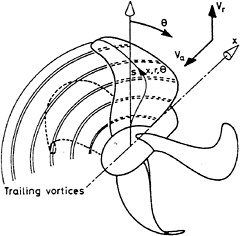
Figure 1 Geometry of propeller with lattice of free, trailing vortices.
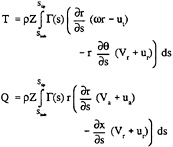
(2)
where Z is the number of blades. Note that if θ≡0, x≡0, then s=r, ∂r/∂s=1 and (2) would be the force expressions used in normal lifting-line theory.
To proceed as in [10] the mid-chord line is subdivided into segments as indicated in Figure 1. The integrations in (2) then become sums and, moreover, the induced velocities are given as
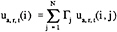
(3)
where ua(i) is the axial velocity induced in the mid-chord line segment no. i. This gives the following expressions for the thrust and torque
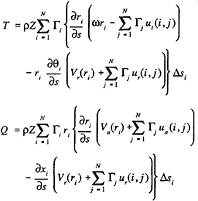
(4)
As shown by Kerwin et al. [ibid.] a variational approach is then used to establish a system of linear equations in Γi (and the Lagrange multiplier) which will lead to the optimum propeller with minimum torque for required thrust. An iterative scheme is adapted using values of previous loops in computing the frictional components of thrust and torque and in aligning the trailing vortices behind the propeller.
Because the velocities are computed on the curved mid-chord line, the influence coefficients ua,r,t(i,j) are computed with free and bound vortices distributed over the blade in a fashion similar to the one used in the vortex-lattice method. The trailers are aligned on helical lines. The integrations are carried out directly.
The optimization is carried out for a given geometry of the mid-chord line, and the general idea is to do several calculations with systematically varied geometries. The output of each optimization is a preliminary blade geometry which can be evaluated not only with respect to efficiency, but also taking other criteria, such as security against cavitation etc. into account. Once the, in its total sense, optimum preliminary propeller has been found, the preliminary blade geometry and the loading is given as input to a lifting-surface computer program which upon the specified chordwise distribution of loading traces the blade geometry of the final propeller.
COMPARATIVE PROPELLER DESIGN
To secure the most realistic comparison between a tip-fin and a conventional propeller from a shipowner's or a shipyard's point of view the design was carried out for an actual ship. Results were available of open-water, self-propulsion and cavitation tests with the model of the propeller originally designed for the ship. Main particulars of the ship are given in Table 1.
Table 1 Main particulars of ship and design data
|
Ship type: container, single screw |
|
|
Lpp |
124.55 m |
|
B |
20.80 m |
|
T |
7.50 m |
|
∇ |
14255.7 m3 |
|
Speed |
9.03 m/s (17.55 knots) |
|
Thrust deduction fraction |
0.136 |
|
Mean wake fraction |
0.267 |
|
Thrust |
706.7 kN |
|
Resistance allowance |
9 per cent |
In addition to ship and propeller models being available they were selected for the comparative study out of consideration for the propeller loading, which was moderate (CTh=1.545), a wake field which was typical for a ship of that size and displacement and a combination of thrust loading coefficient and advance ratio which was favourable for both the conventional and tip-fin propeller.
Drawing and main particulars of the conventional or reference propeller are shown in Figure 2. The propeller was designed for the ship by the Danish Maritime Institute, DMI. In the design the highest possible efficiency was emphasized, but in the same time a certain amount of tip unloading was applied to limit the extent of possible noise and vibration. The propeller was designed to absorb a given power at a given rate of revolutions, producing as high a thrust as possible. The expected corresponding ship speed was found from the model test results. In this case it corresponds to an allowance or increase in resistance of 9 per cent.
The tip-fin propeller was designed to have the same number of blades, the same diameter and the same expanded-area ratio as the comparative propeller. It was also designed to operate in the same wake field and to produce the same thrust at minimum power. This design for given thrust is in contrast to the reference propeller which was designed for given power absorbtion. This means that the tip-fin propeller may operate at a rate of revolutions different from that of the conventional propeller for a given ship speed. The reason for this selection of constant parameters is that the diameter is considered as the more restrictive variable than the rate of revolutions, since the diameter should generally be selected as large as is physically
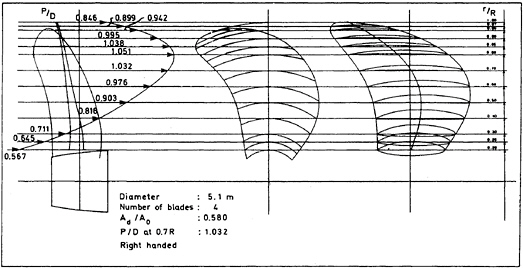
Figure 2 Conventional (reference) propeller.
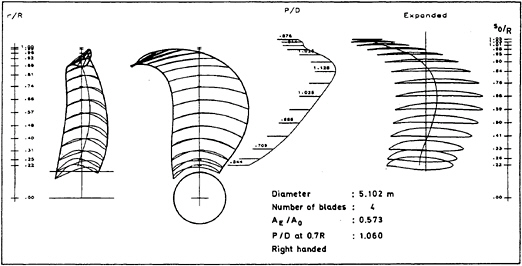
Figure 3 Tip-fin propeller.
possible. But the rate of revolutions can always be adjusted (within limits) when the optimum operation point of the engine is selected. Although it was expected that the effective wake field, the thrust deduction fraction and the relative rotative efficiency would be slightly different due to the modified radial distribution of loading of the tip-fin propeller, the same values as for the conventional design were used.
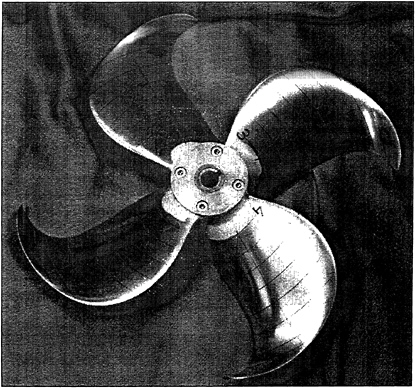
Figure 4 Tip-fin propeller model.
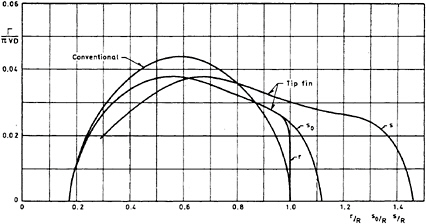
Figure 5 Spanwise distribution of loading in form of chordwise integrated circulation for conventional propeller and tip-fin propeller as function of radius, length of mid-chord-line arc-length s and s0. s0 is the arc-length of the mid-chord line which would arise if skew was removed.
Distribution of thickness was also kept the same as for the conventional propeller with adjustments to accommodate the modified tip. When comparing Figures 3, tip-fin propeller, and 2, conventional propeller it can be seen that the distribution of skew in the inner part of the blade as well as the total skew are approximately the same for the two models, while the distribution of rake is different. The tip geometry was designed on the basis of earlier model experiments as well as experience with a vast number of theoretical design studies carried out using the procedure outlined in the previous section. This gave information on the shape of the tip, i.e. the rounding from blade to fin and the length of the fin. It is the general experience that the fin should be perpendicular to the helix surface of the otherwise conventional part of the blade. In the present case, this was adopted in the outermost part of the blade, but the curved transition region as well as the fin itself was given skew to minimize pressure pulses on the ship hull. Once the geometry of the mid-chord line, the area and the thickness distribution have been established the optimum distribution of spanwise load is obtained by the previously described procedure. Before transferring these data to the vortex-lattice program that carries out the final tracing of the blade surface a slight unloading of the tip was made relative to the optimum load distributions.
The spanwise distribution of blade loading is shown in Figure 5. It can be seen that the tip-fin propeller has a much higher loading in the tip, for given position of r. Despite that, because of the skew the tip loading goes gradually to zero as it must.
OPEN-WATER TESTS
Manufacturing of the tip-fin propeller model was subcontracted to MARINTEK who laboriously made a high-precision bronze model. A photograph of this model is shown in Figure 4. The diameter of this model was 237.5 mm, the same as for the conventional propeller model.
Results of open-water tests are shown in Figure 6. The tests were carried out with a standard set-up. The Reynolds numbers obtained were in the range 5.0–5.6 ·105 based on chord length at 0.7 R and the figure shows model test results with no scaling included. Propeller efficiencies as function of thrust loading are shown in Figure 7. Results at the design thrust loading are summarized in Table 2.
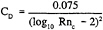
From Figure 6 it can be seen that the tip-fin propeller has higher efficiency over a practical range of advance ratios around the design ratio 0.64. The higher efficiency is maintained over a practical range of propeller loadings. At design loading the increase in efficiency is 0.020 (3.2 per cent relative), cf. Table 2. This table also shows estimates of the contributions due to friction in model and full scale and estimates of thrust and torque coefficients and efficiency in full scale. They are based on simple calculations using the well-known drag coefficient
(5)
for the propeller sections. The efficiency of the full scale tip-fin propeller is 0.025 better than the conventional propeller (3.8 per cent relative). This increase is due to the fact that the tip-fin propeller has relatively more area at the outer sections of the blade where the velocities are higher.
Table 2 Open-water model test results and full scale extrapolation.
|
Tip-fin |
Conventional |
|
|
CTh |
1.545 |
1.545 |
|
Model, D=237.5 mm |
||
|
J |
0.641 |
0.634 |
|
KT |
0.249 |
0.244 |
|
KQ |
0.0405 |
0.0403 |
|
η0 |
0.628 |
0.608 |
|
dKT friction |
–0.00442 |
–0.00436 |
|
dKQ friction |
0.00432 |
0.00361 |
|
Re |
5.2·105 |
5.2·105 |
|
Full scale, D=5.100 m |
||
|
J |
0.643 |
0.636 |
|
KT |
0.250 |
0.245 |
|
KQ |
0.0380 |
0.0383 |
|
η0 |
0.673 |
0.648 |
|
dKT friction |
–0.00199 |
–0.00194 |
|
dKQ friction |
0.00197 |
0.00161 |
|
Re |
3.2·107 |
2.9·107 |
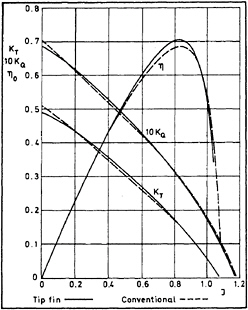
Figure 6 Open-water characteristics for tip-fin and conventional propeller models. Uncorrected model test results Re=5.0– 5.6·105.
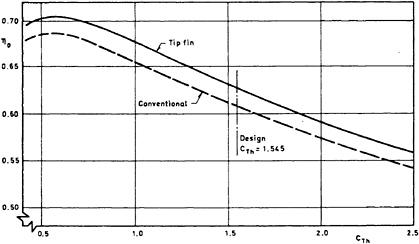
Figure 7 Efficiency as function of thrust loading, based on uncorrected test result of open-water model tests.
SELF-PROPULSION TESTS
Results of the self-propulsion tests in form of a power prognosis is shown in Figure 8. The prognosis includes an extrapolation from model to full scale according to the standard procedure adopted by DMI. In this procedure the resistance of the model is extrapolated to full scale using form factor, allowance coefficient etc.. The rest of the extrapolation uses model test results throughout, except for the wake coefficient which is reduced by 0.044. Results of this prediction at design speed 9.03 m/s are shown in Table 3. Note that this procedure does not allow for differences in propeller characteristics due to friction. The table also shows results extrapolated to ship scale where the wake fraction was extrapolated by use of the ITTC-78 procedure [11]. Instead of using the frictional correction on the propeller as suggested by ITTC-78, the computed correction outlined in the previous paragraph, cf. Table 2, is used. Finally, a combination of methods is used where the DMI-scaling procedure is used for the wake fraction but the frictional correction of the propeller characteristics is as before.
From the table it can be seen that the total efficiency with the tip-fin propeller is 0.026 (3.7 per cent relative) higher than with the conventional propeller, when the DMI extrapolation is used. With the ITTC-method it is 0.029 (3.8 per cent relative) higher and with the DMI-ITTC procedure 0.037 (4.7 per cent relative) higher. The predicted power savings will equal the relative increases in efficiency.
Table 3. Propulsion coefficients, power and rate of revolutions obtained by model experiments and three different extrapolations and by theoretical predictions.
|
V=9.03 m/s |
DMI extrapolation |
ITTC-78 extrapolation |
DMI-ITTC extrapolation |
Design* |
||||
|
Tip-fin |
Conv. |
Tip-fin |
Conv. |
Tip-fin |
Conv. |
Tip-fin |
Conv. |
|
|
w |
0.299 |
0.274 |
0.270 |
0.260 |
0.299 |
0.274 |
0.263 |
0.263 |
|
t |
0.155 |
0.158 |
0.155 |
0.158 |
0.155 |
0.158 |
– |
– |
|
ηR |
1.000 |
1.018 |
1.000 |
1.018 |
1.000 |
1.018 |
1.000 |
1.000 |
|
ηH |
1.205 |
1.160 |
1.158 |
1.137 |
1.205 |
1.160 |
– |
– |
|
η0 |
0.625 |
0.615 |
0.684 |
0.659 |
0.671 |
0.653 |
– |
– |
|
ηD |
0.753 |
0.727 |
0.792 |
0.763 |
0.809 |
0.772 |
– |
– |
 |
1.037 |
1 |
1.038 |
1 |
1.047 |
1 |
– |
– |
|
PD [kW] |
6724 |
6975 |
6405 |
6649 |
6270 |
6567 |
6845* |
7256* |
|
n [1/s] |
1.950 |
1.990 |
1.975 |
2.010 |
1.946 |
1.994 |
1.974 |
2.008 |
|
CTh |
1.583 |
1.485 |
1.461 |
1.424 |
1.583 |
1.485 |
1.545* |
1.545* |
|
*Design includes an increase in resistence (allowance) of 9 per cent. |
||||||||
It is interesting to note that with the tip-fin propeller the thrust deduction is only slightly reduced. This is relative to that of the reference propeller. But the inflow speed as integrated by the propeller is 1–3 per cent higher, whereas the relative rotative efficiency is lower. These changes must be due to the modified radial distribution of blade loading for the tip-fin propeller, which is designed with higher loadings in the tip region, cf. Figure 5. The differences in wake fraction and thrust deduction coefficients result in hull efficiencies that are higher for the tip-fin propeller. But the product of hull efficiency and relative rotative efficiency is almost the same for the two propellers when using the ITTC-method. The other methods give a 2 per cent higher value for this product for the tip-fin propeller. One may therefore conclude that on the basis of the DMI and DMI-ITTC extrapolations the increase in overall efficiency with the tip-fin propeller can be explained as due to both differences in ηH and ηR in combination with a higher propeller efficiency (open water) and that the two contributions to the increase (ηH • ηR and η0) are of the same order of magnitude. But by the ITTC extrapolation the difference in overall efficiency is entirely due to the increase in open water efficiency of the tip-fin propeller.
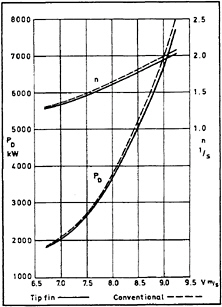
Figure 8 Power and rate of revolutions as function of ship speed. Prognosis on basis of model-test results by DMI-procedure.
According to all three procedures the tip-fin propeller operates at a slightly higher thrust loading (2– 6 per cent) but in all cases with higher open water efficiency.
When comparing the model test results with those computed in the design process it should be noted that the designs were made with an allowance and hence an increase in resistence (and in thrust) of 9 per cent.
CAVITATION TESTS
The cavitation tests were carried out in a conventional circulating-water cavitation test facility. The transverse dimensions of the test section are 0.8 · 0.8 m and the length 1.45 m. It accommodates a dummy afterbody model which, together with suitably adjusted screens, creates the assumed full scale wake field. The tunnel can be evacuated to 95 per cent vacuum.
The wake field created for the cavitation tests was based on a survey of the wake field made in the towing tank. This wake was then transformed to estimated full scale wake and established behind the dummy model in the cavitation tunnel. The axial flow field is shown in Figure 9. It corresponds to the assumed full scale wake field for the ship in full load service conditions.
Results of cavitation tests in form of cavitation inception diagrams are shown in Figure 10. The tests were conducted in the non-uniform wake behind the dummy model. Because of the nature of the wake field, sheet cavitation will inevitably exist in conditions close to the two test conditions. The cavitation inception diagrams show iso-lines of different levels of extent of suction side cavitation, rather than actual inception of the suction side cavitation.
The propellers were tested at two conditions which are outlined in Table 4. The conditions at 100 and 90 per cent engine power apply to the conventional propeller and the parameters of the tests were so adjusted that the tip-fin and conventional propellers would give the same thrust. This means that the ship would sail at the same velocity for a given condition. If the power had applied to the tip-fin propeller it would have given the ship a higher speed than the conventional propeller.
Photographs of the cavitating propellers in Conditions 1 are shown as Figure 11. The conditions are also indicated in Figure 10. During the tests both propellers suffered from sheet cavitation on the suction side around the 12 o'clock positions of the blades. This was expected from the nature of the wake field. Neither pressure side nor bubble cavitation were observed in any condition, nor did thrust breakdown occur. For the tip-fin propeller in Condition 1 (service), the cavitation started at blade position –20° and vanished at 60° (blade position 0° corresponding to 12 o'clock). The largest extent was from slightly less than 0.8R and outwards, leaving, however, the outermost part of the blade, i.e. the tip fin itself free of cavitation. It is interesting to note that a similar behaviour, i.e. cavitation over the curved transition area between blade and tip fin, was observed in the earlier model tests with the tip-fin propeller designed for open water [9]. Note that the tip-fin propeller exhibited very little, if any, tip vortex cavitation. The conventional propeller suffered from slightly less suction side sheet cavitation (Condition 1), starting at 10 ° and vanishing at 60°. At its maximum it extended over the entire suction side of the tip region down to appr. 0.85 R. It had a pronounced tip vortex.
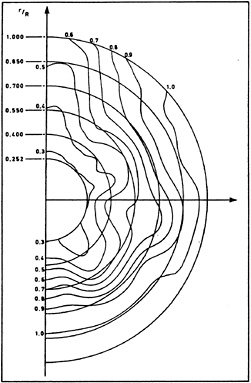
Figure 9 Iso-curves of axial wake behind dummy model, full scale as modelled in cavitation tunnel.
In Condition 2 (trial) a similar behaviour was observed, but at a reduced level of cavitation extent. The tip-fin propeller suffered from more cavitation than the reference propeller but had no cavitating tip vortex.
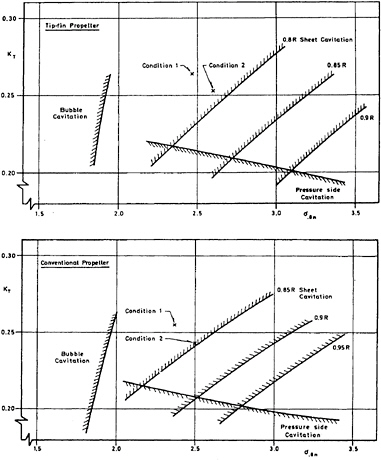
Figure 10 Cavitation inception diagrams: (upper) tip-fin propeller, (lower) reference propeller
Table 4 Conditions for cavitation tests with 237.5 mm diameter propeller models at rate of revolution appr. 25 1/s.
|
Condition 1 |
Condition 2 |
|||
|
Tip fin |
Conventional |
Tip fin |
Conventional |
|
|
V [m/s] |
9.04 |
8.99 |
9.09 |
9.09 |
|
PD [kW] |
7818 |
8062 |
6987 |
7256 |
|
n [1/s] |
2.03 |
2.07 |
1.97 |
2.01 |
|
JA |
0.615 |
0.619 |
0.635 |
0.644 |
|
KT |
0.264 |
0.255 |
0.252 |
0.243 |
|
σ0.8 |
0.368 |
0.354 |
0.386 |
0.371 |
|
σ0,8n |
2.466 |
2.371 |
2.597 |
2.499 |
|
Condition 1: Service condition: Design draught 7.5 m, trial resistance+15 per cent service allowance, 100 per cent engine power with conventional propeller. Wake distribution as in Figure 9. Condition 2: Trial condition: Design draught 7.5 m, trial resistance, 90 per cent engine power with conventional propeller. Wake distribution as in Figure 9. |
||||
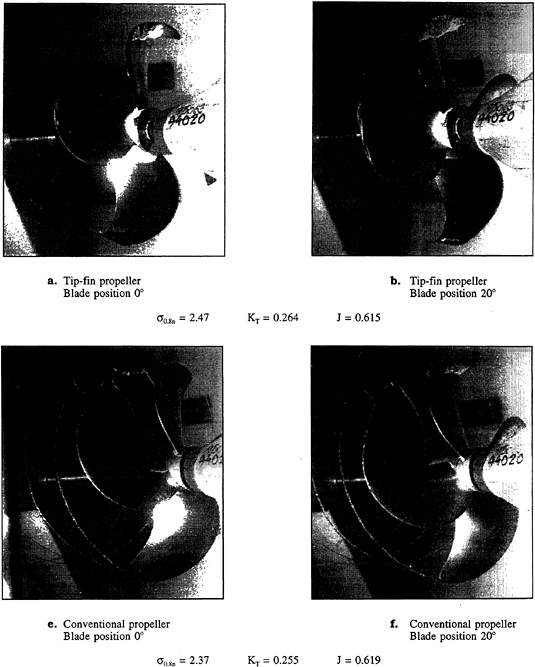
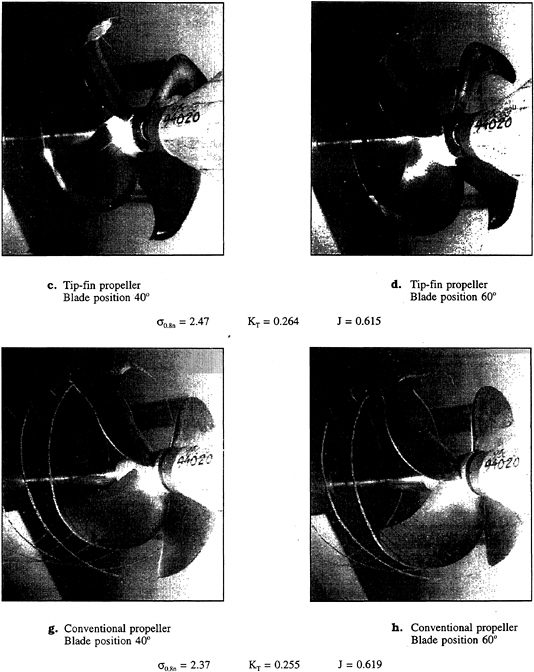
Table 5 Measured pressure levels i kPa for tip-fin and conventional propeller, scaled to ship scale. Maximum values underlined.
|
Order of blade frequency |
Tip-fin |
|||||
|
Condition 1 |
Condition 2 |
|||||
|
Port |
Centre |
Starboard |
Port |
Centre |
Starboard |
|
|
1 |
6.90 |
7.74 |
7.67 |
4.40 |
5.20 |
4.98 |
|
2 |
1.00 |
1.70 |
1.28 |
0.72 |
1.31 |
1.01 |
|
3 |
0.00 |
0.00 |
0.00 |
0.22 |
0.41 |
0.61 |
|
Order of blade frequency |
Conventional |
|||||
|
Condition 1 |
Condition 2 |
|||||
|
Port |
Centre |
Starboard |
Port |
Centre |
Starboard |
|
|
1 |
4.90 |
4.74 |
5.93 |
2.37 |
2.95 |
3.68 |
|
2 |
1.00 |
1.46 |
1.06 |
0.87 |
1.29 |
1.03 |
|
3 |
0.00 |
0.00 |
0.00 |
0.00 |
0.00 |
0.00 |
|
Order of blade frequency |
Ratio: Tip-fin/Conventional |
|||||
|
Condition 1 |
Condition 2 |
|||||
|
Port |
Centre |
Starboard |
Port |
Centre |
Starboard |
|
|
1 |
1.41 |
1.63 |
1.29 |
1.86 |
1.76 |
1.35 |
|
2 |
1.00 |
1.16 |
1.21 |
0.82 |
1.02 |
0.98 |
|
3 |
||||||
|
Order of blade frequency |
Ratio, maxima: Tip-fin/Conventional |
|||||
|
Condition 1 |
Condition 2 |
|||||
|
Ratio, maxima |
Hydrophones |
Ratio, maxima |
Hydrophones |
|||
|
1 |
1.31 |
centre/starboard |
1.41 |
centre/starboard |
||
|
2 |
1.16 |
centre/centre |
1.02 |
centre/centre |
||
During the cavitation tests measurements of pressure pulses were made in three positions above the propeller. The hydrophones were placed in the same longitudinal position 0.43 m (full scale) forward of the reference line of the conventional propeller which corresponds to a further 0.43 m forward of the reference line of the tip-fin propeller. The hydrophones were positioned symmetrically with the centre hydrophone 3.471 m above the propeller axis and the two others 0.814 m to port and starboard, 4.029 m above the plane of propeller axis. The difference in positions of the two propeller reference lines was chosen to obtain the same axial position of the tip regions of the two propellers. It was maintained through all the experiments. Figure 12 shows the tip-fin propeller behind the dummy model and the hydrophones.
Results of pressure level measurements are shown in Table 5. As expected from the observations of cavitation extent the tip-fin propeller gives the largest pressure levels for the same condition, and the service condition has the largest pressure levels for both tip-fin and reference propeller. This applies to the first
Figure 12 Tip-fin propeller behind dummy model with hydrophones.
order pressure pulses which for given hydrophones for the tip-fin propeller were in the order of magnitude of 1.3 to 1.9 times those of the reference propeller. The second-order pressure pulses were of the same order of magnitude for the two propellers, and no or only vanishingly small third-order components were measured. Higher-order components were not found. This indicates that the cavitation formation is stable.
Although only three gauges can hardly be said to be representative for the distribution of pressure over the hull, it is interesting to note that for the first-order pulses the maximum occurs at the center hydrophone for the tip-fin propeller but for the starboard hydrophone for the reference propeller. This is of course in accordance with the history of the cavity growth and collapse as can be seen in Figure 11. But when comparing the maximum values the tip-fin propeller gives pulses 1.31 (Condition 1) and 1.41 (Condition 2) times those of the reference propeller.
As a reason for the larger extent of cavitation and greater pressure-pulse levels for the tip-fin propeller one may offer the simple explanation that the propeller has more load in the tip region, cf. Figure 5, and is hence more susceptible to cavitation due to variation in inflow. Furthermore, during the design process the sectional loading over the tip fin was slightly reduced relative to the optimum prediction. This reduction might have increased the loading in the curved transition region. It may be conjectured that a higher tip loading may be possible without cavitation, thus reducing the loading and cavitation in the transition region. Finally, there may easily be interaction effects between the curved blade sections which has not yet been taken into account in the design procedure.
CONCLUSION
A tip-fin propeller was designed for the same 125 m, 17.5 knot, small container ship and the same condition as the conventional propeller actually fitted to the ship. The performances of both propellers were analysed by open-water, self-propulsion and cavitation tests. From these results it can be concluded that the method used in designing the tip-fin propeller is able to provide a design with satisfactory accuracy as far as thrust and rate of revolutions are concerned. Furthermore, the predicted increase in efficiency was confirmed by the model tests. Depending on the method used in extrapolation to full scale, a reduction in power of 3.7 to 4.7 per cent was found. The tip-fin propeller had higher open-water efficiency than the conventional propeller over a practical range of advance ratios and thrust loading coefficients. In the self-propulsion tests minor differences in thrust deduction and wake fraction coefficients and in relative rotative efficiencies were found for the two propellers.
In the inhomogeneous wake field both propellers suffered from suction side cavitation around 12 o'clock blade position. Slightly more cavitation was found for the tip-fin propeller. This appeared over the curved transition region from blade to tip fin, whereas the tip fin itselt was free of cavitation. In contrast to the conventional propeller no cavitating tip vortex was observed for the tip-fin propeller. As a consequence of the difference in cavitation performance higher pressure pulses on the ship hull were found for the tip-fin propeller. Maximum, measured, first-order pulses were of the order of 1.3 to 1.4 times those of the conventional propeller.
ACKNOWLEDGEMENT
The author is grateful to Mr. J.J.Kappel, who invented the concept of the integrated tip-fin propeller, for this constant and enthusiastic co-operation and support. Invaluable help with the final details of the tip-fin propeller surface was provided by Mr. J.A. Clayton, STONE MANGANESE MARINE Ltd.. The project was carried out in co-operation with the Danish Maritime Institute, who made the model tests.
REFERENCES
1. Prandtl, L. and Betz, A. “Der induzierte Widerstand von Flügeln mit Endscheiben”, Ergebnisse der Aerodynamischen Versuchsanstalt zu Göttingen, III. Lieferung. Verlag R. Oldenburg, München und Berlin, 1927.
2. Whitcomb, R. “A Design Approach and Selected Wind-Tunnel Results at High Subsonic Speeds for Wing-Tip Mounted Winglets”, NASA Langley Research Center, Technical Note, NASA, 1976.
3. Andersen, S.Vogt and Andersen, P. “Hydrodynamic Design of Propellers with Unconventional Geometry”, Trans. of The Royal Institution of Naval Architects, Vol. 129, 1987, pp. 201–221.
4. Itoh, S., Tagori, T., Ishii, N. & Ide, T.: “Study of the Propeller with Small Blades on the Blade Tips (1st Report ”, Journal of the Society of Naval Architects of Japan . Vol. 159, June 1986, pp. 82–89.
5. Itoh, S. “Study of the Propeller with Small Blades on the Blade Tips (2nd Report) ”, Journal of the Society of Naval Architects of Japan, Vol. 161, June 1987, pp 82–91.
6. Gómez, G.P. and Gonzáles-Adalid, J. “Tip Loaded Propellers (CLT). Justification of their Advantages over Conventional Propellers Using the Momentum Theory”, International Shipbuilding Progress, Vol. 42, No. 429, April 1995, pp. 5–60.
7. de Jong, K. “On the Optimization and the Design of Ship Screw Propellers with and without End Plates”, Thesis. University of Groningen, Department of Mathematics, November 1991.
8. de Jong, K., Sparenberg, J., Falcão de Campos, J. and van Gent, W. “Model Testing of an Optimally Designed Propeller With Two-Sided Shifted End Plates on the Blades”, Proceedings of Nineteenth Symposium on Naval Hydrodynamics, National Academy Press, Washington, D.C. 1994, pp. 461–475.
9. Andersen, P. and Schwanecke, H. “Design and Model tests of Tip Fin Propellers”, Trans. of The Royal Institution of Naval Architects , Part B, Vol. 134, 1992, pp. 315–328.
10. Kerwin, J.E., Coney, W.B and Hsin, C.-Y. “Optimum Circulation Distributions for Single-and Multi-Component Propulsors”. Proceedings of Twenty-First American Towing Tank Conference (ATTC) National Academy Press, Washington D.C., 1986, pp. 53–62.
11. ITTC-78. “Report of the Performance Committee”, Proceedings of the 15th International Towing Tank Conference. Netherlands Ship Model Basin, Wageningen, 1978, pp. 359– 404.
DISCUSSION
L.J.Doctors
University of New South Wales, Australia
Figure 7 is interesting in that neither the conventional nor the tip-fin propeller appears to be operating at its optimum efficiency. In fact, the plot shows a design efficiency of 61% or 63% compared to an optimum value of 68% or 71%. Is this simply a problem of there not being sufficient space behind the vessel for a (larger) optimally sized propeller?
AUTHORS' REPLY
The discussor correctly points out the remarkable fact that despite optimization neither the tip-fin nor the conventional propeller operate at their highest efficiencies. They are obtained at thrust loading coefficient CTh=0.57 (Figure 7) and advance ratio J=0.83, appr. (Figure 6), whereas the propellers were designed for CTh=1.545 and J=0.64 (appr.).
This is typical for propeller designs. The propeller is optimized with a constraint, in this case on thrust loading coefficient, resulting in an optimum geometry and advance ratio. A decrease in thrust loading coefficient relative to the design value for the given propeller is obtained by increasing the advance ratio. The blade sections will then experience less inflow angle and lift, and also less induced drag. This will give higher efficiency of the entire propeller. For a sufficiently high-advance ration, the thrust produced by the lift of the blade sections will be annulled by the negative thrust from the frictional drag of the sections. That will also give zero efficiency. In between this and the design advance ratio, the propeller will have a maximum efficiency.
In the present case, the thrust loading coefficient CTh=0.57, where the maximum efficiencies are obtained, would correspond to a propeller diameter of 8.4 m which is not practicable. Even if it were, these propellers would not be optimal since they were designed for a different thrust loading, and an optimization for that much lower thrust loading would give propellers of even higher efficiencies.


