
5
Manpower and Education in Materials Science and Engineering
The interdisciplinary aspect of materials science and engineering is a critical, indispensable component of the field. Interdisciplinary interactions are so important that many industrial materials research laboratories and academic departments now comprise individuals from different disciplines who may work as members of these groups without ever fully losing their separate disciplinary ties.
Some of the great materials discoveries of history have been made by scientists, by engineers, or by craftsmen; many have been made by teams of all three types of individuals. The focus on materials has united the efforts of all three groups as they have sought to use materials practically and economically. Within universities, much emphasis is now being placed on improving interactions between scientists and engineers and on forging ties with industry to facilitate interactions with practicing engineers and craftsmen.
This chapter considers the educational problems and challenges posed by materials science and engineering. A brief description of the number and types of personnel employed in materials science and engineering is followed by an assessment of and recommendations regarding undergraduate, graduate, and continuing education. Also briefly discussed are issues related to precollege education and to the role of professional societies in promoting the development of materials science and engineering.
The field ranks high on the list of top careers for tomorrow’s scientists and engineers. In a recent opinion survey, materials development was ranked as the most promising career path for young engineers (Graduating Engineer, March 1988). Experts questioned included the deans of engineering schools,
school placement directors for engineering, and heads of firms that emphasize advanced technology and employ significant numbers of engineers. Every expert interviewed put materials research and development at or near the top of the list. Burgeoning needs were found in areas ranging from high-performance, specialty applications to high-volume mass production.
A related development involves the current efforts of physics and chemistry departments at many major research universities to expand their faculties in materials-related areas in response to the general perception of expanding opportunities in this field.
PERSONNEL IN MATERIALS SCIENCE AND ENGINEERING
The rich diversity of materials science and engineering is reflected in the wide variety of educational backgrounds represented by materials science and engineering practitioners (Table 5.1). Professionals who work as materials scientists or engineers include not only individuals with degrees from materials-designated departments (including materials science and engineering, metallurgy, ceramics, and polymer departments), but also individuals with degrees in chemistry, physics, engineering, and a wide range of other disciplines. The pluralism of its talented constituencies is a major contributor to the strength and promise of materials science and engineering.
The multidisciplinary nature of materials science and engineering complicates any assessment of personnel levels in the field, but rough estimates are possible (Figure 5.1). According to a report issued by the National Science Foundation (NSF), U.S. Scientists and Engineers: 1986 (Surveys of Science Resources Series, NSF 87–322, NSF, Washington, D.C., 1987), there were 53,100 individuals employed in the United States in 1986 who identified themselves as materials scientists and engineers and had backgrounds in metallurgy, materials, or ceramics. There were also 72,600 physicists and astronomers and 184,700 chemists employed in the United States in 1986 (Table 5.2). By analyzing the subdisciplines of physics and chemistry, the
TABLE 5.1 Educational Backgrounds of Employed Scientists and Engineers in the United States
|
Profession |
Doctorate |
Masters |
Bachelors |
Others |
|
Physicists and astronomers |
56 |
21 |
23 |
– |
|
Chemists |
35 |
18 |
46 |
1 |
|
Materials engineers |
13 |
27 |
51 |
9 |
|
All engineers |
4 |
23 |
62 |
11 |
|
SOURCE: U.S. Scientists and Engineers: 1986, Surveys of Science Resources Series, NSF 87–322, National Science Foundation, Washington, D.C., 1987. |
||||
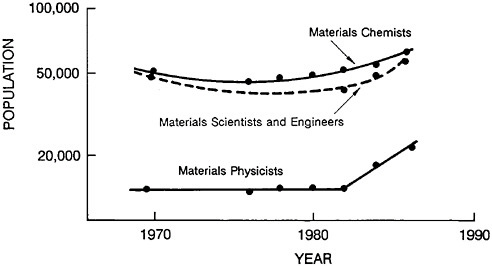
FIGURE 5.1 Estimated numbers of physicists, engineers, and chemists working in the field of materials science and engineering, 1970 to 1986.
TABLE 5.2 Scientists and Engineers Employed in the United States in 1986
|
Profession |
No. Employed in U.S. |
No. with Materials Focus |
|
Physicists and astronomers |
72,600 |
21,800 |
|
Chemists |
184,700 |
61,000 |
|
Materials engineers |
53,100 |
53,000 |
|
Nonmaterials engineers |
2,390,000 |
? |
|
Life scientists |
412,000 |
? |
|
Total |
|
135,900 |
|
SOURCE: U.S. Scientists and Engineers: 1986, Surveys of Science Resources Series, NSF 87–322, National Science Foundation, Washington, D.C., 1987. |
||
committee has estimated that 30 percent of the former group and 33 percent of the latter group have specialized in materials science and engineering. Therefore, for the purposes of this analysis, 21,800 materials physicists and 61,000 materials chemists can be considered to have been working in the field of materials science and engineering in 1986. By combining these estimates, the committee concluded that a core population of approximately 136,000 individuals was involved in materials science and engineering work in 1986.
TABLE 5.3 Primary Work Activity of Employed Scientists and Engineers in the United States (in percent)
|
Profession |
R&D |
Management and Administration |
Teaching |
Production and Inspection |
Other |
|
Physicists and astronomers |
43 |
28 |
21 |
2 |
6 |
|
Chemists |
40 |
25 |
14 |
15 |
6 |
|
Materials engineers |
39 |
29 |
3 |
20 |
9 |
|
All engineers |
33 |
30 |
2 |
17 |
18 |
|
SOURCE: U.S. Scientists and Engineers: 1986, Surveys of Science Resources Series, NSF 87–322, National Science Foundation, Washington, D.C., 1987. |
|||||
Many engineers other than materials engineers regularly use materials or encounter materials-related problems. For instance, engineers who design electronic devices or are involved in aspects of their assembly regularly confront complex materials fabrication problems. However, a relatively small proportion of such groups is involved daily; most of the individuals are using the fruits of, rather than contributing to, materials science and engineering. Within the large and expanding population of life scientists, some individuals specialize in biomaterials. There is no way at present to estimate the contributions to the materials science and engineering community from these disciplines, so contributions from these groups also were not included in this analysis.
An important feature of the personnel statistics arises in their portrayal of work activities. Among materials engineers, nearly twice as many individuals work in R&D as in production or inspection (Table 5.3), and the relative proportions are much greater for materials chemists and physicists. This is another indication of the relative lack of emphasis accorded synthesis and processing within materials science and engineering. Changes in educational programs and industrial management will be necessary to involve more materials scientists and engineers in production-related activities. These changes must involve raising the perception of the intellectual level and value of these areas.
DEGREE PRODUCTION IN MATERIALS-RELATED DISCIPLINES
An important gauge of the interest and growth in materials science and engineering is the number of degrees granted each year in materials-related disciplines. As shown in Figure 5.2, the annual production of B.S. degrees from materials-designated departments was about 1000 per year in 1970; that number declined in the middle to late 1970s but now again stands at about 1000 per year. Figure 5.2 also shows the annual B.S. production rates in
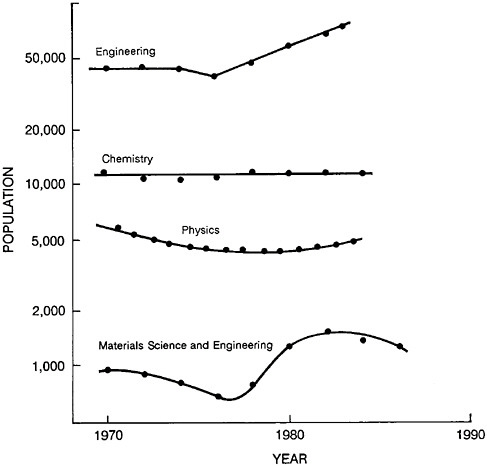
FIGURE 5.2 Estimated number of B.S. degrees earned annually from materials-related departments in U.S. universities, 1970 to 1986.
physics, chemistry, and engineering; the rate for engineering is about 50 times the production rate of bachelor’s degrees from materials-designated departments. It is clear that the materials-designated engineering departments have not shared in the recent large increase in undergraduate engineering enrollment. The committee has concluded that this lack of growth is due to a troubling and continued lack of awareness of the field in high schools rather than to a lack of career opportunities (Table 5.4). A specific recommendation is to encourage changes in high school chemistry and physics curricula in order to introduce students to solid-state behavior and phenomena. Visible recent advances in superconductivity and magnetism should be exploited to achieve this goal. The flat enrollment picture may, in addition, mean that some materials-designated engineering departments are not capitalizing on the growth and expansion of the field.
TABLE 5.4 Degree Intentions of College-Bound High School Seniors (percentage of total population)
The number of doctorates granted in materials-related specialties gives an indication of the number of new research-oriented practitioners entering the field. However, it is difficult to decide which of these specialties should be included within the field of materials science and engineering. Graduate work focused on polymers is conducted in chemistry and chemical engineering departments as well as in polymer and materials departments. Condensed-matter physics, a subfield of physics that now accounts for about 30 percent of all physics Ph.D. students, is a spawning ground for many who later work as materials scientists or engineers. Electronic materials are becoming an increasingly important concern of electrical engineering departments. An increasing number of civil, mechanical, nuclear, and aeronautical engineering departments have faculty and students whose primary focus is materials and materials issues.
For the purposes of this analysis, the committee chose to distinguish between subdisciplines within the core of materials science and engineering and those in which materials problems are an important subset of a broader field of interest. These core specialties consist of solid-state and polymer physics, polymer chemistry, and the engineering fields of materials science and engineering, metallurgy, ceramics, and polymers. Within these core specialties, virtually every doctoral candidate can be considered to be involved with materials science and engineering. A more expansive but less realistic view of materials science and engineering would include significant fractions of many engineering fields and physical, inorganic, organic, and analytical chemistry. Within these specialties, certain percentages of doctoral candidates (percentages that are not known accurately at present) can be considered to be working in materials science and engineering, but as a secondary interest.
In 1985, materials-designated engineering departments granted 343 Ph.D.’s, polymer chemistry departments granted 84 in polymer areas, and solid-state
and polymer physics departments granted 259. When contrasted with the numbers from 1972, these figures reflect a growing number of Ph.D.’s being granted in polymer chemistry, polymer physics, and materials science and engineering, and a declining number in solid-state physics and metallurgy. The total of approximately 700 Ph.D. degrees awarded by these departments was little changed from that awarded 13 years earlier, in 1972. In 1985 the 343 doctorates granted in materials-designated departments equaled about one-half the number of physics doctorates and one-fifth the number of chemistry doctorates awarded in that year. The committee believes that students in the materials-related departments who focused on materials in earning their degrees will be a rich source of materials science and engineering professionals, given the growing importance of materials-related problems in many of these areas.
UNDERGRADUATE EDUCATION IN MATERIALS SCIENCE AND ENGINEERING
The committee believes that bachelor’s programs leading to careers in materials science and engineering should serve two purposes: (1) they should provide sufficient grounding for a graduate to perform effectively over time in industry and (2) they should provide the fundamental underpinnings that will permit students who so desire to pursue graduate work in the field. As noted above, the majority of materials scientists and engineers do not earn advanced degrees, giving undergraduate education a special importance.
Whether or not a bachelor’s student goes on to graduate school, designing course content on the basis of the present pressures of the marketplace is seldom wise, nor is it advisable that much of the content be devoted to immediate applications. Such expertise is generally short lived and creates quick obsolescence, particularly in a field developing as rapidly as materials science and engineering.
Undergraduate education can be divided logically into degree-granting and degree-supporting efforts. The former fit naturally into materials-designated departments. The latter can take a variety of forms, ranging from service courses in materials science and engineering to materials-based options in chemistry, physics, or engineering, to joint programs between two or more departments.
The committee recommends that, regardless of their institutional location and organization, undergraduate courses and programs in materials science and engineering be centered on the four basic elements of materials science and engineering—synthesis and processing, structure, properties, and performance—and on the relationships among them. The emphasis, where possible, should be on learning and applying fundamentals that cut across all classes of materials to ensure that students and researchers appreciate and
understand why different materials compete with one another. New subjects should be developed that deal in a fundamental way with the control of structure through synthesis and processing to achieve desired structures and properties in materials at acceptable economic and social costs. A particularly compelling need is to provide a grounding in processing science and in the engineering of materials, and in how these relate to manufacturing processes.
The generic approach to materials science and engineering requires integrating disciplines and drawing contributions from physics, chemistry, and various engineering specialties. Obviously, universities should not simply teach separate courses in physical metallurgy, ceramics, and polymers and expect students to develop an integrated understanding of materials science and engineering. A sequence of generic courses on the synthesis and processing, structure, properties, and performance of all materials should be a central part of the undergraduate academic program of materials science and engineering departments. The most effective materials scientists and engineers will be well versed in fundamental principles and yet conversant with the general language of the multiple disciplines subsumed by the field.
Although the idea of integration has been repeated often in this report, its execution may be especially difficult at the undergraduate level, given the wide range of student interests and the constraints imposed by the goals of a liberal arts education. For this reason, the relative contributions of each field to the mastery of principles of materials science and engineering must be clarified and then integrated into the undergraduate curriculum. Some suggestions and models for accomplishing this were presented in a Materials Research Society Symposium on Materials Education (MRS Bulletin, May/June 15, 1987).
Materials-Designated Departments
There are slightly more than 100 academic departments in the United States that offer materials-designated degrees at the bachelor’s level. Increasing recognition of materials science and engineering as a broadly based field rather than a loose collection of disciplines is reflected in the growth of the number of those departments that identify themselves with the term materials science and engineering. In 1970 less than 50 percent of these departments had the term materials in their name, whereas today more than 80 percent do. Typically, the departments include courses taught by a faculty with expertise in metallurgy, ceramics, polymers, and perhaps electronic materials.
A few materials-designated departments have more focused interests, concentrating almost entirely on a single class of materials such as metals or polymers. In certain cases there are local or regional reasons why some materials departments should remain focused primarily on a single materials
class. Particularly for schools with limited resources, the value of materials-specific programs should be recognized. But for most materials departments, a broader emphasis on materials is to be preferred.
The historical roots of materials departments are evident in the background and interests of the faculty now teaching in those departments. Of the estimated 1000 faculty members in materials departments in the United States, about 70 percent have metallurgy as a primary research focus. This group includes scientists and engineers specializing in extractive, processing, mechanical, and physical metallurgy, as well as those who have traditionally worked with metallic systems to understand general phenomena that can apply to many types of materials. Of the remaining 30 percent of the faculty members in materials departments, about 12 percent specialize in ceramics, 9 percent in polymers, and 9 percent in semiconducting, magnetic, or optical materials.
This profile of faculty in materials departments is hardly indicative of the tremendous diversity in the discipline. Apparently, the large and growing interest in materials other than metals has not yet manifested itself in a significant redistribution of faculty interests and expertise. Many of the faculty in materials departments who have specialized in metals are now nearing retirement age, so that these departments now have the opportunity to achieve a more balanced representation of materials classes.
The growing importance of materials classes other than metals could undoubtedly lead to a different distribution of research interest among materials department faculty in the future. Already, many former metallurgists and chemists are broadening their research and teaching and are pioneering in the development of the new field of materials science and engineering.
In the future, the hiring policies of materials-designated departments, particularly materials science and engineering departments, should reflect the goal of a comprehensive, generic educational program. This can best be accomplished by achieving a faculty balanced in background and research interests and of sufficient size to adequately address the burgeoning materials area, and by seeking faculty members whose interests extend to more than one materials class. Of necessity, smaller programs must create effective links with other departments to ensure adequate coverage.
Materials departments have made great progress toward the goal of broad-based programs in the years since the study by the NRC’s Committee on Science and Materials Technology (COSMAT; Materials and Man’s Needs, National Academy of Sciences, Washington, D.C., 1975) was issued. The substantial increase over the last decade in the number of departments describing their scope as materials science and engineering is one gauge of this progress. Another is the ongoing development of solid-state chemistry and physics courses for freshmen students in a number of materials departments, a development endorsed by the present committee. But old roots are strong
roots, and most academic departments still have much to do to broaden and strengthen their undergraduate programs in materials science and engineering. Close links with other departments (e.g., polymers, chemistry, chemical engineering, and electrical engineering departments) will aid development of modern generic materials science and engineering subjects.
Role of Other Departments in Materials Science and Engineering
At most institutions, materials-designated departments do not account for the majority of materials-related activities, particularly in graduate education and research. According to an informal survey conducted by this committee, each faculty member in a materials department typically has at least two counterparts working on materials in other parts of the institution, such as in a chemistry, physics, or engineering department. Furthermore, most colleges and universities do not have materials departments, but many of these institutions have research and educational programs that can be classified as materials science and engineering programs. As was also concluded in the COSMAT study, accurate data describing current activities of faculty members outside materials departments are nearly impossible to obtain, but it seems reasonable to assume that the interests of this broad group are in areas encompassing the use of metals, ceramics, and polymers.
For example, the curricula of most university engineering departments include a course in materials, usually tailored to the specific interests of the specialty. In civil and mechanical engineering departments, students study a selection of materials on the basis of required design performance and life cycle costs. Similar subject matter is taught in aeronautical and nuclear engineering departments, with an emphasis on aspects of materials important to those fields. In electrical engineering, undergraduates are typically exposed to topics such as the electrical, optical, and magnetic properties of materials and the fundamentals of thin-film processing. Such courses are sometimes taught by faculty within the individual departments, sometimes by faculty from materials departments, and sometimes jointly by faculty from both departments.
These courses are a valuable part of engineering education, but a danger is that their focus may be narrow or outdated by the rapid development in the field. Faculty members who are educated in the fundamentals of materials science and engineering and are working at the forefront of the field have the advantage that they can adjust course contents according to advancements in the science and technology of materials.
One approach to the education of nonmaterials science and engineering students in materials is the joint teaching of subjects by faculty from materials and nonmaterials science and engineering departments. A second approach is to teach such students a sequence of two or more courses, the first given
by materials science and engineering faculty and the second by nonmaterials science and engineering faculty. The first course should attend to the underlying principles of materials science and engineering. This course must lay the foundation for the second course, which should focus on the materials problems and needs specific to a given engineering field. For instance, mechanical engineers might have a second course that emphasizes the elasticplastic properties of materials; chemical engineers might study the degradation, corrosion, and processing of materials; and civil engineers might study construction materials, composites, and so on.
Some materials science and engineering departments grew out of physics and chemistry. Now, many physics and chemistry departments are including components of materials science and engineering in their undergraduate and graduate curricula. This active development of discipline-specific courses focused on materials is a welcome and needed action. It appears likely, for example, that some chemistry departments will adopt curricular changes so that they can offer courses in synthesis and chemical preparation of materials, in the chemistry of materials processes, and ideally, in how synthesis and processing can affect properties in the design and manufacture of structures and devices. If successful, such redirection can serve as a model for other fields and disciplines that may wish to expand their efforts to emphasize materials.
Diversity and Integration
The preceding description of the dispersed institutional composition of materials science and engineering draws attention to the need for integration in the field. The committee believes that undergraduate materials engineering education should be centered in materials departments offering accredited degree programs with specialties in metallurgy, ceramics, or polymers, or broader programs that cover materials more generally. These departments should develop strong interactions in research and teaching with other engineering departments and with some science departments. Examples of such interactions include joint development and teaching of subjects, coordinated sequential teaching, joint faculty appointments, joint research activities, and interdepartmental degree-granting programs.
The specific outlines of such interactions will vary according to the institution, but the important feature is the construction of an undergraduate materials program around existing or developed materials departments or programs. The success of such ventures and the ability to clarify and exploit the relationships among materials, physics, chemistry, and engineering departments will in large measure determine whether the materials science and engineering field will be identified as having a major impact on the future health of R&D and of manufacturing in the United States. Such issues are
currently being addressed, examined, and debated by such groups as the University Materials Council, representing heads of accredited materials science and engineering departments and of other materials-based programs, and key government and industrial leaders in the field.
Textbooks and Computers
An impediment to the development of broadly based undergraduate curricula has been the lack of good textbooks, particularly for intermediate-level courses. Although a number of excellent introductory texts are available, the paucity of more advanced textbooks and teaching materials is especially acute. Of the few intermediate-level texts available, hardly any attempt to integrate principles across materials categories, and none deals broadly with materials synthesis and processing. The lack of textbooks is exacerbated in part by the vast research opportunities for most materials science and engineering faculty. It is clear that materials science and engineering faculty now spend a much higher fraction of their time on research and are writing fewer textbooks today than in the past two decades. This shortcoming needs to be explicitly addressed and corrected through the direct intervention and, if needed, the financial support of government agencies and professional societies. The materials community should identify incentives for writing textbooks and other teaching materials that address materials as a whole and that focus on the interrelationships among synthesis and processing, structure, properties, and performance. These textbooks should also explicitly address the complementary approaches of physics, chemistry, and engineering.
A related deficiency—one shared with other areas of undergraduate education—is the underutilization of computers as teaching tools. Personal computers are now quite common on college campuses, presenting a tremendous opportunity for materials education. The materials community should develop programs that demonstrate and integrate the field’s underlying principles. Here, too, incentives are needed to accomplish this worthwhile task. As has been shown in other fields, agencies such as NSF are ideally positioned to provide such opportunities through programmatic identification and support.
The Laboratory
An academic program that does not go beyond generic fundamentals would be a stale program indeed. An essential component of a student’s education is applying these principles to real materials in the laboratory. Through experimentation, students can evaluate the validity of theories, gain familiarity with the tools of their future professions, and explore the interrelationships among the synthesis and processing, structure, properties, and
performance of materials. These experiences are of vital importance to the modern materials curriculum.
At a minimum, a student’s first laboratory course should deal with materials as a whole rather than with a single class of materials. Whenever possible, laboratory courses should use examples from several materials classes. One such course could focus on how the structure of materials determines their properties. The principles learned in these exercises could be applied in a subsequent laboratory course that emphasizes the synthesis and processing of materials.
The teaching value of these exercises depends greatly on the quality of the instrumentation in the laboratory. As discussed in Chapter 4, the tools of materials science and engineering are becoming increasingly expensive, making it difficult for institutions to equip their laboratories with modern instruments. An x-ray analyzer or scanning electron microscope far less sophisticated than the ones required for advanced research can cost more than $100,000. Equally expensive are the tools of modern materials processing and those for measuring the properties and performance of materials. Added to this is the great cost of computers and the interfaces and software needed to link instruments and computers.
Undergraduate laboratories at most universities are woefully inadequate, a consequence of the high cost of equipment and its maintenance. Ways must be found to upgrade undergraduate laboratories in materials science and engineering. The minimum cost for a basic materials laboratory is on the order of several million dollars. Keeping the laboratory up to date by replacing outmoded equipment requires annual funding equivalent to 10 to 15 percent of the initial investment. Solutions to this problem may have to include combining graduate and undergraduate laboratories and facilities, particularly expensive and often specialized instruments for structural characterization. The success of such an approach would depend on explicit ongoing support for technicians, maintenance, and upgrading.
Cooperative Programs with Industry
Besides working in the laboratory, students should be exposed to real materials and materials-related problems in other ways. Many universities now offer undergraduate students the opportunity to work with graduate students and faculty members on research problems. Cooperative programs with industry, such as summer jobs and work-study programs, are also becoming more common, exposing students to equipment, materials, and ideas that may not be available at academic institutions. Some of these programs have been broadened to allow students to do research for their senior theses, or to design projects, in an industrial setting. These programs should be expanded. In addition, a senior thesis or design problem—a proven means
of exposing students to real materials-related problems and processes—should be a requirement incorporated into all materials science and engineering curricula.
GRADUATE EDUCATION IN MATERIALS SCIENCE AND ENGINEERING
The committee believes that the best materials scientists and engineers are well grounded in a core, materials-related discipline but are knowledgeable and respectful of the goals, philosophy, and methodology of several related disciplines. Focused project work (as is required in most master’s degree programs) and thesis research (requisite for the Ph.D.) are proven means of encouraging specialization. Both serve as an apprenticeship in how to do research and how to apply theoretical principles. In addition, research at the doctoral level ideally should result in an original contribution to the field.
If students are to develop an appreciation for the productive interplay among disciplines, their graduate school experience must truly embody the interdisciplinary nature of materials science and engineering. Their education should demonstrate the fertile overlap of the chemical synthesis point of view of chemistry, the desire for a rigorous theoretical understanding of phenomena characteristic of physics, and the practical focus of engineering on end use. The aim should be to integrate a student’s area of specialization—whether it be ceramics, condensed-matter physics, or materials chemistry—into the whole of materials science and engineering. Successful integration will breed familiarity with other disciplines, equipping students with the knowledge and skills they will need to exploit advances outside their specialty. In addition, experience in team research is particularly desirable and often obligatory in the more applied areas, since that is the common mode of applied work in industry. Such experience is also desirable in basic research on complex, interdisciplinary materials problems, as is well illustrated in research on high-Tc oxide superconductivity.
At the graduate level, as at the undergraduate level, materials science and engineering is at a point in its development where a growing fraction of the subjects taught to graduate students can be generic, dealing with materials as a class and with examples chosen from all materials classes. Among the courses that should be treated in this way are the thermodynamics, kinetics, properties, and processing of materials.
Of the four basic elements of materials science and engineering, the element of synthesis and processing has suffered the most neglect, both at universities and in industry. Universities should play a role in correcting this national weakness. Students who acquire understanding of synthesis and processing and an appreciation of problems encountered at the design and engineering end of materials development will bolster the ranks of scientists
and engineers working to develop low-cost, high-quality materials processing methods.
Mechanisms for Achieving Goals in Graduate Education
Goals can be accomplished only with a concrete plan of action, the specific details of which will depend on the institution. But this committee believes that materials are so central to the development of modern science and technology, and to problems of productivity and international competitiveness, that each university should have the strengthening and broadening of materials science and engineering as important institutional goals.
Among the well-established means for fostering a productive mix of interests and activities are shared central facilities, courses taken in common and perhaps jointly taught and based on examples from all materials classes, interdepartmental thesis committees, shared use of teaching assistants, and seminars taken in common. At a minimum, universities should identify the full complement of courses that pertain to materials science and engineering. Faculty members interested in materials science and engineering should bear this responsibility. In some cases, cross-listing of courses in course schedules may be sufficient. Faculty members, however, must also help students select courses that not only pertain to their interests but also broaden their view of materials science and engineering. Core departments can further this aim by requiring students to take courses in other materials-related departments.
An option for small universities, where all of the core subdisciplines may not be represented, is to develop a multidisciplinary materials science and engineering program. Although not based in a department, such a program uses existing courses as a nucleus. New courses also may be required to achieve the breadth desired in materials education at the graduate level. High-quality multidisciplinary programs are notoriously difficult to maintain over long periods. Yet this approach may offer the best solution for universities that do not have a materials-related department with sufficient staff and resources to address the needs of graduate education in materials science and engineering. Dedicated faculty members are the key ingredient in making nondepartmental programs successful. Establishing a complementary research program—perhaps one that focuses on an inherently interdisciplinary area, such as polymer-based composites or biomaterials—may help to sustain a high level of faculty commitment.
Dedicated faculty members are also the hallmark of successful interdisciplinary and multidisciplinary research projects. Projects may run the gamut from joint research projects between two faculty members to large efforts carried out within the various collaborative entities sponsored by, for example, NSF or the Department of Defense. Interdisciplinary research programs that involve students are the most common means of their receiving
substantial exposure to other disciplines. These interdisciplinary programs also provide faculty with a broader view of the field and with the impetus needed for developing broader and more generic curricula for their students.
An expected but not yet fully realized benefit of sponsored centers such as engineering research centers and materials research laboratories and groups is that they encourage collaborations with industry. Such collaborations allow graduate students working at these centers to experience how industry addresses materials problems, which usually require a multidisciplinary approach. Participating university faculty members should ensure, however, that this apprenticeship in how to do industry-oriented research does not slight the more academic educational aspects that should be incorporated into collaborative projects.
Examples of Institutional Arrangements
Implementing an interdisciplinary graduate education program requires unifying diverse materials communities and sometimes necessitates making formal arrangements that span long-standing divisions between departments, schools, and colleges. There are many alternative organizational models for accomplishing this. A large materials department can include faculty members who represent most or all of the core subdisciplines in the field, and its size can enhance its ability to develop ties with other departments.
In large or small departments, faculty members who hold appointments in two or more materials-related departments can serve as catalysts for interdisciplinary graduate education programs. Through their research, these faculty members are likely to expose students to the principles and detailed methodologies of several disciplines, as well as to the benefits of merging materials-related interests.
Some institutions do not have a department of sufficient size and with the necessary integration of disciplines to serve as a home for graduate programs in materials science and engineering. For these universities, one option is to create a school, institute, or other organizational division that performs this role. Regardless of its designation, the organization should be accorded equal status with other graduate divisions at the institution.
Whatever the specific approach to graduate education in materials science and engineering taken by a particular university, the implications of annual B.S. degree production in the United States (see Figure 5.2) must be recognized: there are simply not enough materials science and engineering graduates at the B.S. level to fill the current and projected needs for advanced degree holders in the field. Substantial numbers of students with undergraduate degrees in physics, chemistry, and other engineering fields must be encouraged to do graduate work in materials-related areas. New advanced-level introductory graduate courses must be developed to rapidly educate
students who have not had at least a basic introduction to materials science and engineering at the undergraduate level. There is also a major need for texts that introduce principles of materials science and engineering at an advanced level to students who have been well grounded in scientific and engineering principles but not necessarily in materials science and engineering. Such texts would do for materials science and engineering graduate students what Kittel’s text, Introduction to Solid State Physics (John Wiley & Sons, Inc., 1971), does for physicists who intend to explore condensed-matter physics.
CONTINUING EDUCATION IN MATERIALS SCIENCE AND ENGINEERING
The pace of technological change is now so rapid that the skills of scientists and engineers who do not stay abreast of new developments can become obsolete in only a few years. It is commonly held, for example, that engineers require some level of retraining at least every 5 years. In a dynamic, wide-ranging field like materials science and engineering, the risk of obsolescence and the consequent need for continuing education are especially great. Many companies, universities, and professional societies recognize the need for continuing education in materials science and engineering. Many options, varying in quality and effectiveness, are available.
Options for Providing Continuing Education
The traditional method of taking courses on campus works well for employees of companies located near a university. Most urban universities offer night classes, and many firms pay the tuition and fees of employees who take job-related courses. University-based short courses provide an intensity of focus and access to laboratory demonstrations and specialized on-site equipment.
Some large firms have integrated continuing education into their operations. Typically, they offer courses that are up to 15 weeks long, and subjects range from introductory physics to topics of technical interest to the company. In-house experts or university professors serve as instructors.
Less time-consuming than the preceding options, short courses and workshops that span one or several days are quite popular. National professional organizations, such as ASM International, the Materials Research Society, the American Physical Society, and the American Chemical Society, offer short courses before or after national conferences. In-house symposia and seminars are other means of keeping employees abreast of the latest technological developments.
The University of Minnesota, Stanford University, and the Illinois Institute
of Technology are examples of academic institutions that provide live telecasts of lecture courses to local firms. Telecommunications links allow students at remote sites to ask the instructor questions. Videotaped courses are an even more popular means of continuing education. The Association for Media-Based Continuing Education for Engineers (AMCEE), a consortium of 33 universities, offers a total of 518 courses in 16 disciplines, including materials science and engineering. This effort is supplemented by professional organizations that offer videotapes of short courses and workshops.
An outgrowth of AMCEE, the National Technological University (NTU) offers live and videotaped courses over a satellite network. NTU already offers a variety of courses in materials science and engineering, ranging from a short course on materials selection to live lectures from the University of Illinois course on composite materials for doctoral students, and it is considering a master’s degree program in the field.
Needs and Goals in Continuing Education
Industry and professional societies should take a more active role in ensuring that a multidisciplinary message is transmitted to materials scientists and engineers who need additional technical education or redirection and in strengthening educational efforts in materials synthesis and processing. Moreover, it is recommended that the national associations track trends in materials science and engineering and identify developments that have the potential to increase the competitiveness of U.S. materials industries. This surveillance would help determine the content of continuing education programs.
Textbooks and other teaching aids are badly needed to help materials scientists and engineers grow with the discipline and to supplement video-taped courses and other instructional programs. One problem is that materials scientists and engineers constitute a small market. Textbook publishers thus have little incentive to address this need, and they require assistance from industrial and professional associations. The Educational Modules for Materials Science and Engineering, a national body incorporated into the Materials Education Council, has made a good beginning. It has prepared a sizable number of chapter-length teaching modules that have been published in the Journal of Materials Education but that unfortunately have not yet been widely adopted.
PRECOLLEGE EDUCATION
Although the committee has focused on undergraduate, graduate, and continuing education in materials science and engineering, it joins the many other bodies that have called for substantial improvement of science education in primary and secondary schools. Neglect of science at these levels imposes the burden of remedial education on university and college science and
engineering departments. Perhaps more important, the nation’s primary and secondary schools are failing to instill the awareness and curiosity that can inspire students to pursue a career in science or engineering.
For an area of great technological promise like materials science and engineering, this shortcoming can be especially severe. Current statistics on incoming engineering students suggest that only a few are interested in materials. This probably reflects the fact that the subject is usually ignored in high school chemistry and physics courses, which are the likely choices for an introduction to this fast-moving area of science and technology.
Materials scientists and engineers could well consider volunteering some time to their local school systems. Lectures on their careers, fields of science, or some aspect of materials science and engineering could provide vital stimulation, and such activities are greatly appreciated by school administrators and teachers. Industries, universities, government laboratories, and federal agencies could stimulate these activities by providing some sort of organization to help with contacts, provide guidance on quality, and advise on content.
Mentoring and tutoring in science-related topics are other activities that would be helpful. Summer employment and summer courses at universities also provide opportunities for precollege students to learn more about the nature of applied science and its role in the economy.
The professional societies, in particular, must seek ways to promote these activities. A greater variety and number of programs to help science teachers become more proficient in their fields and to more fully appreciate the role of science and technology in the economy could be organized. Programs such as summer jobs in industry and summer courses at universities need to be organized for teachers and should be sponsored by industry, universities, professional societies, and the states.
The professional societies, NSF, and other government agencies should make efforts to use television to work toward many of the goals described above. The Public Broadcasting Service, through series such as Nova and a wide variety of nature programs, appears to have had a significant impact on public attitudes toward basic science and environmental concerns. It seems that similar programs could be-developed that would increase the prestige of manufacturing and production activities. It was not many years ago that American society glorified the activities of men like Edison and Ford. It is important to recapture some of those attitudes. The popularity of series like Nova and the number of magazines describing scientific advances for the general public show that the public is receptive.
ROLE OF PROFESSIONAL SOCIETIES
The many societies devoted to materials sciences and engineering, some of them recently established and others more than 100 years old, illustrate
the field’s richness and diversity. Some have as their focus specific materials such as metals, ceramics, plastics, and composites. Others began as divisions of already well-established societies in physics, chemistry, and engineering. Still others have their roots in materials research, engineering, and processing, and a fourth group sprang up around techniques and phenomena such as electron microscopy, crystal growth, corrosion, and testing. Almost all have broadened their initial foci as the materials science and engineering field has evolved. Most perform some or all of the functions described below.
Professional societies facilitate exchange of information at society-wide and regional meetings for presentation of experimental results, new theories, and review papers. The scope of such meetings ranges from brief research-in-progress presentations to in-depth symposia on specific technical topics. Dissemination is enhanced by the publication of journals, transactions, or magazines as well as conference proceedings. The societies also provide education on many different levels, including in-depth tutorials in emerging areas of the field; home study, training, and video courses; and special seminars. Some societies provide scholarships for college freshmen or upperclassmen to encourage study in the field.
The societies promote information gathering and dissemination, including collection and publication of data bases, bibliographies, abstracts, translations, handbooks, and other information services. Many of these are available as software programs for personal computers, and eventually they will be available as on-line services to subscribers. Other information may deal with government policy issues such as tax incentives, investment credits for R&D, patent policy, environmental policy, and international competitiveness.
Similar functions are performed by societies in other technical fields, but the professional societies in materials science and engineering seem particularly important because the field is still young, relies a great deal on dissemination of experimental research, and encompasses a very broad range of interests. Society activities also provide a common bond and opportunities for professional interactions among members and help to develop the interdisciplinarity of the field. Greater cooperation among the societies could be advantageous for advancing the field as a whole.
FINDINGS
-
The field of materials science and engineering is pluralistic, drawing significant numbers of its practitioners, particularly at the Ph.D. level, from physics, chemistry, and allied engineering fields, as well as from materials-designated departments.
-
Undergraduate courses and programs, regardless of departmental location, should emphasize the four basic elements of the field and their in-
-
terrelationships: synthesis and processing, structure, properties, and performance of all classes of materials. The area of synthesis and processing has suffered neglect in our universities and in industry. A particularly compelling need is to provide undergraduates with a thorough grounding in the science of the engineering of processing and its relation to manufacturing. At the graduate level, students exposed to synthesis and processing research activities will be better equipped to contribute (and more interested in contributing) to this area of industrial need.
-
New courses and new textbooks, dealing generically with all materials, are needed at both the undergraduate and graduate levels. A special need is evident in the area of synthesis and processing, covering the spectrum from processing science to manufacturing.
-
Undergraduate materials engineering education should be centered in materials departments. Such departments should interact strongly with other science and engineering departments to develop interdisciplinary materials-related educational programs.
-
Graduate education in materials science and engineering should emphasize a sound education in a specific discipline, while providing understanding of, involvement with, and respect for the goals, philosophies, methodologies, and tools of complementary disciplines.
-
Existing institutions for continuing education should be expanded and should be more widely publicized, and badly needed appropriate textbooks should be produced. Assistance and encouragement from industrial and professional associations are critical to both endeavors.
-
The many professional societies associated with materials sciences and engineering should establish mechanisms for cooperative action to advance the field as a whole.
-
Perhaps most importantly, the annual production of bachelor’s degrees for materials-related departments is currently about 1000 per year, a figure that has changed little from the early 1970s. The number of doctorates is just under 700, again a figure little changed from the early 1970s. Thus the production of educated professionals has remained essentially constant in the face of greatly increased needs and opportunities in the field and expansion of the field to include new materials such as electrooptical materials, advanced composites, and high-temperature superconductors. Additional educated personnel are required to meet these needs and opportunities. National strengthening of synthesis and processing and of performance will require additional manpower.


